Willard Park
Word count: 2081
Choice count: 20
Section count: 10
Image count: 10
Error count: 38
Field Related Analysis
Archaeology : 80 matches
(alignment, class, community, context, core, enclosure, environment, explanation, feature, filler, form, group, her, here, history, household, lineage, park, point, re, restoration, section, site, space, style, understanding)Sociology : 75 matches
(abstracted, attitudes, authority, class, community, consciousness, deleuze, deviant, economic, explanation, fact, group, guattari, household, language, lineage, material, official, park, school, sign, simone, small, systems, thomas)Education : 54 matches
(campus, choice, class, college, disruptive, don, down, first, goals, library, middle school, Montessori, playground, project, reader, reflective, school, social, specific)Target Structure: (2 matches)
purpose (1 match)
purposes (1 match)
Willard Park
Welcome!
Its a sunny afternoon in the park. You've just arrived to do a little looking around, but your commute is still fresh in your mind. What direction are you coming from?
Choice 1 : From the North
Choice 2 : From the South

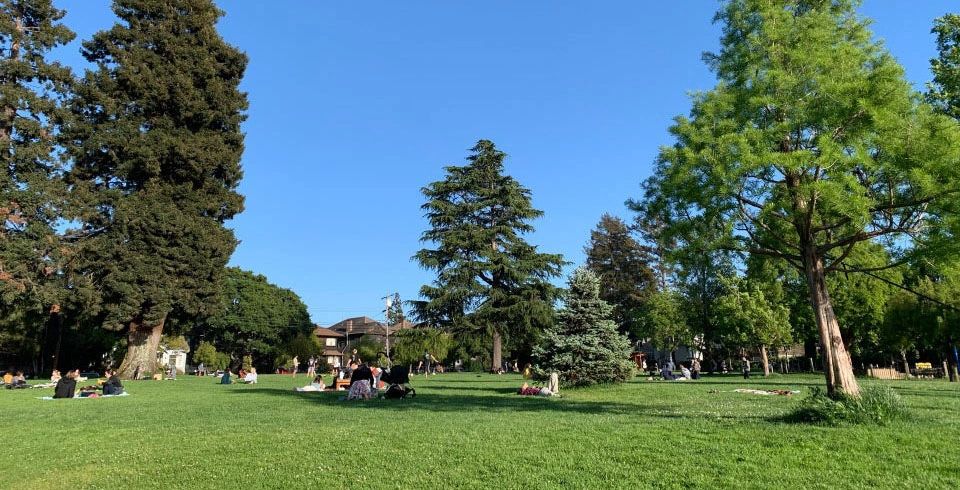
South Berkeley/UC campus neighborhood.
If you’re coming from the North, walking South to the park you might have walked along Telegraph and up Derby, along Regent, or along College and turned down Derby. If you walked up Derby, you might have felt inclined to grab a snack at CVS. Or if you walked down Derby, your snack might have come from The Derby Food Store instead. Coming from the North, you’re also more likely to have had an altercation with an electric scooter, or to have passed a twin size IKEA mattress outside an apartment building. Approaching the park, something catches your eye. You pause to read it. What is it?
Choice 1 : Flyer posted on telephone pole
Choice 2 : Graffiti on the pavement near the redwoods
Choice 3 : Construction sign on fence
South Berkeley/Elmwood.
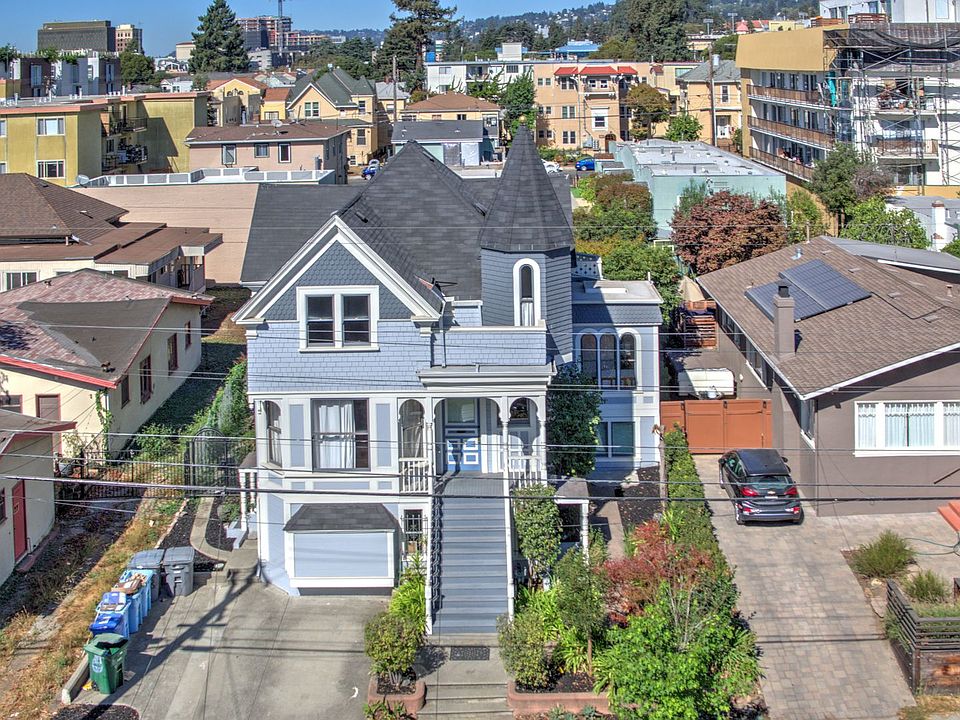
Coming from the South, you likely walked by the front of Willard Middle School, or by a number of nice houses on Hillegass or Russell. While walking along Hillegass opposite the park, you get distracted by something in someone’s yard. What is it?
Choice 1 : The little free library at the end of the block
Choice 2 : Campaign posters in someone's yard

Flyers and advertisements.
Flyers and advertisements work to construct the values of the park as well as determine what types of behaviors are possible or encouraged within the space. Park uses fall along a spectrum of support by the physical parameters of the space. Generally, flyers, a more premeditated and coordinated medium than something like graffiti, encourage socially supported activities, rather than deviant ones. Social support also exists on a spectrum. A jam session and mommy baby sing-a-long might both retain social support from park users and the community broadly, but the sing-a-long likely has slightly more because it is non-disruptive and family-oriented. The social support spectrum becomes narrower when physical messaging in a space skews political. Political advertising in the form of, for example, campaign posters, are necessarily reflective of the political composition of the surrounding area. With that in mind, Willard Park is perhaps more forgiving of instances where these boundaries of social support are crossed or upended, likely due to the fact that a variety of social behaviors take place concurrently within the park boundaries and users have become accustomed to internalizing and adhering to physical and social boundaries. In “Rhetorical Cartographies” Senda-Cook, Middleton, and Endres write about Omaha's ConAgra Park, a place in which social boundaries are less benign, and rather work to exclude poor people and discourage continuous foot traffic in the neighborhood.
Choice 1 : Go look at the graffiti
Choice 2 : Go look at the construction site
Graffiti.
Graffiti in public parks can provide an example of abstract boundaries contained in the space. It can make clear the boundary between people that use the park intentionally (it is a scheduled part of their day) versus those that use it as more of a landing place. Crucial to making sense of this distinction is taking stock of the material changes made to the park, and the existence of official and organized changes occurring simultaneously with improvisational changes that may or may not be as permanent as the former ones. The graffiti in the park, for example, could be classified as an “improvisational change,” although some of it is likely very intentional in the same way that someone posting a flyer advertising their yoga class might be doing so intentionally. Still, much of the graffiti in the park — most of which is on the fringes of the official boundaries — is impromptu. The back wall of what used to be a basketball court (there is no hoop there now, only a pole at one end that serves no other apparent purpose) is covered in chalk phrases and drawings. The chalk suggests a desire for these changes to be impermanent, witnessed, but not for very long.
Choice 1 : What's on the bulletin board?
Choice 2 : Flyers and advertisements.

Language and construction.
The ongoing construction at Willard Park is due to a project undertaken by the city in March 2024 and is set to wrap up in June 2025. A few signs posted on the fences that partition off the construction site from the rest of the park detail this endeavor. The one by the Southwest corner of the park (defaced with graffiti) reads: “Willard Park Clubhouse and Restoration Project includes the demolition of the existing 565 sf clubhouse, trellis, and public restroom; and construction of a new 3,301 sf single-story multipurpose community building, a stand-alone public restroom, and trash enclosure. Scope of work includes site work, building core and shell, interior improvements, as well as mechanical, electric, plumbing, fire protection, security systems, and related work.” The syntax of the sign is notable for a few reasons. While there is nothing glaringly odd about it, certain filler words are omitted for the sake of brevity, while lists of project details appear to be extensive and thorough. Tuan writes in “Language and Place” that there is a certain “... intellectual assurance of being offered a rigorous explanation of a necessarily narrow and highly abstracted segment of reality.” This sentiment is on display (literally) here, due to the way in which park users (the audience for this sign) have no real way of knowing whether or not the purported goals and particulars of the project are the “real” ones, which ones will be prioritized, the rationale for the project, the communities the people who proposed the project imagine it serving… etc. Although much of this is implied, and we have no reason to believe that the sign is trying to deceive us in any way, it is nonetheless a fragment which assumes a disproportionate importance and authority in the reader’s imagination.
Choice 1 : What's behind that fence?
Choice 2 : I'm tired, I want to go home

Little library and street junk.
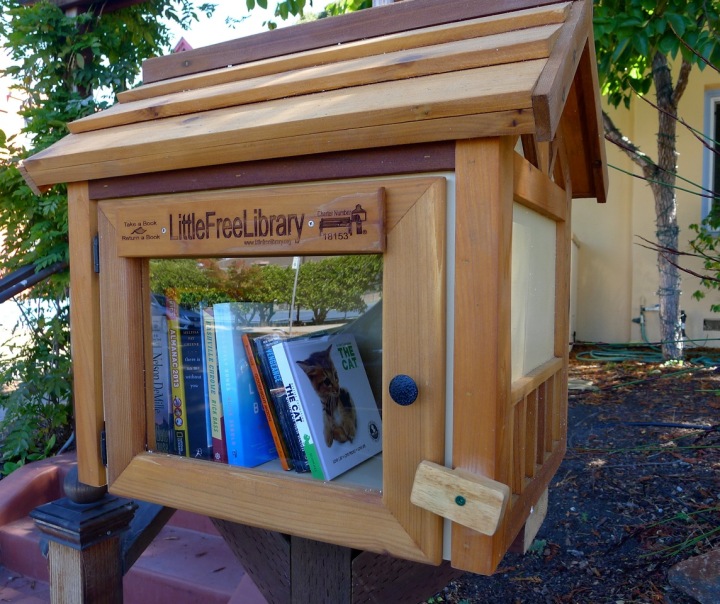
Little libraries and household objects left on the sidewalk can also define boundaries, despite the fact that they exist outside the immediate physical borders of Willard Park. Visitors to the free little library (located at the corner of Ellsworth and Russell) are encouraged to form a set of assumptions about the neighborhood from both the fact of its existence and the titles available. Similarly, objects left out on the curb can point towards the economic composition of the surrounding area and what kinds of materials its residents are willing to part with.
Choice 1 : What's on that telephone pole?
Choice 2 : What's written on that bench?
Bulletin board.
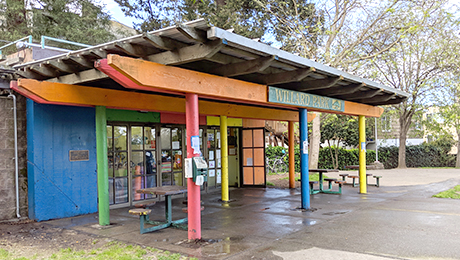
The bulletin board outside the entrance to the playground contains additional flyers and local notices, placing them in a slightly more official and visible place for visitors to see. Its proximity to the playground means that much of the information posted there is geared towards families of small children. Flyers are not rotated out particularly frequently, many announcements of events that have already passed remain up. An even more permanent flyer hangs framed on one side of the board, commemorating the community effort to build the Willard playground, which began in 1990. The title reads “Your Neighbors Built This Tot Lot.” Tuan writes in “Language and Place:” “The proper name and the geographical feature so merge in the consciousness of the people who know both that to change the name is to change, however subtly and inexplicably, the feature itself.” While the names contained by and evoked by the park are usually not particularly important or even conspicuous to park users, they have the potential to be meaningful if users take time to engage with them, and will ultimately shape their understanding of the place. The flyer singles out a man named Bill Lipsky, who died in 2011 and is said to have coordinated the project. His photo is at the bottom of the page, along with an image of the playground under construction. At the top of the front side of the board is a plaque that reads “Friends of Willard Park,” the group formed to complete the playground project. On it is an embossment of the park’s namesake, Frances Willard. The embossment doesn’t bear her name or any information about her. According to the City of Berkeley webpage about the park, she was a “suffragette, educator, and temperance leader.” When the park was first established in 1970, it was given the name “Ho Chi Minh Park” by activists and didn’t receive its current name until 1982. The history embedded within the physical features of Willard Park is subtle and largely not intended to be a notable fixture of users’ interactions with the space. Yet, when attended to, it does allow visitors to view themselves as part of a lineage of people making similar use of and having similar experiences within a public space.
Choice 1 : What's behind that fence?
Choice 2 : What's on that wall?
Choice 3 : I'm tired, I want to go home
Desire and construction.
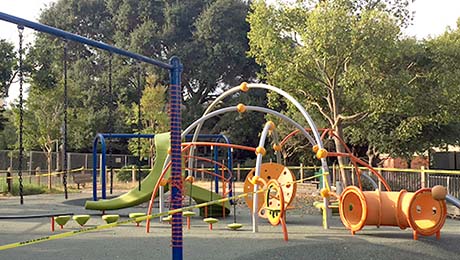
"Assemblages are passional, they are compositions of desire. Desire has nothing to do with a natural or spontaneous determination; there is no desire but assembling, assembled, desire’ (1987: 399). Desire, for Deleuze and Guattari, is never separable from . . . micro-formations already shaping postures, attitudes, perceptions, expectations, semiotic systems, etc. Desire is never an undifferentiated instinctual energy, but itself results from a highly developed, engineered setup rich in interactions’ (1987: 215)." (Thomas) Assemblages are innately about desire, but there can also be other affects present. In the context of Willard Park, desire is both social and personal. Experiencing desire in this space might mean you seek out pleasure in the nature that is present, or that you tacitly aspire towards a specific kind of lifestyle (maybe you wish you were an affluent Berkeley mom, wrangling your children who go to Montessori school.) Park users desire for the place to look a certain way that aligns with their use of it. Those who go there to relax in something sort of akin to nature (maybe under the redwoods) likely don’t want the park to become particularly developed. If there were a proposal to put in walking paths, for example, it would disrupt this present use and make the space less desirable for their particular purposes. Accordingly, any sort of development that takes place at the park needs to be measured and non disruptive to the natural environment and people's aesthetic sensibilities. The new “Willard Clubhouse” being built is non disruptive to this particular instance of user desire because it does not take up significantly more physical space in the park than the old structure did. But it may be disruptive in the sense that the new building is in a different architectural style from the previous, a style which is not exactly in alignment with that of the surrounding neighborhood.
Choice 1 : Wait what does that sign say?
Choice 2 : I'm tired, I want to go home

You're back at home.
As your trip to Willard Park becomes less immediate, your experience of the place might be increasingly reliant on input from others, whether they’re your friends or strangers. How do you interact with the park in the upcoming weeks? A group of your friends from home are visiting Berkeley. You discuss going to the park with them and your roommates. The group assembled has a variety of familiarity with the space — and some none at all. Your roommate Simone does yoga there every Saturday morning, and describes the park as peaceful to your hometown friends. Another roommate, April, interjects to contradict her, telling a story of the time she got broken up with at Willard and then chased by raccoons. Tuan remarks on how “varied” the “linguistic material” of place can be. While we may be inclined to view some sources of it as more authoritative or authentic to our own experiences, we are influenced by all of it. Speech, by virtue of the fact that it is not as bound to a specific space, time, and context as much as other forms of “linguistic material,” makes it more influential in shaping perceptions of place after the fact.
Select a section to link to here.