Business Glossary
Business Glossary
20 Vocabulary about Business Management terms
Hello! My name's Akins, and I'm currently studying at Ahuntsic College. Throughout my studies, I've learned that to understand something and to become good at it, you need to know the subject and how to use it. It's the exact same thing in business. To master the subject, you need to understand it at first and that what this glossary is for! It had been created to provide clear and simple definition about key Business Terms.
- AIDA
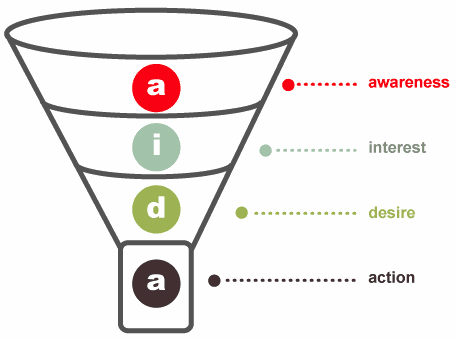
- An acronym used in Sales that stands for Attention/Awareness, Interest, Desire, Action. They are the four steps of the now somewhat-outdated Purchase Funnel (although most agree the funnel is much more complex than what is represented in this traditional model), wherein customers travel from awareness to purchase.
- ARR
- Annual Recurring Revenue. For recurring revenue companies, ARR provides a high-level look at how recurring revenue or subscription business is growing over time. It's a good metric for models that have longer term subscription durations. It's also great for long-term planning.
- BANT
- An acronym used in sales for lead qualification that stands for Budget, Authority, Need, Timeline. It's a famous tool for sales reps and sales leaders to help them determine whether their prospects have the budget, authority, need, and right timeline to buy what they sell
- Example: B = Budget: Determines whether your prospect has a budget for what you're selling.
A = Authority: Determines whether your prospect has the authority to make a purchasing decision.
N = Need: Determines whether there's a business need for what you're selling.
T = Timeline: Determines the time frame for implementation.
- Bluebird Sales
- A "bluebird" is a sale that came seemingly from nowhere or with unexpected ease. A sales rep might say, "Fortunately, a bluebird flew right in at the end of the quarter, helping me reach my goal."
One thing to keep in mind with inbound sales is that many of these sales may not be true bluebirds since your inbound engine is actively building awareness and helping prospects along a buyer's journey. With high-performance sales organizations, you'll want to have some control over your pipeline forecasting and be able to look at lead attribution, so it's best not to rely on bluebirds.
- Churn Rate
- A metric that measures how many customers you retain and at what value. To calculate churn rate, take the number of customers you lost during a certain time frame, and divide that by the total number of customers you had at the very beginning of that time frame. (Don't include any new sales from that time frame.)
Churn rate is a significant metric primarily for recurring revenue companies. Regardless of your monthly revenue, if your average customer does not stick around long enough for you to at least break even on your customer acquisition costs, you’re in trouble.
- Example: For example, if a company had 500 customers at the beginning of October and only 450 customers at the end of October (discounting any customers that were closed in October), their customer churn rate would be: (500-450)/500 = 50/500 = 10%.
- Flywheel
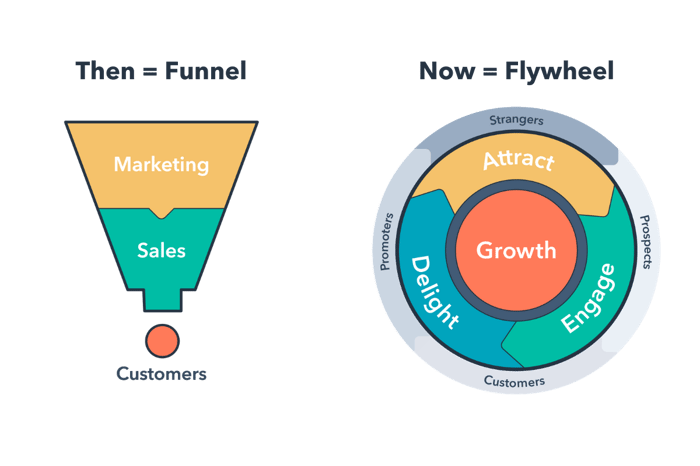
- The flywheel is a new way of conceptualizing the sales process, replacing the funnel where customers are thought of as an output. The flywheel demonstrates that awareness, engagement, and delight can happen at any point during the customer journey and that the best way to achieve growth is to apply force and remove friction in each stage.
- GPCTBA/C&I
- Goals, Plans, Challenges, Timeline, Budget, Authority, Negative Consequences, Positive Implications. The lead qualification criteria sales reps should use to qualify prospects -- it's a better tool than BANT to help sales reps and sales leaders to determine whether their prospects have the goals, plans, challenges, and right timeline to buy what they sell.
- Lead Qualification
- The process of determining whether a potential buyer has certain characteristics that qualify him or her as a lead. These characteristics could be budget, authority, timeline, and so on. Popular lead qualification criteria acronyms are GPCTBA/C&I and BANT.
- Lifetime Value (LTV)
- A prediction of the net profit attributed to the entire future relationship with a customer. To calculate LTV, follow these steps for a given time period:
Take the revenue the customer paid you in that time period.
Subtract from that number the gross margin.
Divide by the estimated churn rate (aka cancellation rate) for that customer.
- Example: For example, if a customer pays you $100,000 per year where your gross margin on the revenue is 70%, and that customer type is predicted to cancel at 16% per year, then the customer's LTV is $437,500.
- Loss Leader
- Used in retail to refer to a product sold at a low price (either at break-even or at a loss) for the purpose of attracting customers into the store. The goal is for customers who go into the store to buy other items that are priced to make a profit.
- LTV:CAC
- The ratio of lifetime value to customer acquisition cost. Once you have the LTV and the CAC, compute the ratio of the two.
- Example: If it costs you $100,000 to acquire a customer with an LTV of $437,500, then your LTV:CAC is 4.4 to 1.
- Middle of the Funnel (MOFU)
- The stage that a lead enters after identifying a problem. Now they’re looking to conduct further research to find a solution to the problem. Typical middle of the funnel offers include case studies, product brochures, or anything that brings your business into the equation as a solution to the problem the lead is looking to solve.
- MRR
- Monthly Recurring Revenue. For recurring revenue companies, MRR provides a month-to-month look at how recurring revenue or subscription business is growing. Includes MRR gained by new accounts (net new), MRR gained from up-sells (net positive), MRR lost from down-sells (net negative), and MRR lost from cancellations (net loss). MRR may not be ideal for longer term subscription models since there will be natural fluctuation over shorter time periods, but it can be a better metric for recurring revenue companies that aren't ideal for long-term subscriptions. It's also great for short-term planning.
- Net Promoter Score (NPS)
- A customer satisfaction metric that measures, on a scale of 0-10, the degree to which people would recommend your company to others. The NPS is derived from a simple survey designed to help you determine how loyal your customers are to your business. To calculate NPS, subtract the percentage of customers who would not recommend you (detractors, or 0-6) from the percent of customers who would (promoters, or 9-10).
Regularly determining your company’s NPS allows you to identify ways to improve your products and services so you can increase the loyalty of your customers. Learn more about how to use NPS surveys for marketing here.
- Pain Point
- A prospect's pain point, or need, is the most important thing for a sales rep to identify in the selling process. Without knowing a prospect's pain points, they can't possibly offer benefits to help resolve those pain points.
- Qualified Lead
- A contact that opted in to receive communication from your company, became educated about your product or service, and is interested in learning more. Marketing and Sales often have two different versions of qualified leads (MQLs for Marketing, and SQLs for Sales), so be sure to have conversations with your sales team to set expectations for the types of leads you plan to hand over.
- Service Level Agreement (SLA)
- For salespeople, an SLA is an agreement between a company's sales and marketing teams that defines the expectations Sales has for Marketing and vice versa. The Sales SLA defines the expectations Marketing has for Sales on how deeply and frequently Sales will pursue each qualified lead, while the Marketing SLA defines expectations Sales has for Marketing with regards to lead quantity and lead quality.
SLAs exist to align Sales and Marketing. For companies to achieve growth and become leaders in their industries, it is critical that these two groups be properly integrated.
- Smarketing
- Used to refer to the practice of aligning Sales and Marketing efforts. In a perfect world, marketing would pass off tons of fully qualified leads to the sales team, who would then subsequently work every one of those leads enough times to close them 100% of the time. But since this isn't always how the cookie crumbles, it’s important for Marketing and Sales to align efforts to impact the bottom line the best they can through coordinated communication.
- Sound Bite
- A series of words or phrases sales reps use to respond to and overcome a customer objection.
- Top of the Funnel (TOFU)
- he very first stage of the buying process. Leads at this stage are identifying a problem they have and are looking for more information. At this point, marketers create helpful content that aids leads in identifying this problem and providing next steps toward a solution.