Sales vocabulary
Sales vocabulary
20 null terms
- AIDA
- An acronym used in Sales that stands for Attention/Awareness, Interest, Desire, Action. They are the four steps of the now somewhat-outdated Purchase Funnel (although most agree the funnel is much more complex than what is represented in this traditional model), wherein customers travel from awareness to purchase.
- ARR
- Annual Recurring Revenue. For recurring revenue companies, ARR provides a high-level look at how recurring revenue or subscription business is growing over time. It's a good metric for models that have longer term subscription durations. It's also great for long-term planning. See also MRR.
- BANT
- An acronym used in sales for lead qualification that stands for Budget, Authority, Need, Timeline. It's a famous tool for sales reps and sales leaders to help them determine whether their prospects have the budget, authority, need, and right timeline to buy what they sell.
B = Budget: Determines whether your prospect has a budget for what you're selling.
A = Authority: Determines whether your prospect has the authority to make a purchasing decision.
N = Need: Determines whether there's a business need for what you're selling.
T = Timeline: Determines the time frame for implementation.
- Bluebird Sales
- A "bluebird" is a sale that came seemingly from nowhere or with unexpected ease. A sales rep might say, "Fortunately, a bluebird flew right in at the end of the quarter, helping me reach my goal."
- Bottom of the Funnel (BOFU)
- A stage of the buying process leads reach when they're just about to close into new customers. They've identified a problem, have shopped around for possible solutions, and are very close to buying.
- Churn Rate
- A metric that measures how many customers you retain and at what value. To calculate churn rate, take the number of customers you lost during a certain time frame, and divide that by the total number of customers you had at the very beginning of that time frame. (Don't include any new sales from that time frame.)
- Conversion Path
- The "events" on a company's website that help companies capture leads. In its most basic form, it'll consist of a call-to-action (typically a button that describes an offer) that leads to a landing page with a lead capture form, which redirects to a thank-you page where a content offer resides. In exchange for his or her contact information, a website visitor obtains a content offer to better help them through the buying process.
- DMARC
- Domain-based Message Authentication, Reporting & Conformance (DMARC) is a widely recognized email protocol that helps people and businesses protect their email addresses and domains from being misused by third parties. It helps identify that an email you send is from the real you. This method of email authentication protects both senders and recipients from activities like phishing, spamming, and spoofing.
- FCC
- The Federal Communications Commission (FCC) is a United States government agency that regulates communication devices and systems, which includes the internet. They ensure all citizens have fair access to these communication platforms and that they’re safely performing in the interest of the public and national security. In most cases, the FCC is the agency responsible for crafting consumer protection rules such as privacy protections, while the Federal Trade Commission (FTC) enforces these rules.
- Featured Snippet
- A section of Google’s search engine results page that tries to answer a question without a person having to click through to another web page. They include Google’s best guess at an answer, the title of the page the answer comes from, the page’s URL, and an image from the page. While featured snippets are designed to save time for the person searching, they’re mostly machine generated and aren’t fact checked.
- Flywheel
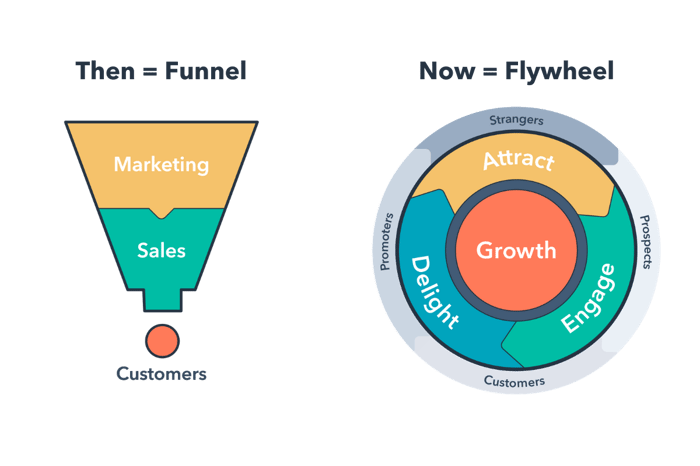
- The flywheel is a new way of conceptualizing the sales process, replacing the funnel where customers are thought of as an output. The flywheel demonstrates that awareness, engagement, and delight can happen at any point during the customer journey and that the best way to achieve growth is to apply force and remove friction in each stage.
- FTC
- The Federal Trade Commission (FTC) is tasked with promoting competition in the United States marketplace and protecting consumers. In the world of e-commerce and digital marketing, the FTC is responsible for providing rules and guidance around online advertising, which it refers to as the “rules of the road.” It enforces the CAN-SPAM Act to ensure email marketing isn’t misleading or harassing.
- GPCTBA/C&I
- Goals, Plans, Challenges, Timeline, Budget, Authority, Negative Consequences, Positive Implications. The lead qualification criteria sales reps should use to qualify prospects -- it's a better tool than BANT to help sales reps and sales leaders to determine whether their prospects have the goals, plans, challenges, and right timeline to buy what they sell.
G = Goals: Determines the quantifiable goals your prospect wants or needs to hit. An opportunity for sales reps to establish themselves as an advisor by beginning to help prospects reset or quantify their goals.
P = Plans: Determines the prospect's current plans that they'll implement in order to achieve those goals.
C = Challenges: Determines whether the sales rep can help a prospect overcome their and their company's challenges; ones they're dealing with and ones they (or the sales rep) anticipate.
T = Timeline: Determines the time frame for implementation of their goals and plans, and when they need to eliminate their challenges.
B = Budget: Determines how much money a prospect has to spend.
A = Authority: Determines who in the organization will help champion and/or decide to make a purchase.
C = Negative Consequences: Discusses the negative things that'll happen if a prospect doesn't meet their goal.
I = Positive Implications: Discusses the positive outcomes that'll happen if a prospect meets their goal.
- LTV:CAC
- The ratio of lifetime value to customer acquisition cost. Once you have the LTV and the CAC, compute the ratio of the two. If it costs you $100,000 to acquire a customer with an LTV of $437,500, then your LTV:CAC is 4.4 to 1.
- Middle of the Funnel (MOFU)
- The stage that a lead enters after identifying a problem. Now they’re looking to conduct further research to find a solution to the problem. Typical middle of the funnel offers include case studies, product brochures, or anything that brings your business into the equation as a solution to the problem the lead is looking to solve.
- MRR
- Monthly Recurring Revenue. For recurring revenue companies, MRR provides a month-to-month look at how recurring revenue or subscription business is growing. Includes MRR gained by new accounts (net new), MRR gained from up-sells (net positive), MRR lost from down-sells (net negative), and MRR lost from cancellations (net loss). MRR may not be ideal for longer term subscription models since there will be natural fluctuation over shorter time periods, but it can be a better metric for recurring revenue companies that aren't ideal for long-term subscriptions. It's also great for short-term planning.
- Pain Point
- A prospect's pain point, or need, is the most important thing for a sales rep to identify in the selling process. Without knowing a prospect's pain points, they can't possibly offer benefits to help resolve those pain points.
- Smarketing
- Used to refer to the practice of aligning Sales and Marketing efforts. In a perfect world, marketing would pass off tons of fully qualified leads to the sales team, who would then subsequently work every one of those leads enough times to close them 100% of the time. But since this isn't always how the cookie crumbles, it’s important for Marketing and Sales to align efforts to impact the bottom line the best they can through coordinated communication.
- Sound Bite
- A series of words or phrases sales reps use to respond to and overcome a customer objection.
- Weighted Pipeline
- A more detailed version of a sales pipeline, in which each opportunity is given a specific value based on which stage they're in in the sales process. For example, potential buyers in the prospecting stage could be assigned a 10% chance of closing the deal, demo stage buyers 60%, closed-won 100%, and so on. A sales rep could say that, instead of having 10 prospects in her pipeline, she has 10 opportunities at 50% or greater likelihood of closing with a weighted pipeline value of $50,000.