Hello,
Hello, this glossary contains 15 essentials terms used in neuroscience. Each entry includes a clear definition, and in some cases, examples or explanations to show how the term is used in real-life situations. To create this glossary I selected terms from course materials, textbooks and reliable academic sources such as neuroscience websites. This resource is designed to support your learning and deepen your understanding of neuroscience.
Have fun!(:
Axon
Noun
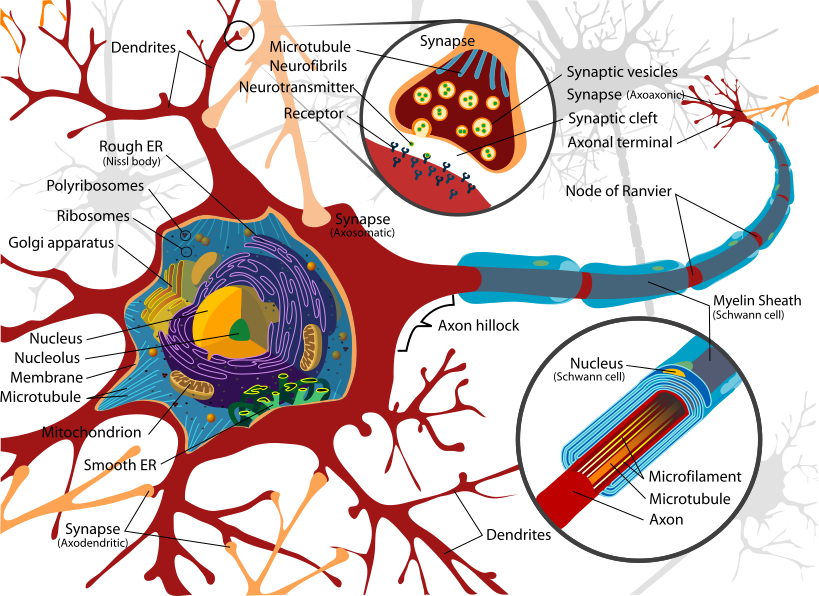
The long fiber of a neuron that transmits signals away from the cell body.
Example: The axon carries the electrical impulses to other neurons.
fr: Axone
Axonal transport
Noun
The system in which proteins, organelles, and other materials are moved along the axon of a neuron.
Example: Disruptions in axonal transport are linked to several neuron, enabling communication between cells.
fr: Transport axonal
Connectome
Noun
The complete map of neutral connections in the brain.
Example: Scientists study the connectome to understand the brain organization.
fr: Connectome
Depolarization
Noun
A reduction in membrane potential that makes a neuron more likely to fire.
Example: Depolarization occurs when sodium ions enter the neuron.
fr: Dépolarisation
Excitotoxicity
Noun
A pathological process in which there is excessive stimulation by neurotransmitters.
Example: Excitotoxicity is believed to play a role in conditions such as stroke.
fr: Excitotoxité
Gliogenesis
Noun
The formation of glial cells, which support and protect neurons in the nervous system.
Example: Gliogenesis increases after birth as the brain develops its support system.
fr: Gliogenèse
Hyperpolarization
Noun
An increase in membrane potential that makes a neuron less likely to fire.
Example: Hyperpolarisation happens when potassium ions leave the cell.
fr: Hyperpolarisation
Myelination
Noun
The process of forming myelin sheath around nerve fibers to increase signal speed.
Example: Myelination improves the speed and efficiency of nerve signal transmission.
fr: Myélinisation
Neurogenesis
Noun
The process of generating new neurons in the brain.
Example: Neurogenesis occurs in the hippocampus even in adults.
fr: Neurogenèse
Neuron
Noun
A specialized cell that transmits nerve impulses in the brain and nervous system.
Example: The neuron sends signals to other cells through electrical impulses.
fr: Neurone
Neuroplasticity
Noun
The brain's ability to reorganize and adapt.
Example: Neuroplasticity allows the brain to recover after an injury.
fr: Plasticité cérébrale.
Neurotransmitter
Noun
A chemical messager that carry synapses between neurons.
Example: Dopamine is an important neurotransmitter involved in reward.
fr: neurotransmetteur
Synapse
Noun
The jonction between two neutrons when signals are transmitted.
Example: Neurotransmitters cross the synapse to pass messages between neurons.
fr: Synapse
Synaptic vesical
Noun
A small sac that stores neurotransmitters in the presynaptic neuron.
Example: Synaptic vesicles release neurotransmitters into the synapse.
fr: Vésicule synaptique
Synaptogenesis
Noun
The process by which new synapses ( connections) form between neurons, especially during brain development.
Example: Early childhood is marked by rapid synaptogenesis, allowing the brain to adapt quickly to new experiences.