My name is Ariane and I have been in my program (210.AA Laboratory Technology: Biotechnology) for 2 years.
Even though there are many words to memorize, here is a glossary of 30 terms related to laboratory theory and practice (like equipment for example). The method I used to find words for my glossary were that I choose words I hear daily in my field and that I need to understand the concept of (in case you were wondering how I chose my words for my glossary). Most of the definitions I took for this glossary came from Google, Wikipedia, and the Usito dictionary. I hope this will help you in your field of study and/or work. If there are concepts and terms that are vague for you or are not in this glossary, you can always do your own research. After all, my glossary is not "The Encyclopedia of Science." :)
Absorbance
noun
Measure of the reduction in intensity of optical radiation after passing through a medium.
fr: absorbance
acid-base reaction
noun
Acid-base reactions are chemical reactions in which an acid transfers a proton to a base, resulting in an exchange of H+ ions.
fr: réaction acido-basique
agglutination reaction
noun
A reaction in which antigens on the surface of certain cells bind to the corresponding antibodies and form clusters.
fr: réaction d'agglutination
antibody
noun
A blood plasma protein synthesized by plasma cells to provide the body’s defense against a particular antigen.
fr: anticorps
antigen
noun
Substance that, when introduced into the body, causes an immune response by inducing the production of antibodies.
fr: antigène
antiserum
noun
Serum produced from an animal immunized with an antigen and having secreted antibodies.
fr: antisérum
beaker
noun
Container used for reactions.
fr: bécher
boiling point
noun
The boiling point corresponds to the temperature at which the vapor pressure of the liquid becomes equal to the atmospheric pressure or to the pressure of the surrounding environment, allowing the formation of vapor bubbles inside the liquid and its transition to the gaseous state.
fr: point d'ébullition
chromosome
noun
Element of the cell nucleus, filamentous or rod-shaped, that carries genes.
fr: chromosome
concentration
noun
The proportion of a substance in a mixture or solution, expressed as a weight, molecular, or volume percentage.
fr: concentration
density
noun
Density (volumetric mass density or specific mass) is the ratio of a substance's mass to its volume.
fr: masse volumique
DNA (adenosine triphosphate)
noun
Nucleic acid containing deoxyribose, a basic component of chromosomes.
fr: ADN (adénosine triphosphate)
electronegativity
noun
Electronegativity is a dimensionless quantity that reflects the tendency of an atom to attract the shared electron cloud when it forms a chemical bond with another atom.
fr: électronégativité
epithelium
noun
Epithelium or epithelial tissue is a thin, continuous, protective layer of cells with little extracellular matrix. An example is the epidermis, the outermost layer of the skin. Epithelial (mesothelial) tissues line the outer surfaces of many internal organs, the corresponding inner surfaces of body cavities, and the inner surfaces of blood vessels. Epithelial tissue is one of the fours basic types of animal tissue, along with connective tissue, muscle tissue and nervous tissue. Epithelial tissues lack blood or lymph supply, but are supplied by nerves.
Bibliography: Wikipedia, accessed on February 23, 2026, https://en.wikipedia.org/wiki/Epithelium
Same site but translated from the French version: Epithelia are tissues composed of closely packed (or contiguous) cells, without intervening fibers or ground substance (visible under a light microscope, which distinguishes them from connective tissues).
Bibliography: Wikipedia, accessed on February 23, 2026, https://fr.wikipedia.org/wiki/%C3%89pith%C3%A9lium
fr: épithélium
heterogeneous
noun
Which is not uniform; whose elements are of different natures or show differences in their structure, function, or distribution.
Example: Mixing water and oil together is an example of a heterogeneous mixture.
fr: hétérogène
homogeneous
noun
Which is uniform; whose elements are of the same kind or show similarities in their structure, function, distribution.
Example: For example, salt water is a homogeneous mixture.
fr: homogène
lab coat
noun
A protective gown worn over clothing.
Example: A lab coat that meets the standards must be long enough to reach the knees, must have snap buttons (in order to remove it in case of accidental spillage of a dangerous product on oneself for example) and must not have elasticated sleeves.
fr: sarrau
laboratory protocol
noun
A laboratory protocol is a document that defines in detail the parameters of a research or analysis experiment. It includes information such as objectives, methodology, ethical considerations, and the steps to follow to carry out the experiment.
fr: protocole de laboratoire
meniscus
noun
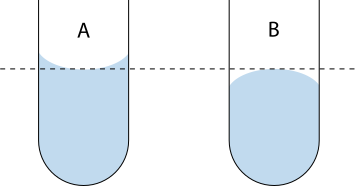
"In physics (particularly liquid statics), the meniscus (pl.: menisci, from Greek 'crescent') is the curve in the upper surface of a liquid close to the surface of the container or another object, produced by surface tension."
Bibliography: Wikipedia, accessed on February 23, 2026, https://en.wikipedia.org/wiki/Meniscus_(liquid)
Other definition: "The meniscus is the curvature of the surface of a liquid in a tube, resulting from cohesive and adhesive forces, and can be concave or convex depending on the liquid-solid interaction."
Example: To measure the meniscus, in the case where it is concave, we read the measurement where the apex of the curve of the meniscus is located.
fr: ménisque
molality
noun
In chemistry, molality is a measure of the amount of solute in a solution relative to a given mass of solvent. This contrasts with the definition of molarity which is based on a given volume of solution.
Wikipedia, accessed on February 23, 2026, https://en.wikipedia.org/wiki/Molality
fr: molalité
molarity
noun
"Molar concentration (also called amount-of-substance concentration or molarity) is the number of moles of solute per liter of solution."
Bibliography: Wikipedia, accessed on February 23, 2026, https://en.wikipedia.org/wiki/Molar_concentration
fr: molarité
molecular attraction
noun
Molecular attraction refers to the forces of attraction that hold molecules together in the different phases of matter. These forces, which are electrostatic interactions, include types such as dipole-dipole interactions, hydrogen bonding, and London dispersion forces. They play a crucial role in determining the physical and chemical properties of substances, influencing phenomena such as boiling points and solubility.
fr: attraction moléculaire
molecular nomenclature
noun
Molecular nomenclature is a set of rules that allows molecules to be named according to their chemical structure. It is based on conventions established by the International Union of Pure and Applied Chemistry (IUPAC), ensuring that each molecule can be uniquely identified. The main elements of nomenclature include the identification of components, the order of mentioning elements, and the addition of prefixes to indicate the number of atoms of a particular element.
fr: nomenclature moléculaire
reflection
noun
Change in the direction of waves, light or sound, when they encounter an intervening object.
fr: réflexion
refraction
noun
Deflection of a light ray (or wave) as it passes from one transparent object to another.
fr: réfraction
Sample
noun
Representative fraction of a given population or substance.
fr: Échantillon
spectrophotometry
noun
Result of a study conducted with a spectrophotometer, a device combining a spectroscope and a photometer that allows for the comparison of a given spectrum to a standard spectrum.
fr: spectrophotométrie
titration
noun
Titration (also known as titrimetry and volumetric analysis) is a common laboratory method of quantitative chemical analysis to determine the concentration of an identified analyte (a substance to be analyzed). A reagent, termed the titrant or titrator, is prepared as a standard solution of known concentration and volume. The titrant reacts with a solution of analyte (which may also be termed the titrand) to determine the analyte's concentration. The volume of titrant that reacted with the analyte is termed the titration volume.
Bibliography: Wikipedia, accessed on February 23, 2026, https://en.wikipedia.org/wiki/Titration
fr: titrage
volumetric flask
noun
A volumetric flask is a calibrated glass container used to measure precise volumes. It is used in laboratories to prepare solutions of precise concentrations, such as standard solutions. Volumetric flasks are designed with a long, narrow neck, allowing them to hold a specific volume of liquid, usually marked on the neck.
fr: ballon jaugé
wavelength
noun
The distance between two consecutive points of the same phase in a wave motion that propagates in a straight line, which corresponds to the space covered by the vibration in a time called the period.