If you find scientific vocabulary difficult to understand, this glossary can help. Health and Life Sciences is the field of study that explores how living organisms function, grow, and interact with their environment. It helps us understand the human body, diseases, cells, genetics, and the biological systems that support life. Here are 21 terms related to Health and Life Sciences, with images, French translations, and pronunciation models. This glossary was created to simplify complex scientific vocabulary and make key concepts easier to understand. By learning these terms, readers can build a stronger foundation in this field and improve their scientific communication skills.
blood
noun
A fluid that transports oxygen, nutrients, and waste products throughout the body.
Example: Blood carries oxygen to the cells.
en: sang
cell
noun
The basic structural and functional unit of all forms of life.
Example: The human body is made of different types of cells.
en: cellule
chromosome
noun
A structure made of DNA that carries genetic information.
Example: Humans have 46 chromosomes.
en: chromosome
cytoplasm
noun
The region of the cell outside the nucleus that contains cytosol and organelles and where many metabolic reactions occur.
Example: Many reactions of metabolism occur in the cytoplasm.
en: cytoplasme
deoxyribonucleic acid (DNA)
noun
The molecule that carries genetic information in living cells.
Example: DNA contains the instructions for building proteins in the body.
en: acide désoxyribonucléique (ADN)
embryo
noun
An early stage of development after fertilization.
Example: The embryo develops into a fetus.
en: embryon
estrogen
noun
A hormone involved in the development and regulation of the female reproductive system.
Example: Estrogen regulates the menstrual cycle.
en: œstrogène
homeostasis
noun
The process by which organisms maintain a stable internal environment.
Example: Homeostasis keeps blood sugar levels stable through the action of insulin.
en: homéostasie
hormone
noun
A chemical messenger that controls bod functions.
Example: Hormones regulate growth.
en: hormone
immunity
noun
The ability of the body to resist or eliminate infection through immune responses.
Example: Vaccination provides immunity against certain diseases.
en: immunité
lipid
noun
A group of molecules that includes fats and oils and stores energy.
Example: Lipids are important components of cell membranes.
en: lipide
meiosis
noun
A specialized form of cell division that produces gametes with half the number of chromosomes.
Example: Meiosis produces sperm and egg cells.
en: méiose
metabolism
noun
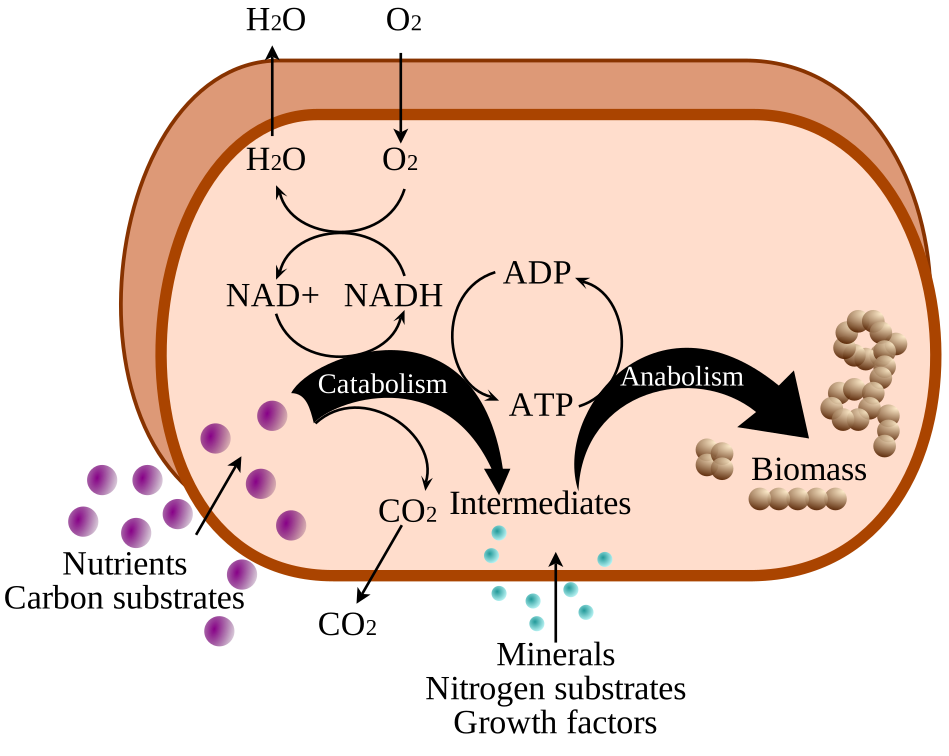
All chemical processes that occur within a living organism to maintain life.
Example: Metabolism breaks down nutrients to produce energy and builds new biomass.
en: métabolisme
mitosis
noun
A type of cell division that produces two genetically identical daughter cells.
Example: Mitosis allows growth and tissue repair.
en: mitose
nutrient
noun
A chemical substance obtained from food that is necessary for growth, energy, and maintenance of life.
Example: Vitamins are essential nutrients.
en: nutriment
organ
noun
A structure made of different tissues joined to serve a common function.
Example: The stomach is an organ that helps digest food.
en: organe
organ system
noun
A group of organs that work together to perform major functions in the body. A group of organs that work together to perform major functions in the body.
Example: The digestive system breaks down food and absorbs nutrients into the body.
en: système d'organes
oxygen
noun
A gas required by cells to produce energy through cellular respiration.
Example: Humans need oxygen to survive.
en: oxygène
photosynthesis
noun
The process by which plants use sunlight to produce food from carbon dioxide and water.
Example: Photosynthesis allows plants to produce glucose (sugar).
en: photosynthèse
testosterone
noun
A hormone responsible for male reproductive development and secondary sex characteristics.
Example: Testosterone influences muscle mass.
en: testostérone
tissue
noun
A group of similar cells that work together to perform a specific function.
Example: There are different types of plant tissue inside a leaf, each with a specific function.


![real name: Artur Jan Fijałkowskipl.wiki: WarXcommons: WarXmail: [1]jabber: WarX@jabber.orgirc: [2]consultations: Masur, Public domain, via Wikimedia Commons](https://upload.wikimedia.org/wikipedia/commons/c/c6/Lipid_raft_organisation_scheme.svg)