If you struggle to describe computer science concepts because you lack the vocabulary, this glossary can help. Here are 20 terms related to computer science, with images, translations into French, and pronunciation models. I used Actively Engaged Online to help me find the vocabulary and Google to find the definitions. Mastering these terms will help you discuss computer science topics with ease and confidence.
algorithm
noun
A step-by-step procedure or formula for solving a problem.
Example: These ALGORITHM works in a similar way to how a human works out their best guess of the shortest circuit.
en: algorithme
asynchronous
adjective
Operations that run independently of the main program flow.
Example: By using ASYNCHRONOUS programming, the app can download data without freezing the screen.
en: asynchrone
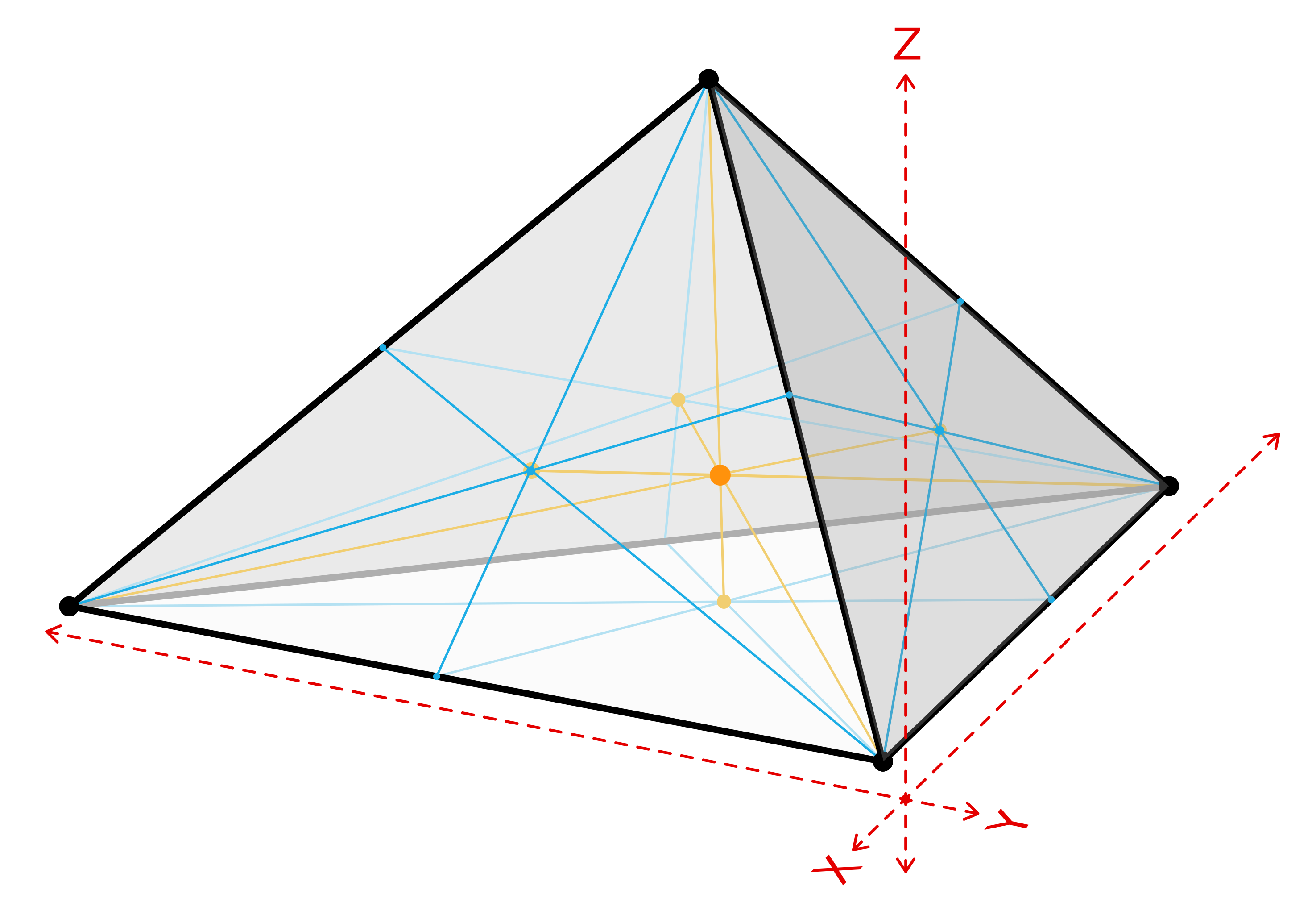
barycentric
adjective
A coordinate system where a point's location is defined relative to the vertices of a simplex.
Example: The GPU uses BARYCENTRIC coordinates to determine how to color the pixels inside a 3D polygon.
en: barycentrique
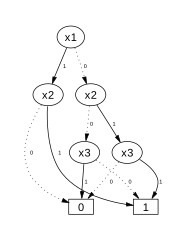
boolean
adjective
A data type with only two possible values: true or false.
Example: The function returns a BOOLEAN value to indicate if the password is correct.
en: booléen
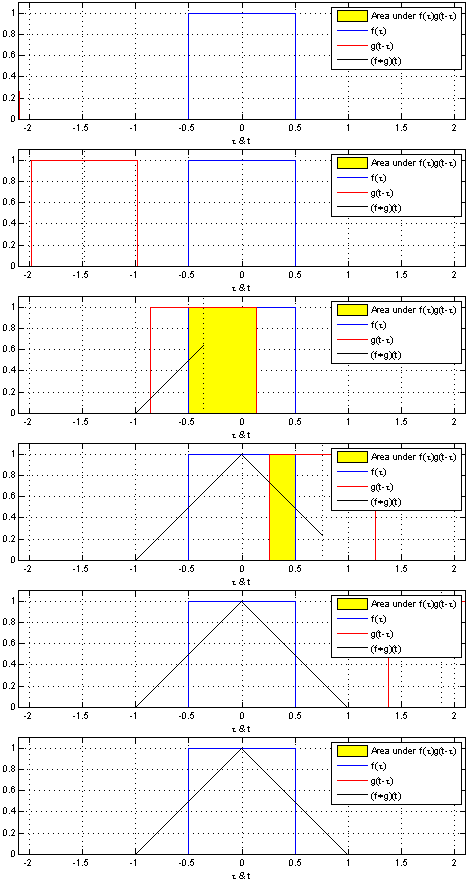
convolution
noun
A mathematical operation on two functions that produces a third function.
Example: A Neural Network uses a CONVOLUTION to identify edges and patterns within a digital photograph.
en: convolution
cyclomatic
adjective
A quantitative measure of the number of linearly independent paths through a program's source code.
Example: The code review failed because the function's CYCLOMATIC complexity was too high, making it impossible to test.
en: cyclomatique
deadlock
noun
A situation where two or more processes are blocked forever, waiting for each other.
Example: The system crashed because of a DEADLOCK where Task A held the disk while Task B held the memory.
en: impasse
eigenvalue
noun
A special scalar such that a linear transformation only scales the corresponding vector.
Example: Google’s PageRank algorithm uses the dominant EIGENVALUE of a web-link matrix to rank pages.
en: valeur propre
encapsulation
noun
Bundling data and methods into a single unit (class) and restricting access to them.
Example: ENCAPSULATION ensures that internal object states cannot be changed unexpectedly by outside code.
en: encapsulation
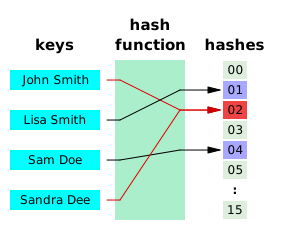
hash
noun / verb
assign a numeric or alphanumeric string to (a piece of data) by applying a function whose output values are all the same number of bits in length.
Example: To store passwords safely, we calculate a HASH so the actual text is never saved in the database.
en: hacher
heuristic
noun
Proceeding to a solution by trial and error or by rules that are only loosely defined.
Example: Since finding the perfect route was too slow, the GPS used a HEURISTIC to find a fast one quickly.
en: heuristique
homomorphism
noun
A structure-preserving map between two algebraic structures of the same type.
Example: A HOMOMORPHISM exists between the compressed data and the original set, allowing us to search without decompressing.
en: homomorphisme
idempotent
adjective
An operation that has no additional effect if it is called more than once with the same input parameters.
Example: A "GET" request is IDEMPOTENT because viewing a page ten times shouldn't change the data on the server.
en: idempotent
iteration
noun
The repetition of a process or a single pass through a loop.
Example: During the third ITERATION of the loop, the variable finally reached the target value.
en: itération
middleware
noun
Software that acts as a bridge between an operating system or database and applications.
Example: The MIDDLEWARE handles the authentication before the request reaches our main database.
en: intergiciel
normalization
noun
The process of organizing data in a database to reduce redundancy.
Example: Database NORMALIZATION helps us save storage space and maintain data integrity.
en: normalisation
recursion
noun
A method where a function calls itself as a subroutine.
Example: Solving the Fibonacci sequence is a classic example of using RECURSION in code.
en: récursivité
serialization
noun
Converting a data object into a format (like JSON) that can be easily stored or transmitted.
Example: Before sending the user profile over the network, we must perform SERIALIZATION on the object.
en: sérialisation
stochastic
adjective
Having a random probability distribution or pattern that may be analyzed statistically.
Example: Artificial Intelligence often uses STOCHASTIC gradient descent to find the best weights for a model.
en: stochastique
topology
noun
The study of geometric properties and spatial relations unaffected by continuous change.
Example: The network TOPOLOGY describes how the computers are physically and logically wired together.