Hi, I am Samuel, and I am currently studying in Science for about two years now.This glossary it's to help new students or people that want to learn or understand what is Science in college. It will perhaps help you join or be interested in this program by showing you what it is about.This glossary will be composed by 20 words related to the Science, it will help you to be interested in this and later help the population in any field of study you want. Each word will have : it's part of speech, a pronunciation by an AI device, a definition from an online dictionary, a translation, an example from Lextutor. And some of the word will have a picture from Wikimedia.
Algebra
Noun
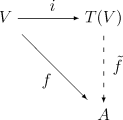
The part of mathematics in which letters and other general symbols are used to represent numbers and quantities in formulae and equations.
Example: Multiplication of two quaternions of this form takes a form expressible in terms of the dot and cross products of 3-dimensional vector ALGEBRA: 2.
en: Algèbre
Astronomy
Noun
The branch of science that deals with celestial objects, space, and the physical universe as a whole.
Example: Their research centred around traditional concepts such as mechanics, optics, ASTRONOMY and planetary motion.
en: Astronomie
Atom
Noun
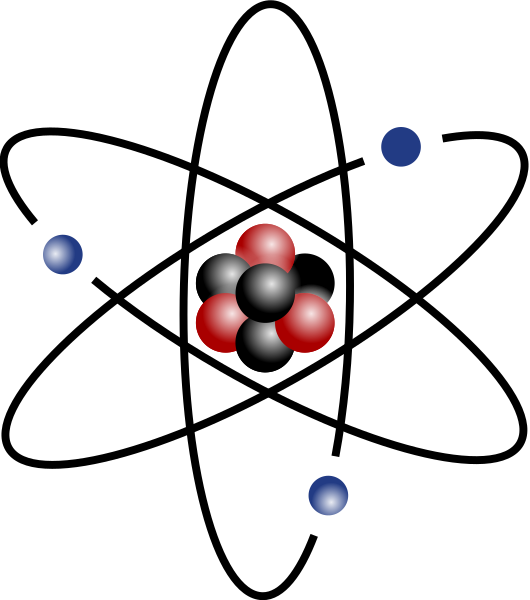
An atom is the smallest, fundamental unit of ordinary matter that retains the properties of a chemical element.
Example: Lecturer; Concepts in Physics Ph1001 In 1913 Niels Bohr released his initial model of the ATOM, as time has passed numerous flaws have arisen in this model.
en: Atome
Biology
Noun
The study of living organisms, divided into many specialized fields that cover their morphology, physiology, anatomy, behavior, origin, and distribution.
Example: Species concepts in systematics and conservation BIOLOGY - an ornithological viewpoint.
en: Biologie
Chemical reaction
Noun
Process that involves rearrangement of the molecular or ionic structure of a substance, as opposed to a change in physical form or a nuclear reaction.
Example: Introduction The aim of this experiment is to investigate the rate of a CHEMICAL REACTION, and see how this is dependant on the temperature.
en: Réaction chimique
Chemistry
Noun
The branch of science that deals with the identification of the substances of which matter is composed; the investigation of their properties and the ways in which they interact, combine, and change; and the use of these processes to form new substances.
Example: CHEMISTRY we can see (with the aid of STM) Sexiphenyl is a molecule composed of six benzene type rings connected together to form a linear chain.
en: Chimie
Derivative
Noun
A derivative is a fundamental concept in calculus representing the instantaneous rate of change of a function with respect to one of its variables.
Example: In some of his proofs, Cauchy also seems to take certain properties of functions for granted, or assume properties which need not be assumed, as in his theorem on the mean value of the DERIVATIVE.
en: Dérivée
Dynamics
Noun
The branch of mechanics concerned with the motion of bodies under the action of forces.
Example: It would be interesting exercise to model the short-term DYNAMICS and test for the presence of a 'J-curve'.
en: Dynamique
Gravity
Noun
The force that attracts a body toward the center of the earth, or toward any other physical body having mass.
Example: We have been living in a world described by what is known as the Standard Model of particle physics, however this model excludes GRAVITY - a fundamental force we experience in everyday life - from its description. So how do we account for GRAVITY, as well as everything else?
en: Gravité
Integral
Noun
A function of which a given function is the derivative, i.e. which yields that function when differentiated, and which may express the area under the curve of a graph of the function.
en: Intégral
Kinematics
Noun
The branch of mechanics concerned with the motion of objects without reference to the forces which cause the motion.
Example: As this is a robot, this problem of inverse KINEMATICS is simplified.
en: Cinématique
Lab coat
Noun
A white protective coat worn by workers in a laboratory.
Example: Other: Glass vacuum apparatus (wear safety glasses) Appropriate lab wear must be worn including LAB COAT, gloves and goggles.
en: Blouse de laboratoire
Laboratory
Noun
A room or building equipped for scientific experiments, research, or teaching, or for the manufacture of drugs or chemicals.
Example: Contamination before sampling can be caused by ground water depositing 14 C deficient minerals, and after sampling contamination can occur by the addition of paper or cardboard in a sample or even the addition of modern mud, these can be corrected at the LABORATORY.
en: Laboratoire
Mathematics
Noun
The abstract science of number, quantity, and space. Mathematics may be studied in its own right ( pure mathematics ), or as it is applied to other disciplines such as physics and engineering ( applied mathematics ).
Example: What principle is used, and what branch of MATHEMATICS is harnessed when developing the finite element equation?
en: Mathématiques
Mechanics
Noun
The branch of applied mathematics dealing with motion and forces producing motion.
Example: "As an alternative, a basic understanding of gait choice might be obtained by calculating energy cost by using MECHANICS-based models.
en: Mécanique
Microscope
Noun
An optical instrument used for viewing very small objects, such as mineral samples or animal or plant cells, typically magnified several hundred times.
Example: The point of failure of the microneedle samples were determined by inspection of the needle tips, using an optical MICROSCOPE (7).
en: Microscope
Molecule
Noun
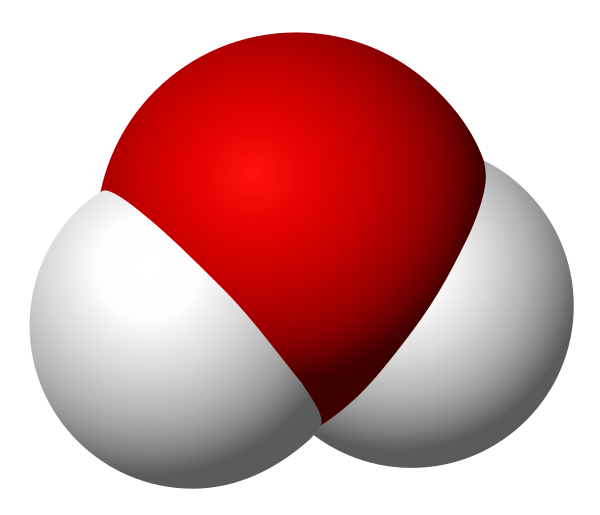
A group of atoms bonded together, representing the smallest fundamental unit of a chemical compound that can take part in a chemical reaction.
Example: An important feature of the MOLECULE's structure are the numerous disulphide bonds which do not only connect the Fab and Fc fragments, but also the heavy and light chains.
en: Molécule
Organic Chemistry
Noun
Relating to or denoting compounds containing carbon (other than simple binary compounds and salts) and chiefly or ultimately of biological origin.
Example: The gradient gives 2 A zA zB . 3.3 Solvent Effects The interaction between solvent and solute is key and critical to determining kinetics of a reaction in ORGANIC CHEMISTRY especially- such as the stabilisation of carbocation intermediates by an electron rich donor solvent, or the competition of two nucleophiles.
en: Chimie Organique
Physics
Noun
The branch of science concerned with the nature and properties of matter and energy. The subject matter of physics, distinguished from that of chemistry and biology, includes mechanics, heat, light and other radiation, sound, electricity, magnetism, and the structure of atoms.
Example: He tried this by combining the old way of thinking - classical mechanics - with a new area in PHYSICS which stared at this time - quantum PHYSICS.
en: Physique
Scientific approach
Noun
A scientific approach is a systematic, empirical method of acquiring knowledge through observation, question formulation, hypothesis testing, and experimental validation.
Example: Essentially EIA is a tool used to 'test and refine explanations', allowing for any potential threats to be mitigated, but is not a SCIENTIFIC APPROACH.