I am a student in Early Childhood Education and I am currently pursuing my training in this field. This glossary is primarily intended for Early Childhood Education students, as well as anyone wishing to better understand the vocabulary related to this profession. It was created to facilitate the understanding of important concepts used in courses and professional practice. The glossary contains 20 words, including theoretical and practical terms specific to Early Childhood Education. To find the definitions, I used my course notes, teaching material and google. The goal of this glossary is to help the reader better understand key terms and reuse them appropriately in a academic or professional context.
Active learning
noun
Active learning is a pedagogical approach that directly involves students in the learning process through activities, games, discussions, and collaborations, rather than passively receiving information in lectures.
Example: In an active learning process, mistakes are seen as opportunities to learn and progress.
en: Apprentissage actif
Areas of development
noun
Specific domains—such as professional skills, personal traits, or human growth stages—targeted for improvement, learning, or progress.
Example: Each child develops at their own pace in the different areas of development.
en: Domaines de développement
Body diagram
noun
Le schéma corporel est la représentation mentale, inconsciente et dynamique que chaque individu a de son propre corps, tant au repos qu'en mouvement.
Example: Movement games and activities in front of a mirror promote the development of body awareness.
en: Schéma corporel
Cognitive domain
noun
The cognitive domain refers to the "thinking" part of learning, focusing on mental skills like knowledge acquisition, problem-solving, critical thinking, and memory, progressing from basic recall to complex creation.
Example: Construction games support the cognitive domain by encouraging logic and planning.
en: Domaine cognitif
Early Childhood Center
noun
A non-profit organization that provides subsidized educational childcare services in facilities whose cost is covered by the government.
Example: Working in an early childhood center requires patience, kindess, and sense of observation.
en: Centre de la petite enfance (CPE)
Ecological approach
noun
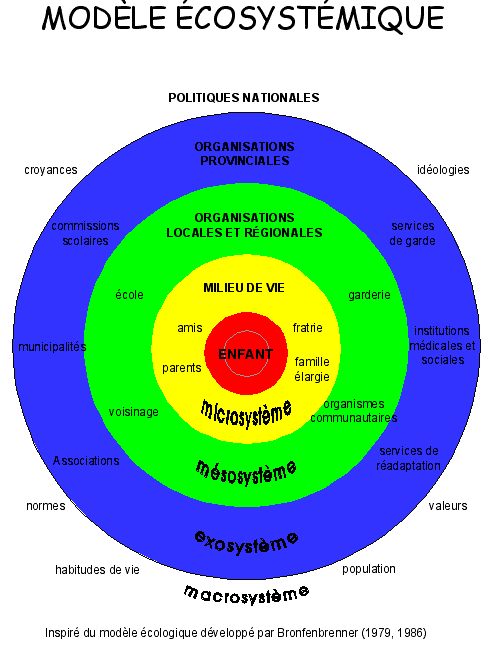
An ecological approach is a comprehensive framework analyzing the interdependent, bidirectional relationships between individuals (or organisms) and their surrounding physical and social environments. It focuses on how these contexts—from immediate surroundings to broader cultural systems—shape behavior, development, and decision-making.
Example: In an ecological approach, the educator observes how different living environments influence the child's behavior.
en: Approche écologique
Educational intervention
noun
A planned, systematic set of actions, strategies, or programs designed to address specific learning, behavioral, or skill gaps in students.
Example: The educational intervention is tailored to each child.
en: Intervention éducative
Educational program
noun
An educational program is a structured, coherent sequence of learning activities, courses, or modules designed to achieve specific, pre-determined educational goals, skills, or learning objectives over a sustained period.
Example: Thanks to the educational program, the team ensures consistency in its teaching practices.
en: Programme éducatif
Executive functions
noun
The set of mental skills that enable goal-directed behavior, involving the organization of thoughts and purposeful activities.
Example: Games that require waiting your turn stimulate executive functions, particularly inhibition.
en: Fonction exécutive
Global development
noun
The entirety of child development dimensions (physical and motor, cognitive, linguistic, social and emotional).
Example: The educator supports the children's overall development through a variety of activities.
en: Développement global
Language domain
noun
The language domain encompasses all the skills that allow human beings to communicate, understand, and express their thoughts through oral, written, or gestural language.
Example: Reading and singing activities stimulate language development from a very young age.
en: Domaine langagier
Parental partnership
noun
Parental partnership is a collaborative, respectful, and reciprocal relationship between parents/carers and practitioners (educators) that aims to support a child's learning, development, and well-being.
Example: Parental partnership promotes harmonious collaboration between the educator and the family.
en: Partenariat parental
Pedagogical approach
noun
A pedagogical approach is the method and practice of teaching, encompassing the theories, strategies, and techniques educators use to facilitate learning and achieve educational goals, considering the learner's needs, subject matter, and cultural context to create effective learning experiences.
Example: Depending on the pedagogical approach adopted, the role of the educator can vary between guide, observer and facilitator.
en: Approche pédagogique
Physical and motor domain
noun
The physical and motor domain refers to a child's bodily growth, physical maturation, and the development of skills to control movement.
Example: Outdoor games stimulate the physical and motor skills by promoting coordination and balance.
en: Domaine physique et moteur
Routine
noun
A sequence of actions regularly followed; a fixed program.
Example: For example, as nurses we can attempt to reduce the possibility of stressors occurring, e.g. help with organizing daily ROUTINE activities.
en: Routine
Self-concept
noun
Self-concept is the mental image, collection of beliefs, and perception an individual holds about themselves, encompassing their personality, abilities, social roles, and physical characteristics.
Example: Adult encouragement contributes to the development of a healthy self-concept.
en: Concept de soi
Social and emotional domain
noun
The social and emotional domain encompasses the ability to understand, manage, and express emotions, build positive relationships, and develop a sense of self.
Example: Group games promote social and emotional development by fostering sharing and cooperation.
en: Domaine social et affectif
Symbolic function
noun
The symbolic function, theorized mainly by Jean Piaget, is the cognitive ability to evoke absent objects, people or events using representations, signs or symbols.
Example: Thanks to the symbolic function, the child can mentally represent absent situations.
en: Fonction symbolique
Temperament
noun
A person's or animal's nature, especially as it permanently affects their behavior.
Example: Understanding a child's temperament allows the educator to adapt her interventions.
en: Tempérament
Transition
noun
A transition in early childhood is the gradual passage from one state, activity, or environment to another, requiring adaptation.
Example: A well-prepared transition helps the child feel safe during a change of activity.