20 This topic is to learn about different expressions or terms used in hockey. terms
This glossary is for my futur students who follow hockey and play it, and for people who want to learn more about it. I chose this topic because it is my passion, and I want to show words that are used to understand more about rules and the culture of this sport that we don't really get in english. With that, terme I will use in class will be understand by the students.
Backchecking
Verb or a noun
Backchecking in ice hockey is a crucial defensive transition strategy where players, usually forwards, skate back from the offensive zone to their defensive zone to disrupt opponents following a puck turnover.
Example: What an effort on the back check to cut the pass. Or : This back checking was incredible, the guy was on the ice for a long time it seems exhausting.
fr: Retour en zone (défensive)
Barn
Noun
A "barn" in hockey terminology refers to an ice rink or arena, often used affectionately to describe older, classic, or intimate venues. The term originated from the similarity of old, rustic arena designs to actual farming structures, or because some rinks were literally converted from barns.
Example: This barn is incredible I really like the stands.
fr: Aréna
Boarding
Noun
Boarding in ice hockey is a penalty assessed when a player violently or dangerously checks, pushes, or trips an opponent, causing them to impact the rink boards. It is a safety-driven rule, often called when a player is hit from behind, in the numbers, or while in a vulnerable/defenseless position 4–5 feet from the boards.
Example: A huge boarding by the number 65 on defense who tried to get the puck. The player is laying on the ice and is having a rough time getting his breath back.
fr: Mise en échec dangereuse contre la bande ou plus précisément donner de la bande.
Celly
Noun
"Celly" is hockey slang for a celebration, specifically referring to the actions a player takes to express joy immediately after scoring a goal. Ranging from subtle to elaborate, popular cellys include fist pumps, team hugs, jumping, or knee-slides across the ice.
Example: The goal scorer is going in front of the opposite bench for a celly.
fr: Célébration
Crease
Noun
It refers specifically to the marked, semi-circular blue area in front of the goal cage where the goalkeeper operates and is protected from unnecessary contact. It is often referred to as the "goal crease
Example: The goal is canceled after video review because the winger was in the goaltenders' crease.
fr: Terrain du gardien
Dangle
Verb
In hockey, dangle refers to a highly skilled, deceptive stick-handling move often involving quick dekes designed to fool a defender or goalie.
Example: What a dangle from the winger.
fr: Feinte
Five-hole
Adjective
The "five-hole" in hockey refers to the gap between a goaltender's leg pads, a primary target for shooters and a critical area for goalies to protect. Coined in the 1970s, it is one of five main scoring zones (including the four corners). This space is most vulnerable during breakaways, dekes, and lateral movements.
Example: He goes on the brake away and puts it five-hole.
fr: Entre les jambières
Forechecking
Verb or a noun
A forecheck is a strategic, organized pressure applied by hockey forwards on opponents within their defensive zone, aiming to force turnovers, disrupt breakout passes, and create immediate scoring opportunities.
Example: The player dump the puck on the offensive zone and start the forecheck.
fr: Échec avant
Freeze
Verb
In ice hockey, "freezing the puck" refers to a goalie covering the puck or a player trapping it against the boards to force a stoppage of play. It is a strategic move to stop pressure, gain a whistle, or manage the game.
Example: The goaltender freezes the puck as the other team was adding constant pressure.
fr: Geler la rondelle
Frozen biscuit
Noun
In ice hockey, a "biscuit" is slang for the puck, which is the small, black, vulcanized rubber disc used in play. "Frozen" refers to the practice of freezing these pucks before games to reduce bounce, ensuring they slide faster and more smoothly on the ice.
Example: He puts the biscuit in the basket.
fr: Palet givré ou rondelle glacé.
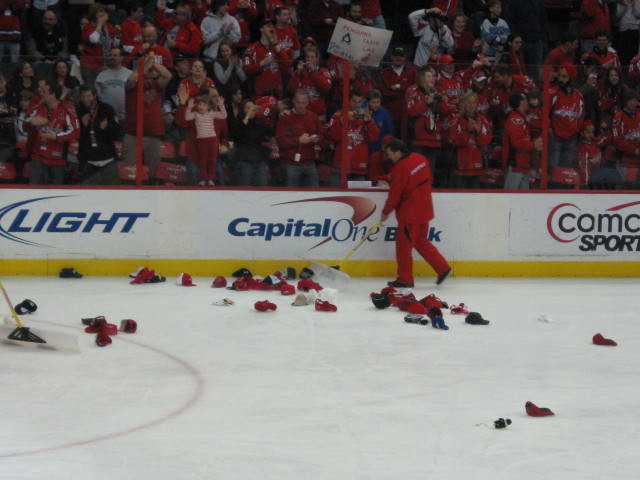
Hat trick
Noun
three successes of the same kind, especially consecutive ones within a limited period.
In ice hockey the scoring of three goals in a game by one player.
Example: What a goal from the player of the game, he puts it in for a hat trick.
fr: Tour du chapeau
High sticking
Noun
High-sticking in ice hockey is referring to the illegal action of carrying the stick blade above shoulder level, often resulting in a penalty if it contacts an opponent. It is a penalized infraction when the stick strikes an opponent in the head or face.
Example: The player gets in the box for two minutes due to high sticking.
fr: Bâton élevé
Icing
Noun
Icing is when a player on his team's side of the red center line shoots the puck all the way down the ice and it crosses the red goal line at any point (other than the goal). Icing is not permitted when teams are at equal strength or on the power play.
Example: The referee blew the whistle and determined that the play was delayed from an icing.
fr: Dégagement refusé
Odd-man-rush
Noun
An odd-man rush in ice hockey occurs when the attacking team has more players moving into the offensive zone than the defending team, creating a numerical advantage (e.g., 2-on-1, 3-on-2). These high-scoring opportunities usually arise from turnovers in the neutral zone, forcing defenders to make quick, often split-second decisions to prevent a shot or pass.
Example: Easy breakout from the team on defense and there is an odd-man rush!
fr: Attaque en surnombre
Offside
Noun
Offside is a rule violation in sports like soccer and hockey, occurring when an attacking player is positioned illegally usually ahead of the ball or behind the last defenders when a play begins.
Example: The referee blew the whistle, the player was offside and the play will return in the middle of the ice.
fr: Hors-jeu
Pipe
Noun
The goalposts (pipes/iron).
Example: The goaltender takes his place between the pipes as the play begins.
fr: Poto
Screen
Noun
A screen in hockey is an offensive tactic where a player positions themselves directly in front of the opposing goalie to obstruct their view of the puck. This technique reduces the goalie's reaction time, increases the likelihood of deflections or rebounds, and forces defenders to battle in front of the net.
Example: This guy is 6 feet and 4 inches, on the power play he is really useful as a screen.
fr: Écran
Shootout
Noun
A hockey shootout is a tie-breaking method used after regulation and overtime, where 3 (or more) alternating players from each team take penalty shots to decide the winner.
Example: The overtime runs out of time, and we are going to the shootout.
fr: Tirs de barrage
Slashing
Noun
Slashing in hockey is a penalty assessed when a player swings their stick at an opponent, or their equipment, with excessive force or without attempting to play the puck.
Example: A big slashing from number 34 on defense as he get two minutes in the box.
fr: Coup de bâton
Winger
Noun
Wingers in hockey typically play on their assigned side (left or right), staying along the boards, responsible for covering opposing defensemen in the defensive zone, supporting breakouts, and creating offense.
Example: The frozen biscuit is getting out of the zone by the wingman who is picking speed for and odd-man rush!