This glossary has been created to help people understand the tools and systems used in modern law enforcement. The police job has become much more technological than ever, incorporating everything from body-worn cameras and automated databases to drones and bulletproof vests. As a result, many of the terms associated with these tools can be easily misunderstood. This glossary intends to help students interested in police work, understand the basic word used by the police department.
badge
noun
A metal emblem worn by a police officer that identifies their authority, department, and official status.
Example: The officer showed their BADGE before entering the building.
en: insigne
bail
noun
Money or property that a person accused of a crime gives to a court as a guarantee that they will return for their trial, allowing them to be released from custody in the meantime.
Example: Black defendants are classed as mentally vulnerable, are less likely than white people to be given BAIL by the criminal justice system and are more likely to receive compulsory psychiatric treatment.
en: caution
booking photo
noun
A photograph taken by police of a person after they are arrested, usually showing their face from the front and side for identification records.
Example: After the arrest, the suspect’s BOOKING PHOTO was taken at the police station.
en: photo d'identité judiciaire
breathalyzer
noun
a device used by police for measuring the amount of alcohol in a driver's breath.
Example: The officer asked the driver to blow into the BREATHALYZER after suspecting drunk driving.
en: Éthylotest
civilian oversight
noun
A system in which members of the public or independent civilian bodies monitor and investigate police actions to promote accountability, transparency, and trust.
Example: The city created a CIVILIAN OVERSIGHT board to review complaints against police officers.
en: contrôle civil
Community policing
noun
A policing approach that focuses on building partnerships and trust between police officers and the communities they serve in order to prevent crime
Example: Through COMMUNITY POLICING, officers regularly meet with local residents to address safety concerns and improve relationships.
en: police de proximité
crime lab
noun
A specialized laboratory where scientists analyze physical evidence from crime scenes using scientific methods and technology.
Example: The blood samples were sent to the CRIME LAB for DNA testing.
en: laboratoire de police scientifique
custody
noun
The state of being under the control or care of the police or legal authorities, usually after being arrested or detained.
Example: All three were related to Ashraf Said, a suspect in the Khan Al-Khalili bazaar blast who died in police CUSTODY.
en: garde à vue
duty belt
noun
A belt worn by police officers that carries essential equipment such as a firearm, handcuffs, radio, baton, and other tools needed for their duties.
Example: The officer adjusted their DUTY BELT before starting patrol.
en: ceinturon de service
Fingerprinting
Noun
The process of collecting and recording a person’s fingerprints for identification or comparison in criminal investigations.
Example: The technique of DNA FINGERPRINTING was invented by Alec Jefferies in 1984, but before being able to fingerprint DNA certain processes have to be carried out first to prepare the DNA sample to be analysed.
en: Prise d'empreinte digitales
forensic
adjective
Relating to the use of scientific methods and techniques to investigate crimes and analyze evidence.
Example: Other applications in DNA FINGERPRINTING are in disease diagnosis and understanding.
en: Médico-légal
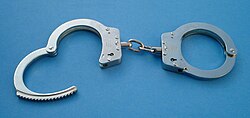
handcuff
noun
a pair of lockable linked metal rings for securing a prisoner's wrists.
Example: Losing control, Jack knocks Sarah unconscious, HANDCUFFS her, and calls for help.
en: menottes
internal affairs
noun
A division within a police department responsible for investigating complaints, misconduct, or wrongdoing by police officers.
Example: The Westphalian model of international law that emerged in Europe was largely based on the existence of sovereign territorial states regulating their INTERNAL AFFAIRS, creating and enforcing laws based on national interest, and engaging in diplomatic relations with other states allowing for mutual coexistence but without interfering in internal matters.
en: affaires internes
police report
noun
an official written document prepared by a police officer that records the details of an incident, crime, or investigation.
Example: The officer filed a POLICE REPORT describing what happened at the scene.
en: rapport de police
probable cause
noun
Probable cause is the reasonable belief, based on objective facts and circumstances, that a crime has been committed or that evidence of a crime will be found in a specific location. It is the legal standard required for police to make arrests, conduct searches, or obtain warrants, establishing a higher threshold than mere suspicion.
Example: The officer had PROBABLE CAUSE to make the arrest after seeing the suspect match the description and flee the scene.
en: cause probable
radar gun
noun
A handheld device used by police to measure the speed of a moving vehicle using radio waves.
Example: The officer used RADAR GUN to determine that the car was speeding.
en: radar de vitesse
radio
noun
A communication device used by police officers to contact dispatch, other officers, and emergency services while on duty.
Example: The officer used the RADIO to request backup during the traffic stop.
en: radio
search warrant
noun
a legal document authorizing a police officer or other official to enter and search premises.
Example: Officers entered the house only after obtaining a SEARCH WARRANT from a judge.
en: mandat de perquisition
spike strips
noun
A device placed on the road by police that contains sharp spikes designed to puncture the tires of a fleeing vehicle to slow it down or stop it safely
Example: Officers deployed SPIKE STRIPS to stop the speeding car during the chase.
en: herses
witness
noun
A person who sees, hears, or has knowledge of an event, especially a crime, and can provide information about it to the police or in court.
Example: This could easily explain the WITNESS's misidentification in this case; as the hypnosis was carried out by a detective there was increased pressure, from this authority figure, to identify the culprit.