Level design is a core game development discipline focused on creating the playable, 3D or 2D environments, layouts, and missions where the game takes place.
Affordance
Noun
Affordance in level design refers to the visual or physical properties of an object that intuitively suggest how a player can interact with it.
Example: To put more emphasis on exploration, I added a passage at the back of the first shop and an eight building at my fourth iteration.
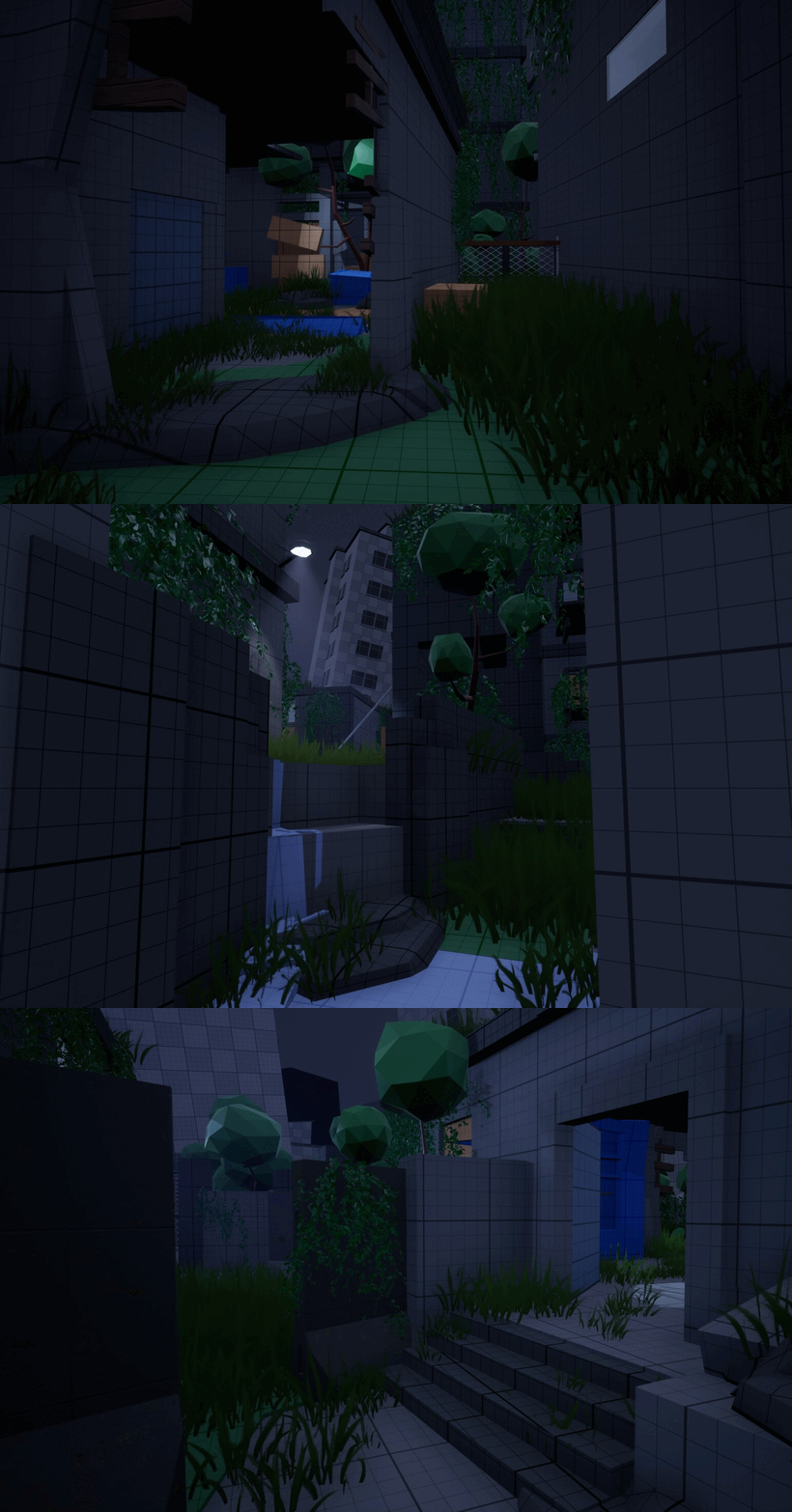
But with these changes the player could easily move away from the Golden Path. So I denied affordance with techniques such as lights and taller grass to guide the player back on track after his exploration.
Attractive opening
Noun
It's a hole, a circle, a rounded doorway. Where the player wants to go.
Example: In my level I used many attractive openings to guide the player.
Back gate
Noun
A structural element, such as a drop-down ledge or a locking door, that prevents players from backtracking. These gates are essential for controlling player progression, ensuring linear flow in complex environments, and preventing players from revisiting already completed areas.
Example: To avoid the frustration of wasting time with unecessary backtracking, I used Back Gates at many locations in the level progression
Blueprints
Noun
Blueprints in video games, specifically within Unreal Engine, refer to a powerful visual scripting system that allows developers to create game logic, interactions, and behaviors by connecting nodes in a graph, rather than writing traditional text-based code.
Example: The alley level being an exploration sequence, it was essential to reward the player for his exploration.
I created a Safe Blueprint hidden in the WLF post and I positioned the Combination Note easily visible in the commercial building.
Pushing the player to explore, before venturing further down the critical path.
en: Un plans
Breadcrums
Noun
Breadcrumbs involve the use of objects that usually share the same shape or form to build a route for players
Example: To guide players to a secret chest, I used coins as breadcrumbs.
en: fil d'Ariane
Critical path
Noun
The critical path is the fastest route to the next part of the game.
en: Chemin critique
Feedback
Noun
Information about reactions to a product, a person's performance of a task, etc. which is used as a basis for improvement.
Example: Yesterday I asked the senior if he could review my level and give me feedback to improve my fnext iterations.
en: Retour
Foliage
Noun
In level design, foliage refers to the placed vegetation—trees, bushes, grass, and plants—used to decorate environments, enhance immersion, and guide player navigation
Example: I used lights and taller grass (foliage) to guide the player back on track after he followed the golden path.
en: Feuillage
Funnel
Noun
A funnel in level design is a technique used to guide players from a large, open area into a narrow, controlled space, forcing a specific encounter or directing them toward a goal
Example: You should add a funnel before your reveal, to create a "wow" moment.
en: Entonnoir
Gates
Noun
In video game level design, a gate is any barrier—literal or metaphorical—that restricts player movement or access to new areas until specific requirements are me
Example: Hard and Soft Gates are excellent solutions to slow down the player's progression. By forcing the player to take a step back and analyse his environment, it creates "small pockets of tension" to release behind actions
en: Barrières
Golden path
Noun
The golden path is the route the level designer put the most effort into creating. It's not the fastest way to finish the game, but it's the one the designer wants the player to take.
Example: I created a Level Sequence of a lightning striking far behind the buildings. The light in the depth of the scene indicates the Golden Path and the noise upstairs indicates the Critical Path with potential encounter.
en: itinéraire dorée
Iteration
Noun
It involves building upon previous versions, using feedback to fix issues, and adding, removing, or tweaking elements until the design is optimal.
Example: With the feedback of my lead, I should start a new iteration for this level.
en: Itération
Landmark
Noun
Unique, prominent, or memorable structures—such as towers, mountains, or distinct buildings—used to catch a player's eye and aid in orientation and navigation.
Example: The senior said he was got lost in my level, maybe I should add a landmark to clarify the main direction I want players to take
en: Point de repère
Lead
Noun
A Lead Level Designer is a senior-level creative professional who oversees the design, layout, and implementation of a video game's levels, ensuring they align with the overall game vision. They manage the level design team.
Example: The iteration of my level being done, I should ask my lead for a meeting to get his feedback.
en: Cadre
level
Noun
A specific, self-contained, and playable space within a video game where a player navigates, overcomes obstacles, and achieves goals.
Example: As our new level designer, you will be in charge of a mid-game level.
It's your responsibility to design and build a level and mission that align with the project’s artistic, creative, and gameplay vision.
en: Niveau de jeu
Level Design Document (LDD)
Phrase
A level design document (LDD) is a detailed blueprint outlining the layout, flow, and, specifically, the moment-to-moment experience of a game level. It bridges conceptual ideas with implementation by documenting enemy placement, pathing, triggers, environmental art, and, importantly, the player’s journey, serving as a guide for level designers to build interactive game spaces.
Example: Make sure to add your 2D plan to the LDD before our LD meeting with the lead.
en: La "Bible" de conception des niveaux de jeux
Level sequence
Noun
A level sequence in video games, particularly within Unreal Engine, is a foundational asset used to create cinematic content, scripted events, and animated sequences directly within a game level. It functions as a timeline-based editor where developers animate cameras, characters, and other objects to play during gameplay or as cutscenes.
Example: For the alley introduction, I wanted to clarify the direction which leads to the Critical Path and the Golden Path.
So I created a Level Sequence of a lightning striking far behind the buildings. The light in the depth of the scene indicates the Golden Path and the noise upstairs indicates the Critical Path with potential encounter.
en: Cinématique
NDA
Noun
A Non-Disclosure Agreement (NDA), or confidentiality agreement, is a legally binding contract that establishes a confidential relationship between parties to protect sensitive information. It restricts the receiving party from disclosing proprietary information—such as trade secrets, client lists, or business plans—to third parties.
Example: Hey Jean ! I heard you worked for Larian Studios. Which project were you working on ?
I can't tell you, I signed an NDA.
en: accord de non-divulgation
Pre-conception
Noun
Pre-conception (or pre-production) in game development is the crucial, initial planning phase where the core vision, mechanics, art style, and scope of a game are established before full-scale production begins. It involves prototyping, market research, team structuring, and creating the Game Design Document (GDD) to minimize risks and ensure a smoother, more efficient development process.
Example: Before starting the production, we should clarify our ideas with a pre-production.
en: Pré-conception
Senior
Noun
An experienced professional—typically with 5+ years in a specific field—who leads technical or creative development, solves complex problems, and mentors juniors.
Example: Today I have a meeting with our team's senior, he always gives me great information to improve on myself.