My name is Sarah-Maude, I'm in my second year of my program, wich is Environmental and Wildlife Management. This glossary will be for all people who want to learn more about the words that we use in environnement and in wildlife. Environnment and the wildlife include everything in related animals, plants, nature, ground, ecology, bugs and a lot more.
Bunodont
Adjective
It's a scientific term describing mammals (like humans, pigs, and bears) with molar teeth that have rounded or conical cusps rather than sharp ridges.
Example: Today we learned that monkeys have bunodont-type teeth.
fr: Bunodonte
Cecotrophy
Noun
Cecotrophy is a natural, essential behavior in rabbits and some rodents where they ingest specialized, nutrient-rich soft feces directly from the anus to re-digest them.
Example: Rabbits are mammals that use the process of cecotrophy.
fr: Caecotrophie
Denitrification
Noun
Denitrification is a microbial process in which bacteria convert nitrate into gaseous nitrogen compounds (like
and in anaerobic (low-oxygen) conditions, typically in soil or water.
Example: In waterlogged soils, bacteria perform denitrification, releasing nitrogen gas back into the atmosphere.
fr: Dénitrification
Ecology
Noun
The branch of biology that deals with the relations of organisms to one another and to their physical surroundings.
Example: The oil spill caused terrible damage to the fragile ecology of the coast.
fr: Écologie
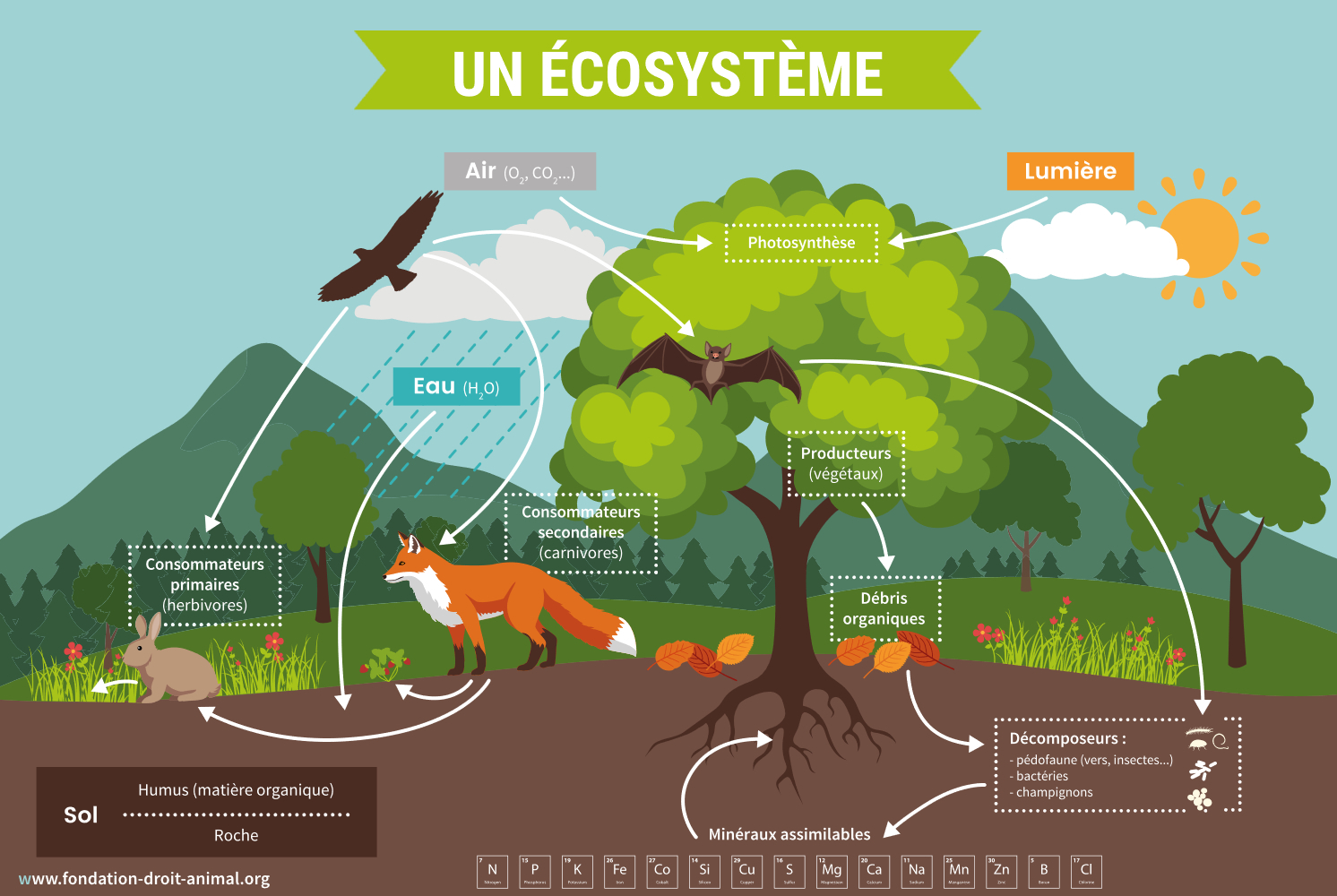
Ecosystem
Noun
A biological community of interacting organisms and their physical environment.
Example: The Amazon rainforest is a complex and diverse ecosystem, supporting a wide variety of plant and animal life.
fr: Écosystème
Ectotherm
Adjective
Ectothermy (often referred to as cold-bloodedness) is a physiological strategy where animals rely primarily on external environmental heat sources—like sunlight or warm surfaces—to regulate their body temperature, rather than generating sufficient heat internally. Their body temperature fluctuates with the surrounding environment.
Example: Because reptiles are ectotherms, their body temperature is controlled by whatever is around them.
fr: Ectotherme
Endotherm
Adjective
Endothermy is the ability of an organism, like mammals and birds, to generate and regulate its own body heat internally, maintaining a stable, warm temperature (warm-bloodedness) regardless of the external environment.
Example: Unlike reptiles, mammals are endotherm to be able to maintain a constant, high body temperature regardless of the outside weather.
fr: Endotherme
Eutherians
Noun
It's a mammal of the major group Eutheria, which includes all the placentals and excludes the marsupials and monotremes. Eutherians (placental mammals) are distinguished from other mammal groups by nurturing their young within the mother’s body via a complex placenta.
Example: Humans, whales, and bats are all examples of eutherian mammals.
fr: Euthériens
Gregarious
Adjective
Gregarious animals are species that habitually live, move, or feed in groups, herds, flocks, or schools rather than in isolation.
Example: Gray Jays are gregarious and are often found in family groups.
fr: Grégaire
Habitat
Noun
A habitat is the natural home or environment of a plant, animal, or the other organism. It provides the organisms that live there with food, water, shelter and space to survive. Habitats consist of both biotic and abiotic factors.
Example: This chance to view the animals in their natural habitat should not be passed by.
fr: Habitat
Hydrology
Noun
Hydrology is the scientific study of the movement, distribution, quality, and storage of Earth's water, focusing on the hydrologic cycle, including water in the atmosphere, on the land surface (rivers, lakes, glaciers), and in the subsurface (groundwater).
Example: Before going into the field, we need to analyze the hydrology of the environment to properly plan our work.
fr: Hydrologie
Lophodont
Adjective
Lophodont refers to a type of mammalian molar or premolar tooth characterized by elongated, hard enamel ridges called "lophs" that connect cusps, used for grinding tough plant material. These transverse or longitudinal ridges act as a "washboard" surface, common in herbivores like tapirs, manatees, and many rodents.
Example: Because they feed on tough, fibrous vegetation, horses have developed lophodont molars to efficiently grind their food.
fr: Lophodonte
Nitrification
Noun
Nitrification is the biological, two-step oxidation process in the nitrogen cycle where specialized bacteria convert ammonia or ammonium into nitrites and subsequently into nitrates. This aerobic process is essential for soil fertility, as it transforms nitrogen into a form easily absorbed by plants.
Example: Soil conditions that have an effect on nitrification rates include, Substrate availability, aeration, moisture, pH, and temperature.
fr: Nitrification
Pedology
Noun
The branch of science concerned with the formation, nature, ecology, and classification of soil; soil science.
Example: Contemporary soils carry imprints of pedogenic processes that were active in the past, although in many cases these imprints are difficult to observe or quantify.
fr: Pédologie
Secodont
Adjective
Secodont refers to specialized, blade-like molar or premolar teeth in mammals designed for shearing, slicing, or cutting meat, acting similarly to scissors. Found primarily in carnivores (e.g., cats, wolves), these teeth—often called carnassials—have sharp, cusped edges adapted for tearing flesh rather than grinding plant matter.
Example: The paleontologist identified the carnivore fossil by its secodont dentition.
fr: Secodonte
Selenodont
Adjective
Selenodont describes mammal molar or premolar teeth characterized by crescent-shaped (moon-like) ridges or cusps on the crown, designed for grinding tough vegetation. Common in ruminant herbivores like deer, cattle, and camels, these teeth feature complex, exposed layers of enamel, dentine, and cementum.
Example: In ruminants and horses, the teeth are selenodont type and are used for grinding the plant matter.
fr: Sélénodonte
Syrinx
Noun
The syrinx is the unique vocal organ of birds, located at the base of the trachea (windpipe) where it splits into the lungs, acting as a "voice box" to produce songs, calls, and mimicry.
Example: A bird doesn't have vocal cords, instead he has a syrinx.
fr: Syrinx
Taxonomy
Noun
The branch of science concerned with classification, especially of organisms; systematics.
Example: The scientist created a new taxonomy for the newly discovered plant species, placing it within its correct group.
fr: Taxonomie
Urohidrosis
Noun
Urohidrosis is a thermoregulatory behavior in certain birds, where they defecate on their own scaly legs to cool down. The evaporating liquid lowers their body temperature, acting as a crucial cooling mechanism (up to 6°C) in high temperatures.
Example: Some bird, like red-headed vulture frequently excrete onto their legs to prevent overheating.
fr: Urohydrose
Zygodactyl
Adjective
It is a type of bird's feet having two toes pointing forward and two backward.
Example: The woodpecker is a type of zygodactyl bird, having two toes facing forward and two facing backward, which allows them to climb trees with ease.