This glossary is purely focused on the words used to describe Antiquity's most famous icons.
Agora
/ˈæɡərə/
A public space used for assemblies and markets in ancient Greece
Example: The citizens met at the Agora to discuss politics and trade goods
en: Agora
Ampitheater
/æmˈfɪθɪətər/
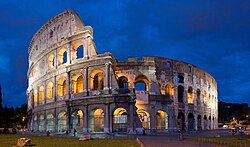
An open-air theater used in ancient Rome for entertainment, often for gladiator.
Example: The Colosseum is the most famous Roman amphitheater.
en: Ampithéatre
Aqueduct
[ak-wi-duhkt]
a bridgelike structure that carries a water conduit or canal across a valley or over a river.
Example: the lyon aqueduct was 300 meters of altitude
en: aqueduc
Barbarian
[bahr-bair-ee-uhn]
A term used by ancient civilizations to describe people considered uncivilized or foreign.
Example: The Romans often referred to tribes outside their empire as barbarians.
en: barbarie
Colosseum
[kol-uh-see-uhm]
an ancient amphitheater in Rome, begun a.d. c70 by Vespasian, having the form of an oval 617 by 512 feet (188 by 156 meters).
Example: The Colosseum could hold tens of thousands of spectators.
en: colisée
Cuneiform
[kyoo-nee-uh-fawrm, kyoo-nee-uh-]
composed of slim triangular or wedge-shaped elements, as the characters used in writing by the ancient Akkadians, Assyrians, Babylonians, Persians, and others.
Example: [kyoo-nee-uh-fawrm, kyoo-nee-uh-]
en: cunéiforme
Democracy
/dɪˈmɒkrəsi/
A government system who appeared in ancient Athens where citizen can vote
Example: I will vote for the blue party
en: Démocratie
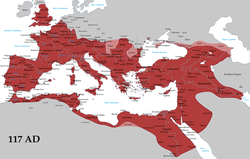
Empire
[ɑ̃piʀ]
A group of nations or peoples ruled by an emperor or a powerful sovereign state.
Example: The Roman Empire was one of the largest empires in ancient history.
en: empire
Forum
[fawr-uhm]
the marketplace or public square of an ancient Roman city, the center of judicial and business affairs and a place of assembly for the people.
Example: The Roman Forum was the center of public life in ancient Rome.
en: forum
Gladiator
[glad-ee-ey-ter]
(in ancient Rome) a person, often a slave or captive, who was armed with a sword or other weapon and compelled to fight to the death in a public arena against another person or a wild animal, for the entertainment of the spectators.
Example: Gladiators fought in the Colosseum to entertain the Roman public.
en: gladiateur
Legion
/ˈfɛərəoʊ/
A unit in the Roman army often around 3000 to 6000 soldiers
Example: A legion who fight for the Roman empire
en: Légion
Mythology
[mi-thol-uh-jee]
a body of myths, as that of a particular people or that relating to a particular person.
Example: Greek mythology includes gods like Zeus and Athena.
en: mythologie
Oracle
[awr-uh-kuhl, or-]
(especially in ancient Greece) an utterance, often ambiguous or obscure, given by a priest or priestess at a shrine as the response of a god to an inquiry.
Example: The Oracle of Delphi was famous in ancient Greece for its prophecies.
en: oracle
Pantheon
[pan-thee-on, -uhn, pan-thee-uhn]
a domed circular temple at Rome, erected a.d. 120–124 by Hadrian, used as a church since a.d.
Example: The Pantheon in Rome is a well-preserved ancient temple.
en: Panthéon
Patrician
/pəˈtriSHən/
An aristocrat
Example: A patrician will go to the senate
en: patricien
Pharaoh
/ˈfɛərəoʊ/
A Monarch in the Ancient Egypt
Example: The Pharaoh has the absolute power of Egypt
en: Pharaon
Philosopher
[fi-los-uh-fer]
a person who offers views or theories on profound questions in ethics, metaphysics, logic, and other related fields.
Example: Diogene living in a barrel
en: philosophe
Republic
[ri-puhb-lik]
a state in which the supreme power rests in the body of citizens entitled to vote and is exercised by representatives chosen directly or indirectly by them.
Example: Ancient Rome was initially a republic before becoming an empire.
en: république
Senate
/ˈsɛnɪt/
An assembly in ancient Rome composed of patricians.
Example: would seem that money played a large part in the senate's decisions regarding conflict seeing that classics
en: Sénat
Toga
[toh-guh]
(in ancient Rome) the loose outer garment worn by citizens in public.
Example: Roman senators wore togas as a symbol of their status.