Hi, my name is Mikaelle Gouin, and I am a Fine Art student at Cegep du Vieux Montreal. I have created this glossary to help people that are interested in knowing more about words related to art. This glossary includes 20 terms that are frequently used by artists and art teachers. Each term has a definition, a picture, an audio for its pronunciation and an example to show how to use the word.
bird's-eye view
noun
An elevated view of an object from above, with a perspective as though the observer were a bird.
Example: The artist used a bird's-eye view to depict the bustling city streets, creating a dynamic sense of scale and perspective.
en: vue à vol d'oiseau
brushwork
noun
The way in which painters use their brush, as evident in their paintings.
Example: The artist's expressive brushwork gives the painting a sense of movement and emotion, with each stroke adding texture and energy to the canvas.
en: coups de pinceau
canvas
noun
A strong, coarse unbleached cloth made from hemp, flax, cotton, or a similar yarn, used as a surface for oil painting.
Example: She began her new painting by stretching a fresh canvas over the wooden frame, eager to bring her vision to life with bold colors and dynamic shapes.
en: toile
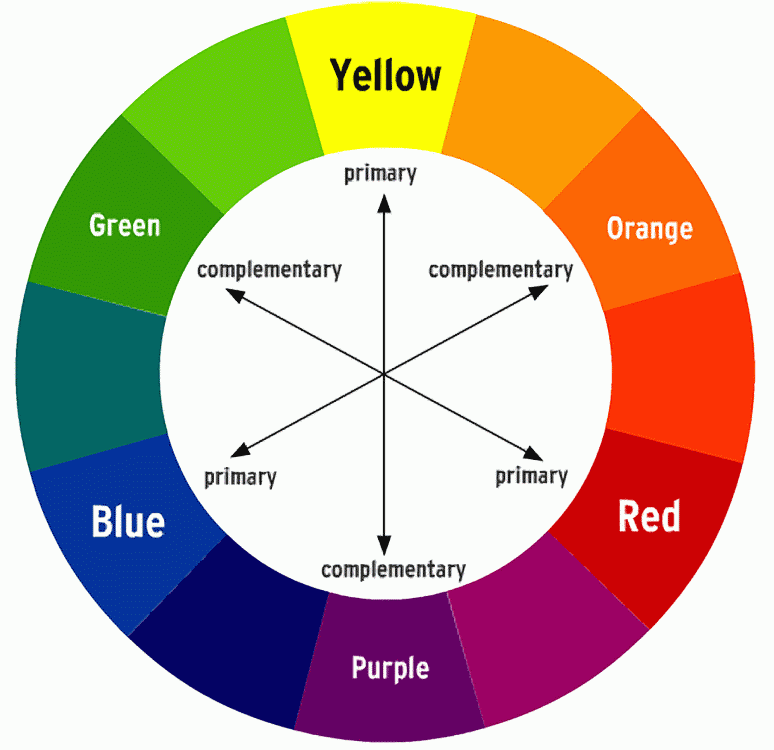
complimentary colors
noun
Pairs of colors which, when combined or mixed, cancel each other out by producing a grayscale color like white or black. Complementary colors may also be called "opposite colors".
Example: The artist used complementary colors, like blue and orange, to create striking contrast and make the subject stand out vividly against the background.
en: couleurs complémentaires
composition
noun
Composition is the arrangement of elements within a work of art.
Example: The composition of the painting skillfully guides the viewer's eye from the foreground to the background, creating a sense of depth and movement.
cross-hatching
verb
(in drawing or graphics) shade (an area) with intersecting sets of parallel lines.
Example: The illustrator used cross-hatching to build up shadows and depth, layering intersecting lines to create a rich, textured effect.
en: hachures croisées
focal point
noun
A focal point is that area of a picture that attracts the eye.
Example: The bright red umbrella in the center of the painting serves as the focal point, immediately drawing the viewer’s attention amid the muted background.
en: point focal
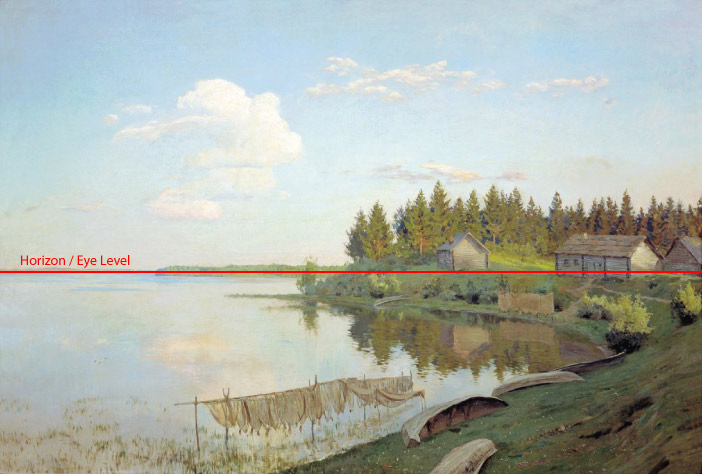
horizon line
noun
Horizon line/eye level refer to a physical/visual boundary where sky separates from land or water.
Example: The painter carefully positioned the horizon line to create a balanced composition, guiding the viewer's eye toward the dramatic sunset.
en: ligne d'horizon
hue
noun
A color or shade.
Example: The artist blended different hues of blue to create a serene, oceanic atmosphere in the painting.
en: teinte
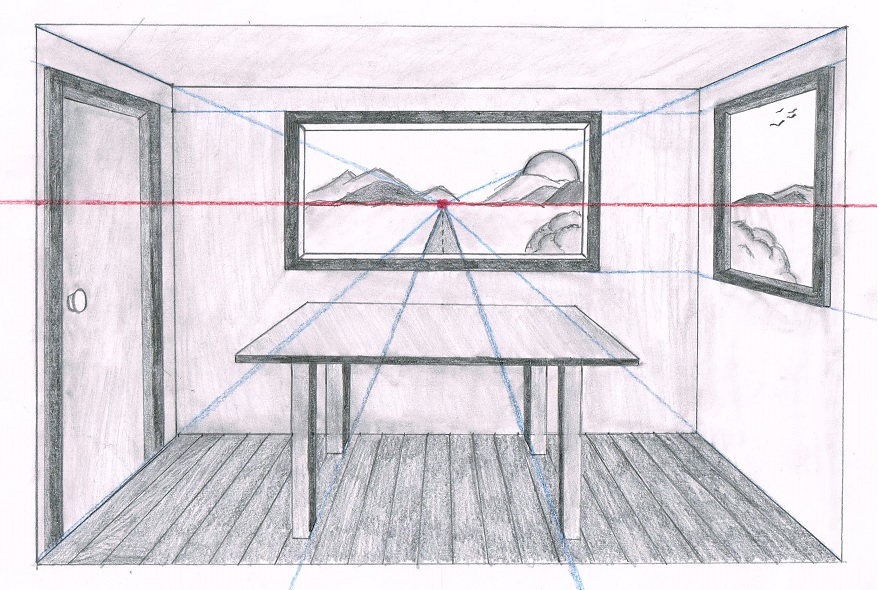
linear perspective
noun
A type of perspective used by artists in which the relative size, shape, and position of objects are determined by drawn or imagined lines converging at a point on the horizon.
Example: By applying linear perspective, the artist created a striking illusion of depth, drawing the viewer’s eye toward the vanishing point in the distance.
en: perspective linéaire
maquette
noun
A sculptor's small preliminary model or sketch.
Example: Before beginning the full-scale sculpture, the artist created a detailed maquette to visualize the final piece and refine the proportions.
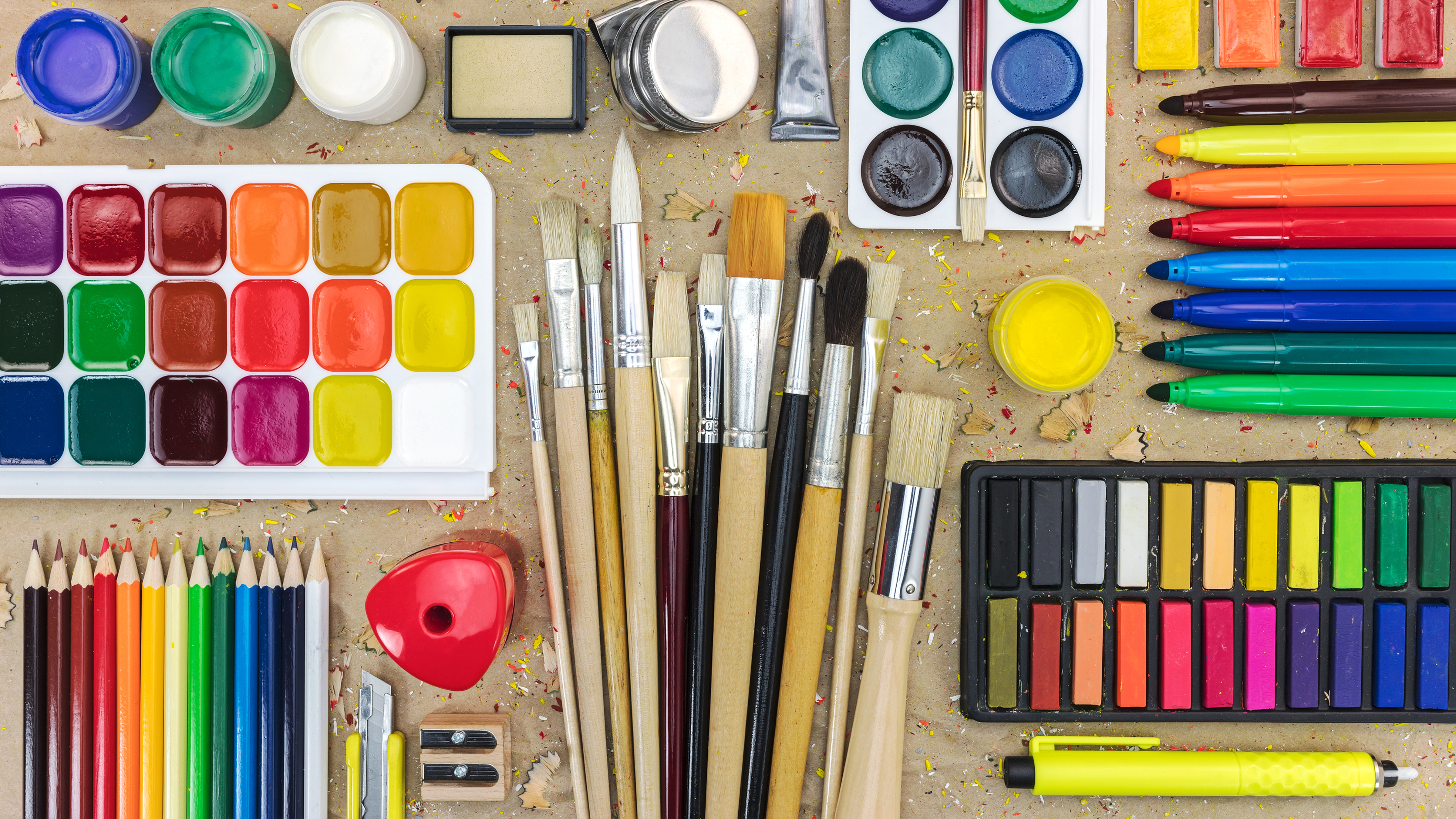
medium
noun
A medium in the art world is the term for the material used to create artwork. Mediums can include paint or inks, sculpting materials, fabric, glass, and even sound or living people in some cases.
Example: Oil paint is her preferred medium because of its rich texture and slow drying time, which allows for detailed blending and layering.
en: médium
mixed media
noun
The use of a variety of media in an entertainment or work of art.
Example: The artist's latest piece is a stunning example of mixed media, combining acrylic paint, newspaper clippings, and fabric to create a textured, multidimensional effect.
en: techniques mixtes
opaque
adjective
Not able to be seen through; not transparent.
Example: The artist layered opaque paint over the canvas to create bold, striking contrasts between light and shadow.
organic lines
adjective
Lines that appear natural and imperfect rather than man-made or mathematical.
Example: The artist's use of organic lines created a flowing, natural composition that mimicked the curves of vines and waves.
en: lignes organiques
pattern
noun
A pattern is a design in which lines, shapes, form or colors are repeated.
Example: The artist incorporated intricate geometric patterns into the design, creating a visually harmonious composition.
en: motif
relief
noun
Any work in which the figures project from a supporting background, usually a plane surface.
Example: The museum's exhibit showcased an impressive relief sculpture, where intricate details were carved into the stone to create a striking three-dimensional effect.
still life
noun
A painting or drawing of an arrangement of objects, typically including fruit and flowers and objects contrasting with these in texture, such as bowls and glassware.
Example: The painter meticulously arranged the fruit and flowers to create a balanced still life composition that highlighted texture and light.
en: nature morte
support
noun
In visual arts, the support is a solid surface onto which the painting is placed, typically a canvas or a panel.
Example: The artist chose a wooden panel as the support for their latest oil painting, giving it a rich, textured finish.
tone
noun
The lightness and darkness of colours.
Example: The interplay of light and dark tones in the painting creates a striking contrast, adding depth and emotion to the composition.