Hi everyone!
My name's Marie-Noëlle Grignon-Venne and I'm nineteen years old. I am currently studying in social studies - the Individual at Collège du Vieux-Montreal. As a career, I'd like to be a speech-language pathologist. I created this glossary to help students or people interested in linguistics. The glossary will help understand the meaning of 18 words related to that field of study. Each word will have a definition, an audio and an example of how we can use the word in a sentence.
alveolar consonant
noun
A class of sounds made when the tongue touches or is close to the bumpy front part of the roof of the mouth, called the alveolar ridge.
Example: The sound /d/ in the word "dog" is an alveolar consonant, formed by placing the tongue tip against the ridge behind your upper front teeth.
fr: consonne alvéolaire
articulation
noun
The way phonemes are formed in speech.
Example: Her precise articulation of her political views left no room for misinterpretation.
fr: articulation
babbling
noun
Babbling is a verbal conduct of infants during the second half of the first year of life.
Example: As the baby grew, his coos slowly transformed into babbling, a series of repetitive consonant-vowel sounds like "ba-ba" or "da-da."
fr: babillage
bilabial
noun
A class of sounds made with both lips.
Example: The sounds /p/, /b/, and /m/ in English are all examples of bilabial consonants because they are produced by bringing both lips together.
fr: bilabial
circumlocution
noun
Literally talking around a word, a method of describing a concept. Circumlocution is a strategy used by people with anomia, as well as a common characteristic of aphasic speech.
Example: Instead of directly saying he was fired, the politician used circumlocution, referring to his "involuntary career transition" and "exploring new opportunities."
fr: périphrase
consonant
noun
A consonant is one of the speech sounds or letters of the alphabet that is not a vowel. Consonants are pronounced by stopping the air from flowing easily through the mouth, especially by closing the lips or touching the teeth with the tongue.
Example: The letter 'B' is a consonant because its sound involves a complete closure of the lips, obstructing the airflow.
fr: consonne
deglutition
noun
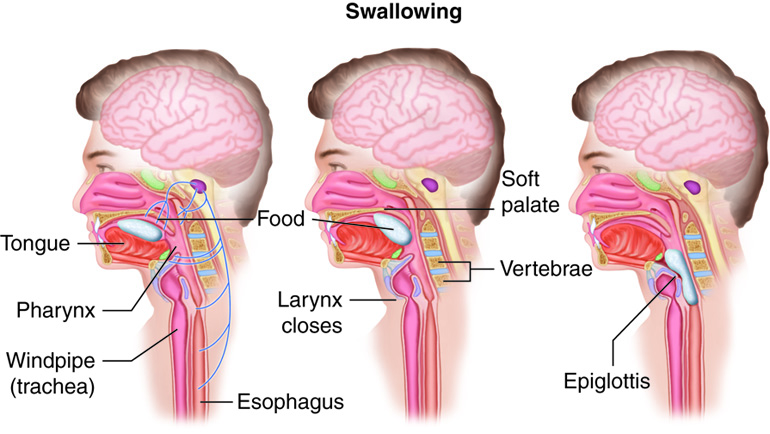
The act of swallowing.
Example: The act of deglutition, or swallowing, is a complex process involving over 20 muscles.
fr: déglutition
fluency
noun
Smoothness with which sounds, syllables, words and phrases are joined together during oral language; lack of hesitations or repetitions in speaking.
Example: After years of dedicated practice, she achieved remarkable fluency in both French and Spanish
fr: aisance
memory
noun
The cognitive process of storing (or encoding) and recalling (or retrieving) information in the brain. There are many types of memory: short-term, long-term, procedural, declarative, semantic, and episodic.
Example: Humans possess an incredible capacity for memory, allowing us to recall past experiences, learn new information, and navigate the world around us.
fr: mémoire
phonation
noun
Sound made when air vibrates the vocal folds in the larynx to produce speech.
Example: Healthy vocal folds are crucial for clear phonation, allowing us to produce a wide range of speech sounds.
fr: phonation
phoneme
noun
The shortest unit of sound in a given language that can be recognized as being distinct from other sounds in the language.
Example: The difference in meaning between "cat" and "bat" is created by the change of a single sound unit, demonstrating that /k/ and /b/ are distinct phonemes in English.
fr: phonème
prelinguistic
noun
Prelinguistic is the behaviors that are thought to precede the acquisition of true language.
Example: During the prelinguistic stage, infants communicate through cries, coos, and babbling, long before they utter their first words.
fr: prélinguistique
remediation
noun
The action of remedying something, in particular of reversing or stopping environmental damage, it's improving the problem.
Example: In speech therapy, the primary goal of remediation is to directly address and improve the underlying communication disorder, such as correcting an articulation error or developing language skills that were previously underdeveloped.
fr: remédiation
resonance
noun
The flow of air through the nose or mouth during speech.
Example: One goal of speech therapy is to achieve optimal resonance by ensuring the proper balance of airflow through the oral and nasal cavities, which contributes to overall voice quality.
fr: résonance
speech disorder
noun
Any deviation of speech outside the range of acceptable variation in a given environment.
Example: After her stroke, she developed a speech disorder that made it difficult for her to articulate certain words clearly.
fr: trouble du langage
stuttering
noun
Disturbance in the normal fluency and time patterning of speech.
Example: Despite extensive speech therapy, his lifelong stuttering still occasionally made it challenging for him to deliver fluent public speeches.
fr: bégaiement
syntax
noun
The syntax is the way in which words are put together in a sentence to convey meaning.
Example: The writer carefully crafted the sentence, paying close attention to its syntax to ensure clarity and impact.
fr: syntaxe
vowel
noun
A vowel is a speech sound produced by human beings when the breath flows out through the mouth without being blocked by the teeth, tongue, or lips. In the English language, the vowels are /a, e, i, o, u, and sometimes y/.
Example: The vowel sounds are the core of nearly every syllable in spoken language, allowing for continuous airflow from the lungs.