Hi, my name is Eddy El Dib and I study in Naturel Science at Ahuntsic College. Even if I love my program, I hate chemistry, because of it big charges. I love biology, so maybe I will be a bio technologist. In my program there is biology. It is the base of human progress and cover almost all aspects of development. This glossary contains the words people use to talk about biology.
adaptation
noun
The action or process of adapting or being adapted.
Example: They give good example of adaptation to habitat and the idea of 'survival of the fittest'.
fr: adaptation
cell
noun
The smallest structural and functional unit of an organism, typically microscopic and consisting of cytoplasm and a nucleus enclosed in a membrane. Microscopic organisms typically consist of a single cell, which is either eukaryotic or prokaryotic.
Example: Endocytosis of a bacterium by an ancestral eukaryotic cell would create an organelle with a double membrane.
fr: cellule
chloroplast
noun
A plastid that contains chlorophyll and in which photosynthesis takes place.
Example: The proteins encoded for by mitochondrial or chloroplast DNA are synthesized on ribosomes within the organelles.
fr: chloroplast
chromosome
noun
A threadlike structure of nucleic acids and protein found in the nucleus of most living cells, carrying genetic information in the form of genes.
Example: Autosomal inheritance Single gene disorders are caused by gene mutations in autosomal pairs, individual chromosomes or sex chromosomes.
fr: chromosome
diffusion
noun
The movement of molecules or particles from an area of high concentration to an area of low concentration.
Example: Due to the small size of the prokaryotic cell and its high surface area to volume ratio it can obtain all the nutrients and gases it needs through simple diffusion, so the cell contains no complicated transport mechanisms.
fr: diffusion
ecosystem
noun
A geographic area where living things (biotic factors) and non-living things (abiotic factors) interact to form a functional unit.
Example: Should the wrong gene "escape" into the environment, the ECOSYSTEM of the local area, and potentially that of the entire planet, could be irrevocably altered.
fr: écosystème
enzyme
noun
A substance produced by a living organism which acts as a catalyst to bring about a specific biochemical reaction.
Example: After which the excess solution can be washed off and a dye containing substrate added, if the enzyme conjugate becomes attached to the surface it will cleave the dye from the substrate causing a colored solution to develop.
fr: enzyme
gene
noun
A unit of heredity which is transferred from a parent to offspring and is held to determine some characteristic of the offspring.
Example: Living in large groups has its individual selfish benefits, benefiting a gene for 'stotting' within the individual survival machine.
fr: gène
hormone
noun
A chemical substance produced by endocrine glands that acts as a messenger, traveling through the bloodstream to affect the activity of cells, tissues, and organs remote from its point of origin.
Example: The binding of leptin also induces the release of melanocyte stimulating hormone (-MSH) that inhibits eating.
fr: hormone
metabolism
noun
The chemical processes that occur within a living organism in order to maintain life.
Example: The main rate-limiting step in bilirubin metabolism is excretion by the canaliculi rather than conjugation.
fr: métabolisme
mitosis
noun
A type of cell division that results in two daughter cells each having the same number and kind of chromosomes as the parent nucleus, typical of ordinary tissue growth.
Example: The archaeal cell provided the cytoplasm and the eubacterial, or a spirochete, enabled mobility and thus mitosis.
fr: mitose
mutation
noun
A change in the DNA sequence of an organism, resulting in a variation in the genetic material.
Example: Cancer is caused by mutations in tumor suppressor genes, oncogenes and DNA repair genes due to exposure to environmental mutagens.
fr: mutation
nucleus
noun
The structure in a cell that contains the chromosomes.
Example: Most DNA in eukaryotes is found in the nucleus, however, around the beginning of the 20 th century, two plant scientists working independently.
fr: noyau
organelle
noun
Any of a number of organized or specialized structures within a living cell.
Example: Hydrogenosomes are another respiratory organelle, found instead of mitochondria in obligate or aerotolerant anaerobes.
fr: organite
osmosis
noun
A process by which molecules of a solvent tend to pass through a semipermeable membrane from a less concentrated solution into a more concentrated one, thus equalizing the concentrations on each side of the membrane.
Example: Osmosis dictates that water follows sodium ions and is thus reabsorbed passively.
fr: osmose
photosynthesis
noun
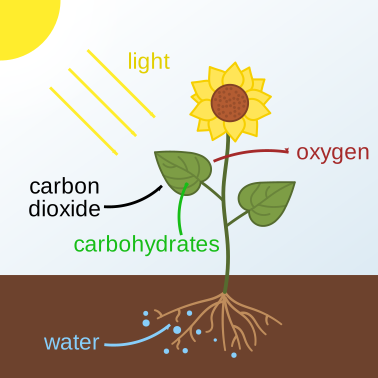
The process by which green plants and some other organisms use sunlight to synthesize foods from carbon dioxide and water. Photosynthesis in plants generally involves the green pigment chlorophyll and generates oxygen as a byproduct.
Example: The plant gains the carbon dioxide needed for photosynthesis through the opening of stomata (pores on leaf surface) but this is also how most of the water loss occurs.
fr: photosynthèse
protein
noun
A complex substance composed of amino acids joined by peptide bonds, essential for life and found in all living organisms.
Example: In the postwar 1940s and 1950s, whale meat became a primary source of food and PROTEIN in Japan following the famines that came with World War II.
fr: protéine
respiration
noun
A process in living organisms involving the production of energy, typically with the intake of oxygen and the release of carbon dioxide from the oxidation of complex organic substances.
Example: Common electron acceptors in anaerobic respiration are inorganic nitrogen compounds.
fr: respiration
ribosome
noun
A minute particle consisting of RNA and associated proteins found in large numbers in the cytoplasm of living cells. They bind messenger RNA and transfer RNA to synthesize polypeptides and proteins.
Example: Genes for a third of the proteins used to build up the chloroplast ribsome.
fr: ribosome
virus
noun
A piece of code that is capable of copying itself and typically has a detrimental effect, such as corrupting the system or destroying data.
Example: Vaccination against Feline Immunodeficiency virus.