Dear readers, I am currently studying in the program called Social Science. In the past two years, my favourite course was psychology because I have learned so many things such as new words, concepts, theories and new personality disorder. I want to be a social worker, so building a glossary with all the difficult words is really helping me to remember all the important concepts in my course. Those words can be really complex to sometimes understand and that's why a glossary can be very useful for someone who wants to learn more about it. Psychology requires a lot of precise terms that can be hard to understand, but with this glossary you'll be able to know the basics. I used any sources to create my glossary such as Wikipedia, Google Images and Actively Engaged Online by Nicholas Walker.
anxiety
noun
A feeling of worry, nervousness, or unease, typically about an imminent event or something with an uncertain outcome.
Example: My anxiety is more intense before an exam.
fr: anxiété
aphasia
noun
Loss of ability to understand or express speech, caused by brain damage.
Example: My aphasia makes it difficult for me to understand when someone is talking.
fr: aphasie
Behaviorism
noun
The theory that human and animal behavior can be explained in terms of conditioning, without appeal to thoughts or feelings, and that psychological disorders are best treated by altering behavior patterns.
Example: Behaviorism is a theory, made by John Watson, that human and animal behavior can be explained in terms of conditioning.
fr: Béhaviorisme
bipolar disorder
noun
A mental condition marked by alternating periods of elation and depression.
Example: My father has bipolar disorder and it brings severe high and low moods and changes in sleep, energy, thinking, and behavior.
fr: trouble bipolaire
butterfly effect
noun
The phenomenon whereby a minute localized change in a complex system can have large effects elsewhere.
Example: How buying a sandwich can lead to World War One is an example of the butterfly effect.
fr: effet papillon
dissociative disorder
noun
Dissociative disorders involve problems with memory, identity, emotion, perception, behavior and sense of self. Dissociative symptoms can potentially disrupt every area of mental functioning.
Example: My best friend has dissociative disorder and sometimes forget what he did because his other personality took control.
fr: trouble dissociatif
egocentrism
noun
Having little or no regard for interests, beliefs, or attitudes other than one's own; self-centered.
Example: Egocentrism is one of many defaults my nemesis has. He always does everything for him and him only.
fr: égocentrisme
ethnocentrism
noun
Evaluation of other cultures according to preconceptions originating in the standards and customs of one's own culture.
Example: "My generation and society are better than the ancient society." is a sentence in which it shows ethnocentrism.
fr: ethnocentrisme
flooding
noun
Flooding is a form of behavior therapy and desensitization—or exposure therapy—based on the principles of conditioning. As a psychotherapeutic technique, it is used to treat phobia and anxiety disorders including post-traumatic stress disorder.
Example: My psychologist uses flooding therapy to help me conquer my fears.
fr: immersion
hypermnesia
noun
Unusual power or enhancement of memory, typically under abnormal conditions such as trauma, hypnosis, or narcosis.
Example: My memory is excellent, I can remember the exact face of someone because of my hypermnesia.
fr: hypermnésie
lucid dreaming
noun
Lucid dreams are when you know that you're dreaming while you're asleep. You're aware that the events flashing through your brain aren't really happening. But the dream feels vivid and real. You may even be able to control how the action unfolds, as if you're directing a movie in your sleep.
Example: Sometimes, I do lucid dreaming, it is very special to know that you are awake while you are sleeping.
fr: rêve lucide
narcissism
noun
Selfishness, involving a sense of entitlement, a lack of empathy, and a need for admiration, as characterizing a personality type.
Example: My brother thinks that he is the king of the world in everything he does, as if he knew everything, it demonstrates narcissism.
fr: narcissisme
obsessive-compulsive disorder
noun
Obsessive-Compulsive Disorder (OCD) is a common, chronic, and long-lasting disorder in which a person has uncontrollable, reoccurring thoughts (obsessions) and/or behaviors (compulsions) that he or she feels the urge to repeat over and over.
Example: I think I have an obsessive-compulsive disorder, because if I don't feel like I wash my hands correctly, I might die.
fr: trouble obsessionnel-compulsif
paranoia
noun
Paranoia is the feeling that you're being threatened in some way, such as people watching you or acting against you, even though there's no proof that it's true.
Example: I am sure that someone follows me every day, my friends think that I have a paranoia.
fr: paranoïa
placebo effect
noun
A beneficial effect produced by a placebo drug or treatment, which cannot be attributed to the properties of the placebo itself, and must therefore be due to the patient's belief in that treatment.
Example: I mixed y medicine with a Tic Tac and my headache was gone after I ate the candy, maybe it was the placebo effect.
fr: effet placebo
prosopagnosia
noun
A neurological condition characterized by the inability to recognize the faces of familiar people.
Example: My friend was born with prosopagnosia.
fr: prosopagnosie
recency effect
noun
The recency effect is a cognitive bias in which those items, ideas, or arguments that came last are remembered more clearly than those coming first. The more recently heard, the clearer something may exist in the juror's memory.
Example: I listened to a speech gave by my father and I retained only the last part, it must be the recency effect.
fr: effet de récence
schizophrenia
noun
Schizophrenia is a serious mental disorder in which people interpret reality abnormally. Schizophrenia may result in some combination of hallucinations, delusions, and extremely disordered thinking and behavior that impairs daily functioning, and can be disabling.
Example: My friend has schizophrenia, and he said to me that he hears a voice in his head all day long.
fr: schizophrénie
stress
noun
Stress is a feeling of emotional or physical tension. It can come from any event or thought that makes you feel frustrated, angry, or nervous. Stress is your body's reaction to a challenge or demand. Stress can be positive, such as when it helps you avoid danger or meet a deadline.
Example: Stress is one of my worst enemies.
fr: stress
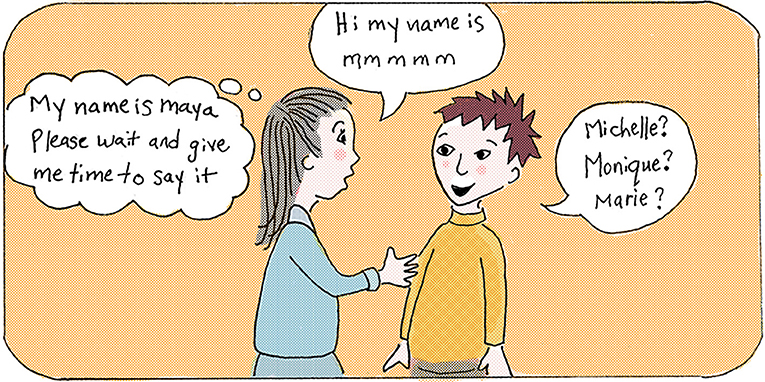
stuttering
noun
Talk with continued involuntary repetition of sounds, especially initial consonants.
Example: My cousin has stuttering, and he always focuses on the letter M, he can pronounce it four times before saying a complete word.








/paranoia-by-getty-images-56cb36495f9b5879cc540a97.JPG)
/cdn.vox-cdn.com/uploads/chorus_asset/file/8803615/500PX_500PX.jpg)


:max_bytes(150000):strip_icc()/what-are-the-symptoms-of-schizophrenia-2953120-cba74c5e1dd942ecafde1824217603f9.png)