15 Therms of pure and applied natural sciences. terms
I have been in the Natural Science program for two years now. This glossary will be useful for future students who want to use scientific terms during their chemistry or biology experiments. The definitions of the following 15 words have been gathered from various internet sources. Using these terms could help you sound more credible during explanations or presentations. I would encourage those who read this glossary to put these scientific terms into practice whenever possible.
atom
noun
The basic unit of a chemical element.
Example: These hydrogen bonds are able to form due to a variation in the electronegativity of atoms, which is an ATOM's ability to attract electrons.
en: atome
bacterium
noun
A member of a large group of unicellular microorganisms which have cell walls but lack organelles and an organized nucleus, including some that can cause disease.
Example: There are still large areas of the BACTERIUM's biology we don't understand, such as it method of transmission, but modern advances in biology are greatly helping researched to take great leaps forward in solving some Helicobacter pylori mysteries.
en: bactérie
beaker
noun
A lipped cylindrical glass container for laboratory use.
Example: To this was added 1:1 Methanol : HPLC grade water from a 300mL BEAKER, the stock solution was filled to just below the volumetric mark.
en: bécher
buret
noun
A graduated glass tube with a tap at one end, for delivering known volumes of a liquid, especially in titrations.
Example: Error Calculation: The error of a measurement is measured by the difference between the actual value of a physical quantity and the measured value of the quantity.: Balance (analytical) 150g + -0.001g BURET 50mL +.
en: burette
burning
noun
Very hot or bright.
Example: The Carbon Cycle, Climate, and the Long-Term Effects of Fossil Fuel BURNING.
en: combustion
cell
noun
In biology, the smallest unit that can live on its own and that makes up all living organisms and the tissues of the body.
Example: The size of the prokaryotic CELL, being on average 10 microns in diameter with over 1000 times greater the volume.
en: cellule
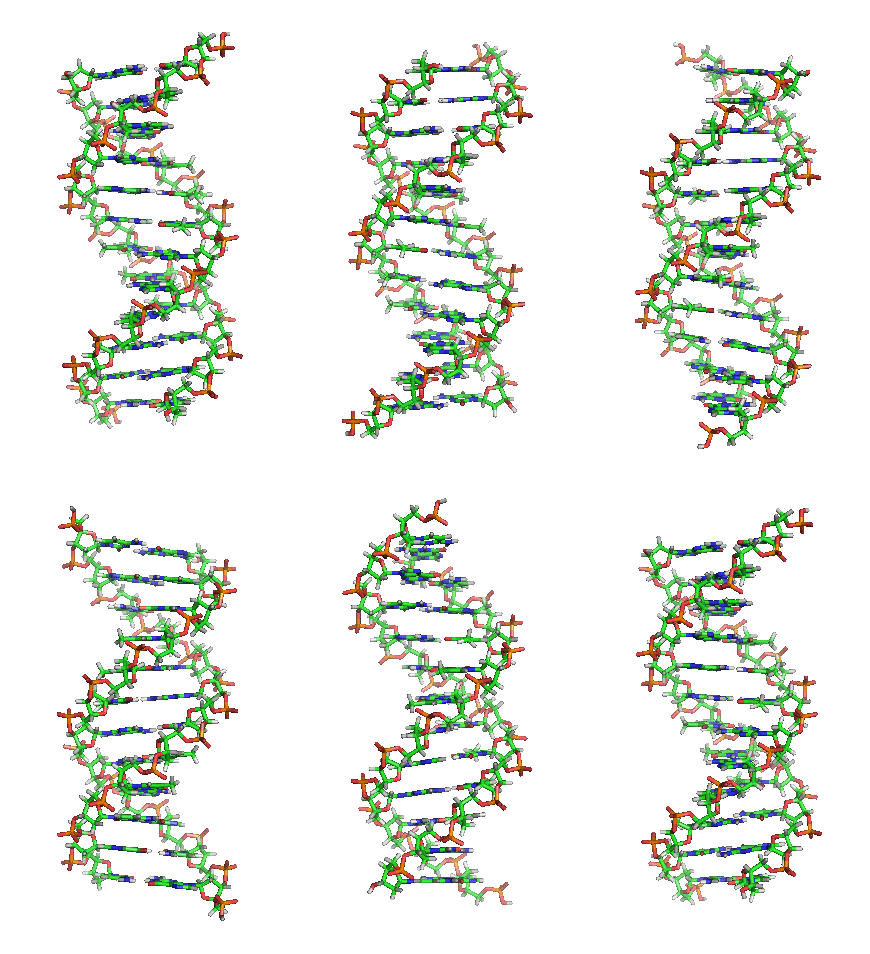
dna
noun
A self-replicating material that is present in nearly all living organisms as the main constituent of chromosomes. It is the carrier of genetic information.
Example: Evidence for the theory is relatively strong, particularly the finding that mitochondria and chloroplasts have circular DNA similar in form to that of bacterial DNA.
en: adn
evolution
noun
He process by which different kinds of living organisms are thought to have developed and diversified from earlier forms during the history of the earth.
Example: Foley, Robert. (2001) 'The Evolutionary Consequences of Increased Carnivory in Hominids' in Stanford, C & Bunn, H.T (eds.) 'Meat Eating & Human EVOLUTION.
en: évolution
metalloid
noun
An element (e.g. arsenic, antimony, or tin) whose properties are intermediate between those of metals and solid nonmetals or semiconductors.
Example: 3 Studies of metal-METALLOID glasses have shown that METALLOID-METALLOID nearest neighbours do not occur, as would be expected in a dense random packing structure.5 This is the same feature that occurred in the Hannon experiment, with no contact between transition metal atoms.
en: métalloïde
microscope
noun
Optical instrument that allows objects invisible to the naked eye to be seen by magnification using a system of lenses.
Example: Viruses are even smaller which can only be seen under electron MICROSCOPE with higher magnification (10,000 × or higher).
en: microscope
mole
noun
A mole is defined as 6.02214076 × 10²³ of some chemical unit, be it atoms, molecules, ions, or others.
Example: In this experiment, 1 MOLE of acid reacts with 1 MOLE of base.
en: mole
molecule
noun
Group of atoms bonded together, representing the smallest fundamental unit of a chemical compound that can take part in a chemical reaction.
Example: An important feature of the MOLECULE's structure are the numerous disulphide bonds which do not only connect the Fab and Fc fragments, but also the heavy and light chains.
en: molécule
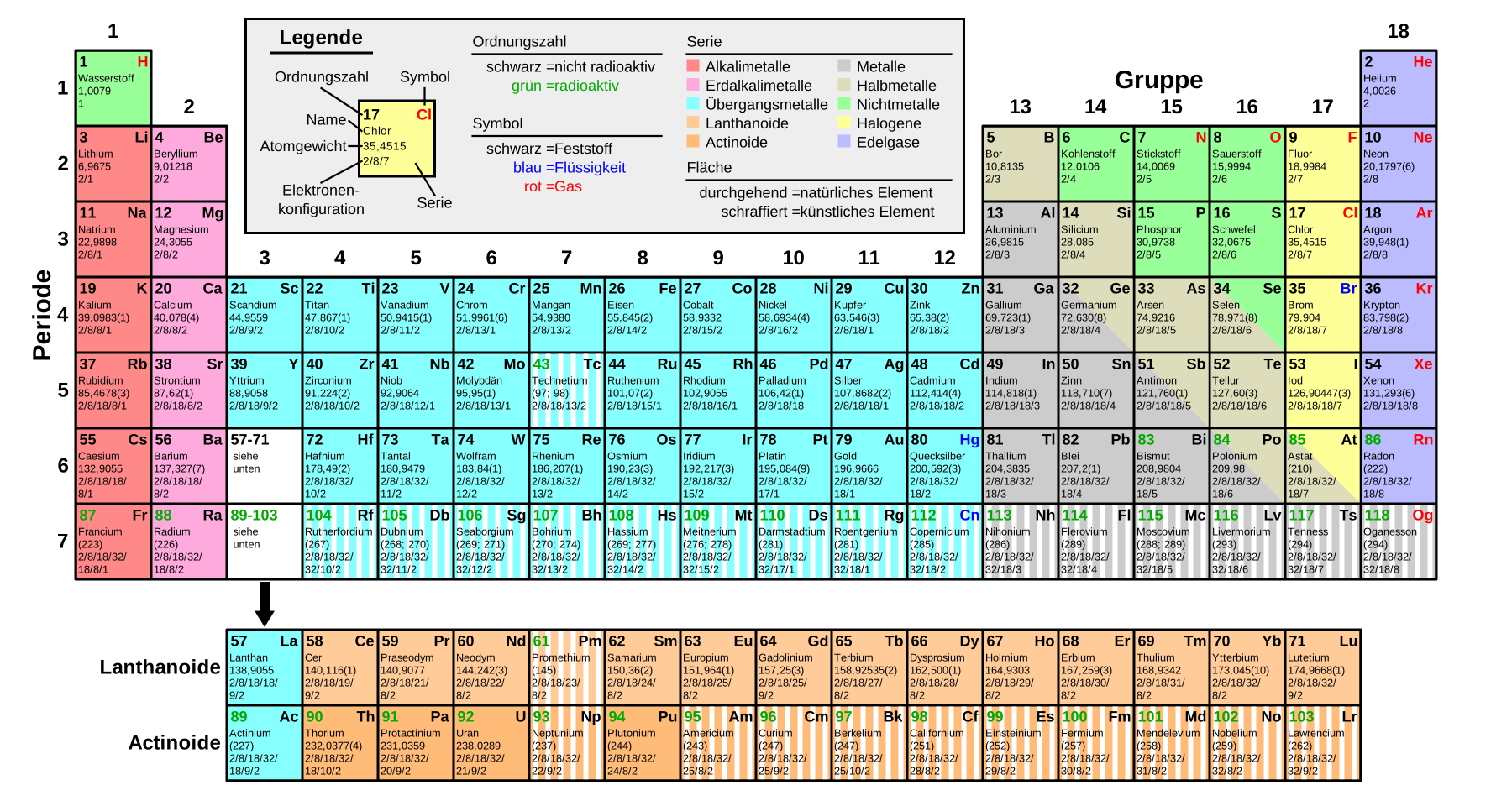
periodic table
noun
A table of the chemical elements arranged in order of atomic number, usually in rows, so that elements with similar atomic structure (and hence similar chemical properties) appear in vertical columns.
en: tableau périodique
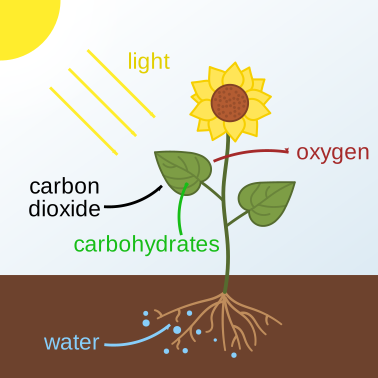
photosynthesis
noun
He process by which green plants and some other organisms use sunlight to synthesize foods from carbon dioxide and water.
Example: They are found primarily in hot, dry environments and predominate in tropical grasslands covering 15% of the earth's vegetated surface, and, despite the small number of species are responsible for about 18% of the global terrestrial PHOTOSYNTHESIS (1).
en: photosynthèse
proteine
noun
Large complex molecule of amino acids, essential constituent of organic matter and living beings.
Example: Protein is found mainly in the following foods: Dairy products, such as cheese, milk and yogurt.