My name is Maria Wendoline Tepoz Huelitl and I study at Ahuntsic College. I’m planing to study radiology next semester. This glossary helps you understand the different words that we use in this program. It includes 22 words the radiologist mostly used with clear definitions, images, and pronunciation. I took the time to search in various websites like Google, Wikipedia, and medical websites. Just click on the sound symbol if you are not sure of the pronunciation.
ablation
noun
The use of heat, cold or chemicals to destroy tissues, tumors or blood vessels.
Example: Many surgeons, who require precision in their tissue ablation, prefer the pulsed mode of operation.
en: ablation
abscess
noun
A swollen area within body tissue, containing an accumulation of pus.
Example: Once the abscesses burst, they usually discharge for several days before gradually healing up".
en: abcès
adrenal glands
noun
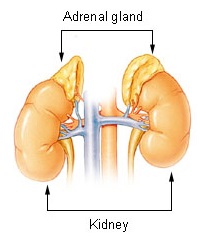
Adrenal glands, also known as suprarenal glands, are small, triangular-shaped glands located on top of both kidneys.
Example: Cancers of the adrenal gland occur in infancy and adult life, but about a quarter are found in children under five years old.
en: glandes surrénales
amniotic sac
noun
The fluid-filled sac that contains and protects a fetus in the womb.
Example: The doctor can then open the amniotic sac and remove the baby.
en: sac amniotique
analgesic
noun
Analgesics, also known as painkillers, are medications that treat pain.
Example: The hospital advised an analgesic for chest and shoulder pains.
en: analgésique
angiography
noun
Angiography is a type of X-ray used to check blood vessels.
Example: She will most likely need an angiogram
en: angiographie
ascites
noun
Ascites is a condition where excess fluid builds up in the abdomen, specifically between the abdominal lining and the organs it covers.
Example: Signs and symptoms are primarily those of liver cirrhosis and ascites.
en: ascite
attenuation
noun
The reduction in intensity of an X-ray beam as it passes through different tissues in the body.
Example: The ability to block x-rays is also referred to as attenuation, where high attenuation structures appear brighter and low attenuation structures appear darker.
en: atténuation
barium
noun
A mixture of barium sulfate and water, opaque to X-rays, which is swallowed to permit radiological examination of the stomach or intestines.
Example: A brief, limited barium swallow examination can confirm if the pouch is small or enlarged.
en: baryum
catheter
noun
A flexible tube inserted through a narrow opening into a body cavity, particularly the bladder, for removing fluid.
Example: The nurse inserted a catheter into his bladder.
en: cathéter
computed tomography (CT scan, CAT scan)
noun
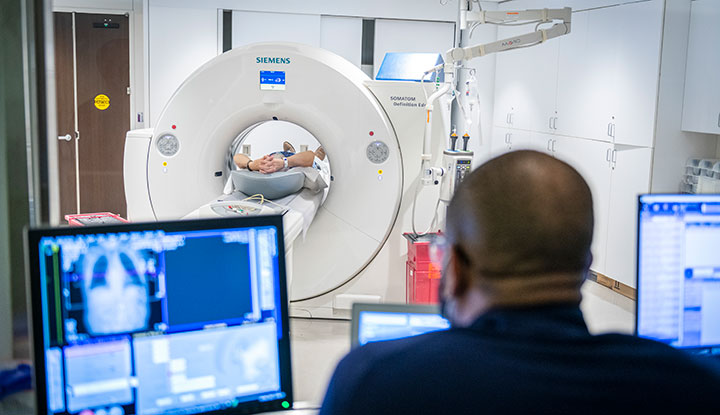
A computed tomography scan, formerly called computed axial tomography scan, is a medical imaging technique used to obtain detailed internal images of the body.
Example: Physicians often use CT as a first step in working out a diagnosis.
en: tomodensitométrie
dosimetrists
noun
A medical professional who is certified to develop radiotherapy treatment plans and to calculate and deliver doses of radiation to cancer patients.
Example: Makelle Barski is a 29-year-old dosimetrist from Trenton.
en: dosimétristes
dysphagia
noun
Dysphagia is the medical term for swallowing difficulties.
Example: Classically, the symptom appears insidiously as dysphagia and progresses slowly to become painful.
en: dysphagie
edema
noun
Edema, also known as fluid retention, is swelling caused by excess fluid buildup in the body's tissues.
Example: The bandages substitute for the elasticity lost by tissues engorged with edema.
en: œdème
embolism
noun
Obstruction of an artery, typically by a clot of blood or an air bubble.
Example: One patient died of a pulmonary embolism.
en: embolie
embolization
noun
A method used to deliver various materials into a blood vessel or structure to block flow. These materials may include gelfoam slurries, metallic coils, beads or glue.
Example: Their study demonstrated clearly the hazard of rapid cooling and extensive gaseous embolization of the cerebral circulation.
en: embolisation
fluoroscopy
noun
Fluoroscopy utilizes a continuous beam of x-ray radiation to generate a moving picture image which is viewed on a computer monitor. Fluoroscopy can assist in evaluating issues with moving joints, gastrointestinal issues, lung or diaphragm abnormalities or swallowing issues. Fluoroscopy is also used during the placement of needles to make sure that needles are located in the appropriate anatomical position.
Example: Boone said that an initial fluoroscope, a low-grade X-ray, came back clean.
en: fluoroscopie
magnetic resonance imaging (MRI)
noun
An advanced medical imaging technique using magnetic fields to provide detailed images of the inside of the body. Intravenous (IV) contrast agents may be used to view organs and tissues better.
Example: The researchers used MRI to record the brain activity.
en: imagerie par résonance magnétique (IRM)
mammography
noun
A technique using X-rays to diagnose and locate tumors of the breasts.
Example: The cancer is too small to be detected by mammography.
en: mammographie
stent
noun
An expandable metal or plastic tube used to hold open a blood vessel or structure from the inside.
Example: Alternative options, such as implantation of stents, need to be evaluated.
en: stent
ultrasound
noun
An ultrasound scan, especially one of a pregnant woman to examine the fetus.
Example: I went in for a routine ultrasound.
en: ultrason
x-ray
noun
A photographic or digital image of the internal composition of something, especially a part of the body, produced by X-rays being passed through it and being absorbed to different degrees by different materials.
Example: The fracture was clearly visible on the X-ray.