Hi, everyone my name is Kadiatou Doumbia. I'm in my second year as a student in the accounting and management field at Ahuntsic. I created this glossary for all the people who's interested to accounting or are beginners in it. It contains 20 useful basic words who could help you to understand more your accounting classes or accounting in general.
accounting
noun
The action or process of keeping financial accounts.
Example: Many organizational members sought to use accounting.
en: comptabilité
accounting period
noun
An accounting period is an established range of time during which accounting functions are performed, aggregated, and analyzed.
Example: The value calculated gives the number of times stock is turned over in that accounting period.
en: période comptable
accounts receivable
acquisition cost
noun
Acquisition cost refers to an amount paid for fixed assets, for expenses related to the acquisition of a new customer, or for the takeover of a competitor.
Example: Between 30%-40% were resold at prices below the acquisition cost.
en: coût d'acquisition
amortization
noun
The action or process of gradually reduce the initial cost of an asset or a loan.
Example: In 2003, the value of fixed asset after depreciation and amortization increased to £1,498 million, compared with £1,491 million in 2002.
en: amortissement
assets
noun
Property owned by a person or company, regarded as having value and available to meet debts, commitments, or legacies.
Example: In recent years, corporate brands have become enormously valuable assets.
en: actifs
balance sheet
noun
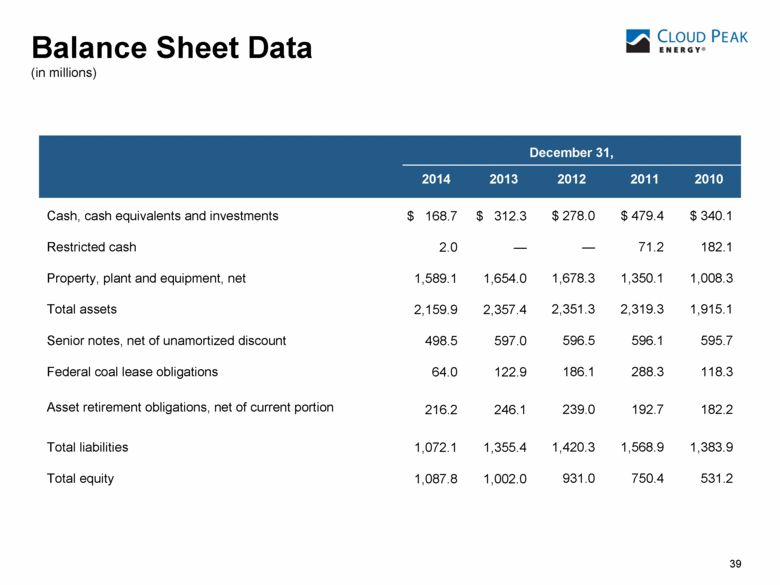
A statement of the assets, liabilities, and capital of a business or other organization at a particular point in time, detailing the balance of income and expenditure over the preceding period.
Example: The balance sheet depicts the financial situation of a business at a particular point in time.
en: bilan
budget
noun
An estimate of income and expenditure for a set period of time.
Example: The budget must conform with organizational objectives for the farm to achieve its mission statement.
en: budget
capital
noun
Wealth in the form of money or other assets owned by a person or organization or available or contributed for a particular purpose such as starting a company or investing.
Example: Rates of return on invested capital were high.
en: capital
cash flow
noun
The total amount of money being transferred into and out of a business, especially as affecting liquidity.
Example: This financial plan will ensure the financial evaluation of operation plans to achieve predefined profitability and cash flow.
en: flux de trésorerie
credit
noun
The ability of a customer to obtain goods or services before payment, based on the trust that payment will be made in the future.
debts
noun
Something, typically money, that is owed or due.
Example: Also, at this time, poverty and even starvation were not uncommon and were arguably enhanced by government policies which built up huge foreign debts.
en: dettes
general ledger
noun
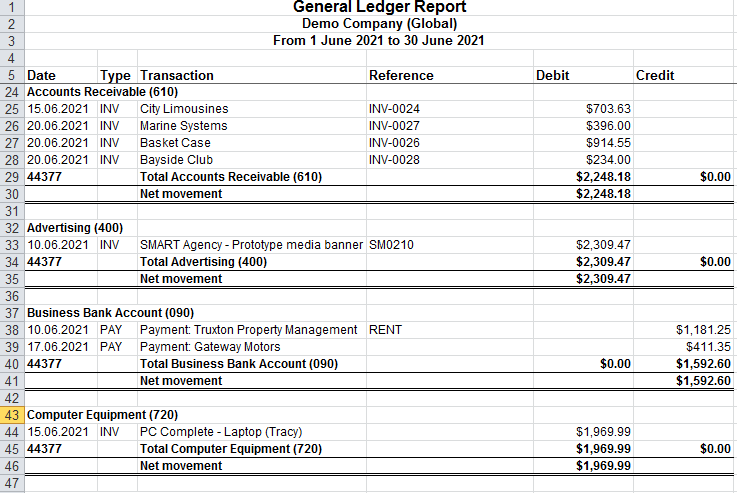
A book or digital record that contains all the financial transactions of a company.
Example: She was responsible for operating expenses and had access to the company's general ledger.
en: grand livre comptable
income statement
noun
Shows a company's revenues, expenses and profitability over a period of time.
Example: These instruments will be recognized in the income statement.
en: état des résultats
interest
noun
Money paid regularly at a particular rate for the use of money lent, or for delaying the repayment of a debt.
Example: Small holders obtained interest-free credit.
en: intérêts
liabilities
noun
A thing for which someone is responsible, especially a debt or financial obligation.
Example: The minimum scale for this ratio is an equal value of both liquid assets and current liabilities.
en: passif
liquidity
noun
The availability of liquid assets to a market or company.
Example: Talk to the corporate finance staff about the state of the company's liquidity.
en: liquidité
loan
noun
A thing that is borrowed, especially a sum of money that is expected to be paid back with interest.
Example: Taking risks should not be always avoided and a well-thought through marketing plan can easily justify a loan.
en: prêt
shareholder
noun
An owner of shares in a company.
Example: The ROI and return on shareholders' fund ratios are used to identify shareholder' benefit.
en: actionnaire
t-account
noun
The graphical representation of a general ledger that records a business' transactions.
Example: Debit mean the record goes on the left side of the t-account and credit means you should use the right side.

:max_bytes(150000):strip_icc()/T-Account_2-cf96e42686cc4a028f0e586995b45431.png)