This glossary are for people in natural sciences when studying in chemistry.
Acid
noun
A chemical substance that neutralizes alkalis, dissolves some metals, and turns litmus red; typically, a corrosive or sour-tasting liquid of this kind.
Example: Protons released by the ACID react with the ionized form of the buffer, A-, neutralising them whilst OH- ions react with the undissociated buffer, HA.
fr: acide
atom
noun
The basic unit of a chemical element.
Example: An ATOM is defined as 'the smallest unit of a chemical element that can exist'.
fr: atome
Avogadro's number
noun
The number of atoms or molecules in one mole of a substance, equal to 6.023 × 10²³.
Example: Introduction The Drude model predicts that in a metal we have: (1) Where N is the number of valence electrons per unit volume, Z is the number of valence electrons per atom, is the N A AVOGADRO number i.e. the number of atoms per mol, Ïm the mass density of the metal and m e the atomic weight of metal.
fr: le numéro d'Avogadro
carbon
noun
A nonmetallic chemical element with atomic number 6 that readily forms compounds with many other elements and is a constituent of organic compounds in all known living tissues.
Example: They occur between a 'donor' group which can be Nitrogen, Oxygen, Sulphur or CARBON, and an 'acceptor' with a lone pair of electrons.
fr: carbone
cation
noun
A positively charged ion, i.e. one that would be attracted to the cathode in electrolysis.
Example: In the introduction to this article the authors describe previous methods to forming azabicyclic ring systems containing a nitrogen atom via CATION-induced inter- and intramolecular electrophilic cyclisation reaction.
fr: cation
Chemical reaction
noun
A process that involves rearrangement of the molecular or ionic structure of a substance, as opposed to a change in physical form or a nuclear reaction.
Example: The molecules of sexiphenyl move by tortional twisting of the rings in an action similar to a caterpillar, and when they reach the silver atom a CHEMICAL REACTION takes place combining the two.
fr: Réaction chimique
Dissociation
noun
He splitting of a molecule into smaller molecules, atoms, or ions, especially by a reversible process.
Example: One such mechanism is the photolytic DISSOCIATION of Nitrogen Dioxide which liberates the important excited state oxygen species, 3 P which plays in integral role in the atmospheric synthesis of Ozone.
fr: Dissociation
experiment
noun
A scientific procedure undertaken to make a discovery, test a hypothesis, or demonstrate a known fact.
Example: The chromatogram only displays the data from one EXPERIMENT; however this EXPERIMENT determines the likely mechanism of the polymerization and therefore is the most relevant in terms of importance to the paper.
fr: expérience
Graph
noun
a diagram showing the relation between variable quantities, typically of two variables, each measured along one of a pair of axes at right angles.
Example: Examining the GRAPH using the half life method, the time from t 0 to t 1 2 is 2750s, and the time taken from t 1 2 to t 3 4 is 3000s.
fr: Graphique
Lab coat
noun
A thin, loose, usually white, knee-length coat with deep pockets that is typically worn in a laboratory or medical office.
Example: Other: Glass vacuum apparatus (wear safety glasses) Appropriate lab wear must be worn including LAB COAT, gloves and goggles.
fr: Sarrau
Molecule
noun
A group of atoms bonded together, representing the smallest fundamental unit of a chemical compound that can take part in a chemical reaction.
Example: The total energy required to fix one CO 2 MOLECULE is 4ATP plus two NADPH (2).
fr: Molécule
Oxidation
noun
The process or result of oxidizing or being oxidized.
Example: The rapid deterioration of the complex due to OXIDATION is likely to be the greatest source of error in this experiment, although steps were taken to reduce this effect such as the addition of the benzyl alcohol and measuring the absorbance of the solutions as quickly as possible after making then up.
fr: Oxydation
oxygen
noun
A colorless, odorless reactive gas, the chemical element of atomic number 8 and the life-supporting component of the air.
Example: In aerobic hydrogen oxidising bacteria, hydrogen is oxidised by OXYGEN, a reaction catalysed by an enzyme called hydrogenase.
fr: oxygène
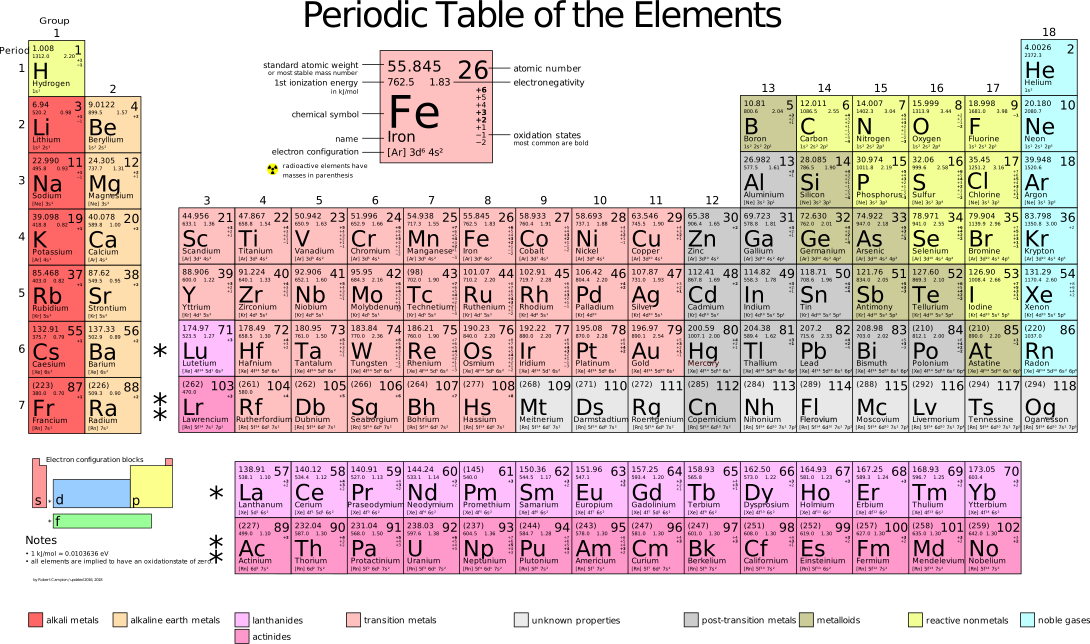
Periodic table
noun
A table of the chemical elements arranged in order of atomic number, usually in rows, so that elements with similar atomic structure (and hence similar chemical properties) appear in vertical columns.
Example: However, Bohr's theory categorized the elements into the PERIODIC TABLE and provided an explanation for these properties.
fr: Tableau périodique
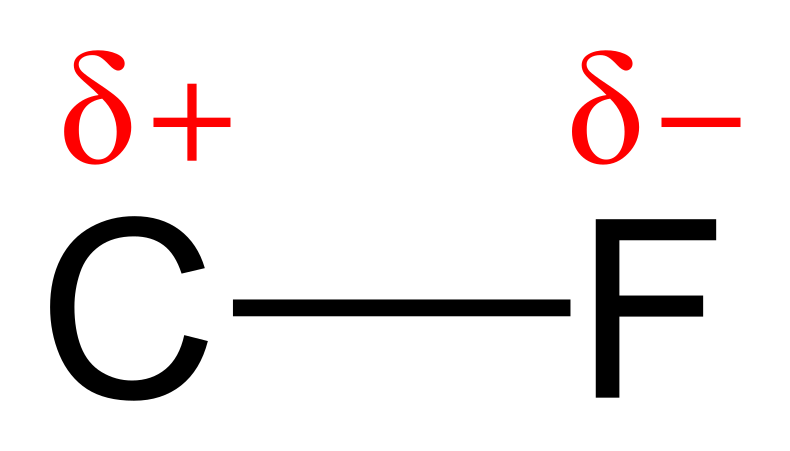
Polarity
noun
The relative orientation of poles; the direction of a magnetic or electric field.
Example: POLARITY of compounds : Polar compounds will travel more slowly especially if the column is also polar, this is due to increased interactions between the analyte and the stationary phase.
fr: Polarité
test tube
noun
A clear glass or plastic container that is much longer than it is wide, commonly has a U-shaped bottom, and has an open top.
Example: ALCOHOL STABILITY TEST: 5ml of UHT milk was mixed for 1 minute with 5ml ethanol in a TEST TUBE.