My name is Jaël Quicano-Molina and I've been studying in Health Sciences for 3 years at Ahuntsic College. I'm more interested in the biology side of sciences. This glossary could help other students who are either starting in biology or already have some experience in it. Each word in that glossary is related to biology and the vocabulary used in this field. This glossary will help to understand different words who can be really important for someone wanting to know more about biology.
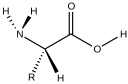
amino acid
noun
A simple organic compound containing both a carboxyl (—COOH) and an amino (—NH2) group.
Example: Point mutation is a change of a single base at one locus, changing the translation of a single codon, or AMINO ACID.
fr: acide aminé
anatomy
noun
The branch of science concerned with the bodily structure of humans, animals, and other living organisms, especially as revealed by dissection and the separation of parts.
Example: Archaeologists have gleaned vast amounts of data from studying their ANATOMY.
fr: anatomie
animals
noun
A living organism that feeds on organic matter, typically having specialized sense organs and nervous system and able to respond rapidly to stimuli.
Example: This is due to the ANIMALS' evolutionary ancestors consuming high quantities of amino acids, and because amino acids cannot be stored for long periods of time in the body, any excess are excreted by the small and large intestine.
fr: animaux
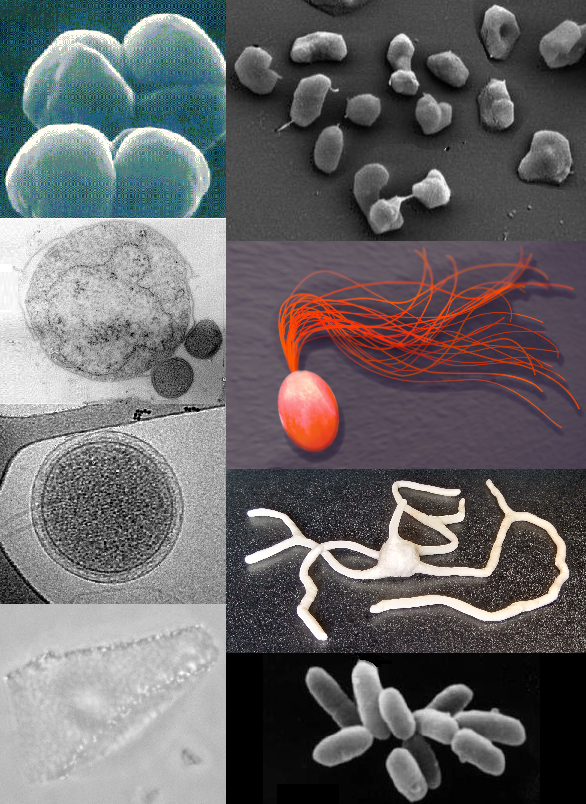
archaea
noun
Microorganisms that are similar to bacteria in size and simplicity of structure but radically different in molecular organization. They are now believed to constitute an ancient intermediate group between the bacteria and eukaryotes.
Example: A typical prokaryotic cell Picture from Prokaryotes are single celled organism like Bacteria and ARCHAEA, which are around one micrometer in length.
fr: archées
bacteria
noun
A member of a large group of unicellular microorganisms which have cell walls but lack organelles and an organized nucleus, including some that can cause disease.
Example: He wrote of eukaryotic symbiosis with BACTERIA, a process he called "the establishment of microsymbiotic complexes" or "symbonticism".
fr: bactéries
biodiversity
noun
The variety of life in the world or in a particular habitat or ecosystem.
Example: Impact lists include impacts on ecosystems, habitats, species and communities important to BIODIVERSITY.
fr: biodiversité
biology
noun
The study of living organisms, divided into many specialized fields that cover their morphology, physiology, anatomy, behavior, origin, and distribution.
Example: Before an adequate evaluation of the validity of this collection of evidence, and thus the accuracy of her theory of endosymbiosis can be established, one must first understand not only the suggestions and implications of the theory towards human cell BIOLOGY, but the original requirement for cells to evolve.
fr: biologie
carbon dioxide
noun
A colorless, odorless gas produced by burning carbon and organic compounds and by respiration. It is naturally present in air (about 0.03 percent) and is absorbed by plants in photosynthesis.
Example: It's responsible for roughly 25% of all CARBON DIOXIDE emissions entering the atmosphere, by the burning and clearing of approximately 34 million acres of trees per year.
fr: dioxyde de carbone
cell
noun
The smallest structural and functional unit of an organism, typically microscopic and consisting of cytoplasm and a nucleus enclosed in a membrane. Microscopic organisms typically consist of a single cell, which is either eukaryotic or prokaryotic.
Example: Once inside the CELL they entered into a mutualistic relationship where one CELL benefited from another.
fr: cellule
cytoplasm
noun
Cytoplasm is the gelatinous liquid that fills the inside of a cell. It is composed of water, salts, and various organic molecules.
Example: The smooth outer membrane is freely permeable to molecules so that ATP and glucose from photosynthesis can easily diffuse out into the CYTOPLASM.
fr: cytoplasme
cytoskeleton
noun
A microscopic network of protein filaments and tubules in the cytoplasm of many living cells, giving them shape and coherence.
Example: These processes are thought to localise the PAR proteins (see fig. 2) to specific areas of the zygote, which is important for establishing and maintaining the anteroposterior axis, but it is not known how PAR proteins interact with the actin CYTOSKELETON or the myosin.
fr: cytosquelette
ecosystem
noun
An ecosystem (or ecological system) is a system that environments and their organisms form through their interaction.
Example: These two methods are specific to pests of crops and if used in an open ECOSYSTEM, it is possible that they could cause an in balance to non-target species.
fr: écosystème
evolution
noun
The process by which different kinds of living organisms are thought to have developed and diversified from earlier forms during the history of the earth.
Example: Even then this does not constitute a close relationship as previously mentioned, they appear to have diverged from this ancestor at a far earlier point in prehistory than modern humans, and thus it is logical to conclude that Neanderthals may be seen as an extinct side branch on the path of human EVOLUTION.
fr: the process by which different kinds of living organisms are thought to have developed and diversified from earlier forms during the history of the earth
extracellular
adjective
Situated or occurring outside a cell or the cells of the body.
Example: Antibodies provide the major defense against pathogens, toxins and EXTRACELLULAR bacteria.
fr: extracellulaire
hydrophobic
adjective
Tending to repel or fail to mix with water.
Example: The domain is completely shielded from the external environment and is highly HYDROPHOBIC, it is mainly defined by 22 amino acid residues.
fr: hydrophobe
lipid
noun
Any of a class of organic compounds that are fatty acids or their derivatives and are insoluble in water but soluble in organic solvents. They include many natural oils, waxes, and steroids.
Example: The discrepancies are especially evident in the sausage values for lipids and carbohydrate; the LIPID, water and carbohydrate values for minced beef; and the LIPID, water, mineral and carbohydrate values of unsmoked bacon.
fr: lipide
membrane
noun
A thin sheet of tissue or layer of cells acting as a boundary, lining, or partition in an organism.
Example: This transfer releases energy, allowing for the pumping of protons across the cell MEMBRANE, creating an electrochemical gradient.
fr: membrane
photosynthesis
noun
The process by which green plants and some other organisms use sunlight to synthesize foods from carbon dioxide and water.
Example: For PHOTOSYNTHESIS to occur, there needs to be a supply of carbon dioxide, water, and light energy.
fr: photosynthèse
plants
noun
A living organism of the kind exemplified by trees, shrubs, herbs, grasses, ferns, and mosses, typically growing in a permanent site, absorbing water and inorganic substances through its roots, and synthesizing nutrients in its leaves by photosynthesis using the green pigment chlorophyll.
Example: Tundra vegetation began to grow which included heather PLANTS.
fr: plantes
protein
noun
Proteins are large biomolecules and macromolecules that comprise one or more long chains of amino acid residues.
Example: Carnivores demand a high intake of PROTEIN requirement in comparison to herbivorous and omnivorous animals, with essential amino acid deficiencies more common in carnivores.