Most importantly, in an ever-changing business universe, chasing down the language of sales and marketing is the golden key to any triumph. This glossary is meant to guide you through industry terms and concepts whether you are an expert, a business owner, or literally just starting on this field.
ABC
Always Be Closing. It’s a motivational phrase that emphasizes the importance of consistently working toward closing a deal, no matter what stage of the sales process you're in.
AIDA
AIDA is a classic marketing and sales model that describes the stages a customer goes through during the buying process. It stands for:
Attention: Grabbing the potential customer’s attention through advertising, outreach, or other marketing efforts.
Interest: Sparking interest in the product or service by showing its relevance or benefits to the customer.
Desire: Building a desire or emotional connection, convincing the customer that they need the product or service.
Action: Encouraging the customer to take a specific action, usually making a purchase or committing to a next step like signing up or requesting a demo.
B2B
Business 2 Business. B2B is a term that describes the transactional relationship between provider and client where the provider is a business and the client is another business. "Our B2B marketing strategy targets organizations in the manufacturing niche."
B2C
Business 2 Consumer. B2C is a term describes the transactional relationship between provider and client where the provider is a business and the client is an individual consumer. "Our B2C marketing strategy targets new moms."
Bad Leads
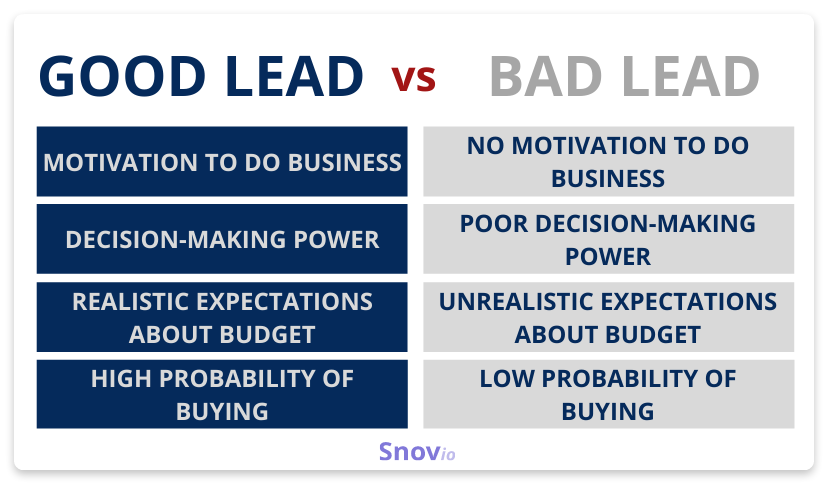
Leads that are unlikely to become paying customers -- and a sales rep's worst nightmare, because they are a waste of time. A tough challenge for most marketers is how you separate good, high-quality leads from the people who are just poking around your site.
BANT
An acronym used in sales for lead qualification that stands for Budget, Authority, Need, Timeline. It's a famous tool for sales reps and sales leaders to help them determine whether their prospects have the budget, authority, need, and right timeline to buy what they sell.
Benefit
In sales and marketing, a benefit refers to the positive outcome or advantage that a customer will experience by using a product or service. Benefits go beyond the features of a product, which describe what it does, and instead focus on how those features improve the customer’s life, solve a problem, or fulfill a need.
Closing Ratio
The Closing Ratio (also known as the close rate or conversion rate) in sales refers to the percentage of leads or prospects that successfully result in a sale. It measures how effective a salesperson or team is at turning potential customers into actual buyers.
Cold Calling
Making unsolicited calls in an attempt to sell products or services. It's also a very inefficient way to find potential customers.
Decision-Maker
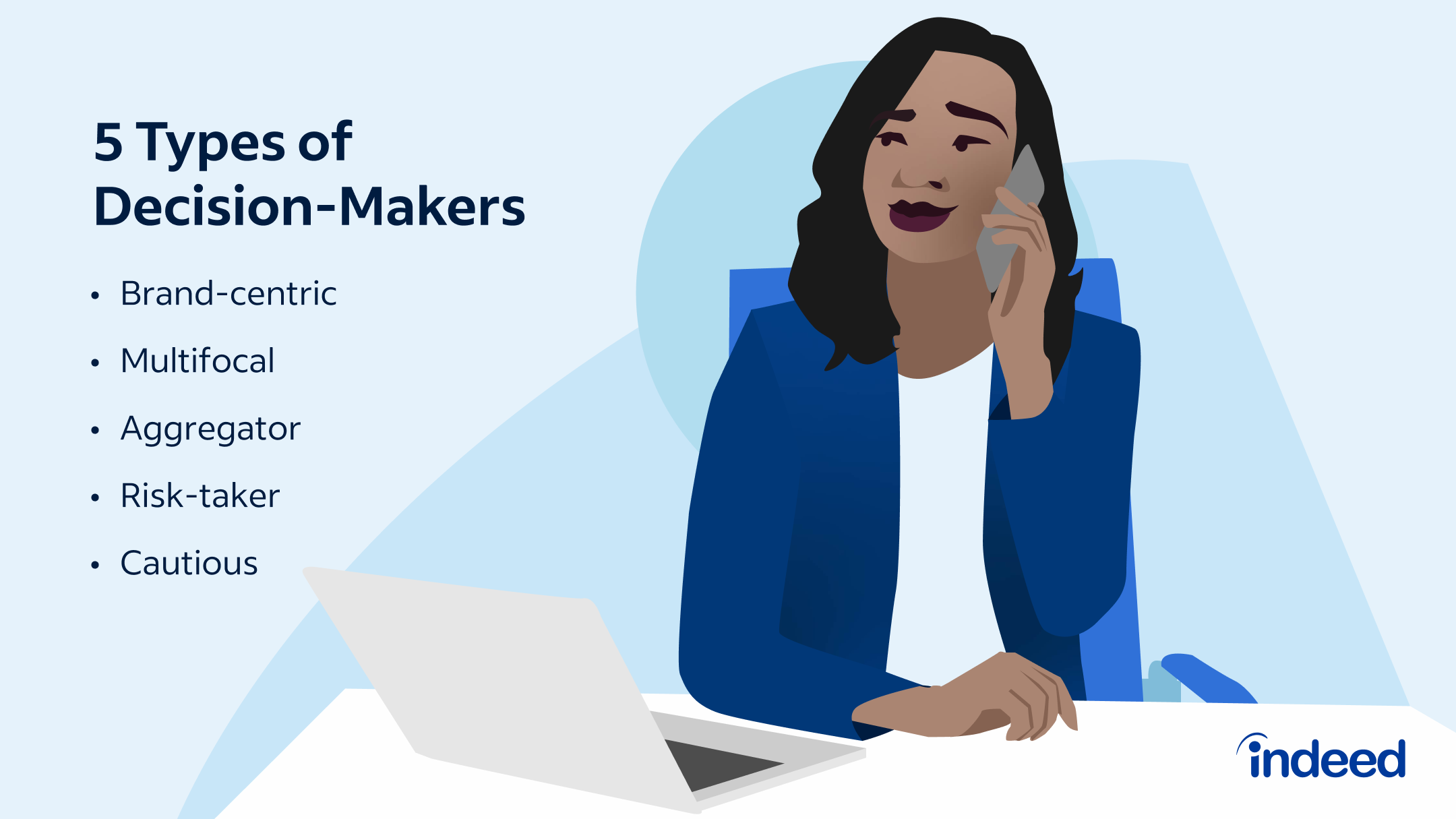
The person who, or role that, makes the final decision of a sale. They are often "guarded" by a gatekeeper.
Digital Marketing
Any marketing that uses electronic devices to convey promotional messaging and measure its impact. In practice, digital marketing typically refers to marketing campaigns that appear on a computer, phone, tablet, or other device. It can take many forms, including online video, display ads, and social media posts. Digital marketing is often compared to “traditional marketing” such as magazine ads, billboards, and direct mail. Oddly, television is usually lumped in with traditional marketing.
Distribution Channel
The path a product or service takes as it travels from where it is created to the person who will use it. In marketing, distribution channels are typically broken into business-to-business (B2B) and business-to-consumer (B2C). B2B deals with the interactions between companies to create products, while B2C focuses on how products get to the people who actually use them. For example, a business may sell directly to a customer, or it may sell to a retailer who in turn sells to the end user.
E-commerce
E-commerce is the buying and selling of goods and services using the internet. It starts when a potential customer learns about a product. It continues through purchase, use, and, ideally, ongoing customer loyalty. Data powers the most successful e-commerce operations, which take advantage of best practices such as targeted email marketing, audience segmentation, and marketing automation.
Email Marketing
The use of email to promote a business’s products and services. Email marketing can make the customers on your email list aware of new products, discounts, and other services. It can also be a softer sell to educate your audience on the value of your brand or keep them engaged between purchases. It can also be anything in between. Mailchimp can help you design, build, and optimize your email marketing to get the best ROI.
FCC
The Federal Communications Commission (FCC) is a United States government agency that regulates communication devices and systems, which includes the internet. They ensure all citizens have fair access to these communication platforms and that they’re safely performing in the interest of the public and national security. In most cases, the FCC is the agency responsible for crafting consumer protection rules such as privacy protections, while the Federal Trade Commission (FTC) enforces these rules.
Go-to-Market Strategy
A plan that helps you launch your new business, product, service, or brand to your customers. It usually includes target audience research, the key differentiators in your market, and a planned approach for marketing and distribution.
Hard Bounce
An email that is rejected by an email server for a permanent reason. An email may hard bounce if a recipient email address or domain name doesn't exist—or the recipient email server has completely blocked the delivery. There are, however, occasionally times when a valid email address will hard bounce.
Hreflang Tags
An HTML tag that helps search engines find and display content in a specific language when a website uses multiple languages. For example, Hreflang tags can help people in the United States find a page in English while a similar search performed in Mexico would return a page in Spanish. Hreflang pages also solve the problem of duplicate content penalties. Hreflang tags help search engines understand when content is customized to specific audiences rather than being duplicated as a search engine optimization (SEO) trick.
Iframe
An iframe is a section of a web page that contains content that comes from another page. It’s a page within a page. Iframes are typically used to pull in content from third parties. For example, you can set up iframes on your website to display banner ads from Google Ads or another ad network. Iframes are different from framesets (also called just “frames”), which were used in the early days of the internet to make page layouts easier and navigation consistent.
Inbound Marketing
A marketing strategy that encourages people to actively seek out and engage with your brand. Social media, content marketing (such as sponsored content and blogs), and search engine optimization (SEO) are common tactics. Inbound marketing offers consumers something they want—information, entertainment, a chance to be heard—and places information about a product and service within this context. Inbound marketing attracts prospects and encourages them to engage with your brand in the hopes of converting them to paid customers.

:max_bytes(150000):strip_icc()/Term-Definitions_Digital-Marketing-5ae6ea1aee934b02a94a1a4d9401443d.jpg)

