Natural Science Glossary
Natural Science Glossary
19 Natural Science terms
My name is Malak, and I am a student in Natural Science at Ahuntsic College and I have been in this program for a year now. This glossary is made to people like me who struggle with sciences' courses. It has .. terms with the definition, the translation and examples. For you to success this course you need to understand firstly the term. Personally it helped me so much.
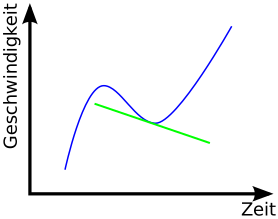
- acceleration
- The change in velocity of an object per unit of time.
- fr: accélération
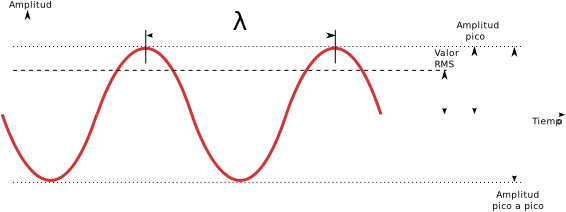
- amplitude
- The maximum value of an oscillation or wave relative to its equilibrium position.
- fr: amplitude
- anion
- An anion is an ion with a negative charge. It creates when an atom gains one or multiples electrons.
- Example: Cl (chloride) is an anion because he gains an electron and OH (hydroxide) too
- fr: anion

- balanced equation
- When the reaction is made at exactly the same speed as the reaction in reverse, it seems like nothing happened.
- fr: équation à l'équilibre
- catalysis
- When you add a catalysis the reaction speed increases.
- fr: catalyse
- cation
- A cation is the opposite of an anion, a cation is an ion with a positive charge because he gives away his electrons when an atom or a molecule is formed
- Example: Na is a cation because when it is formed it loses an electron.
- fr: cation
- concentration
- Concentration refers to the quantity of a solute present in a quantity of solvent or solution. There are different forms of concentration ; mass concentration (g/L), molarity (mol/L) and more.
- Example: If you have 50g of a solute and 500mL of a solvent, the concentration is 100g/L.
- fr: concentration
- derivative
- It is the slope of the function's graph at a specific point. It measures how fast the function's value changes as its input changes.
- fr: dérivé
- Dissolution
- Dissolution is the processes of a solute which is in most cases a solid dissolves in a solvent (liquid) to form a homogeneous solution. Most of the time the solvent is water.
- Example: Salt (NaCl) which is the solute and water which is the solvent mixed together gives a homogeneous solution
- fr: Dissolution
- Electronegativity
- The electronegativity is the measure of the tendency of an atom to attract a bonding pairs of electrons when forming a chemical bond with another atom.
- Example: Fluorine (F) have the highest electronegativity.
- fr: Électronégativité
- force
- Any interaction that, when applied to an object, changes its state of motion. It is measured in newtons (N).
- fr: force
- gravitation
- The attractive force that exists between all masses in the universe. Newton's law of universal gravitation describes it.
- fr: gravité
.png)
- inertia
- The tendency of an object to resist any change in its state of motion.
- fr: inertie
- kinetics
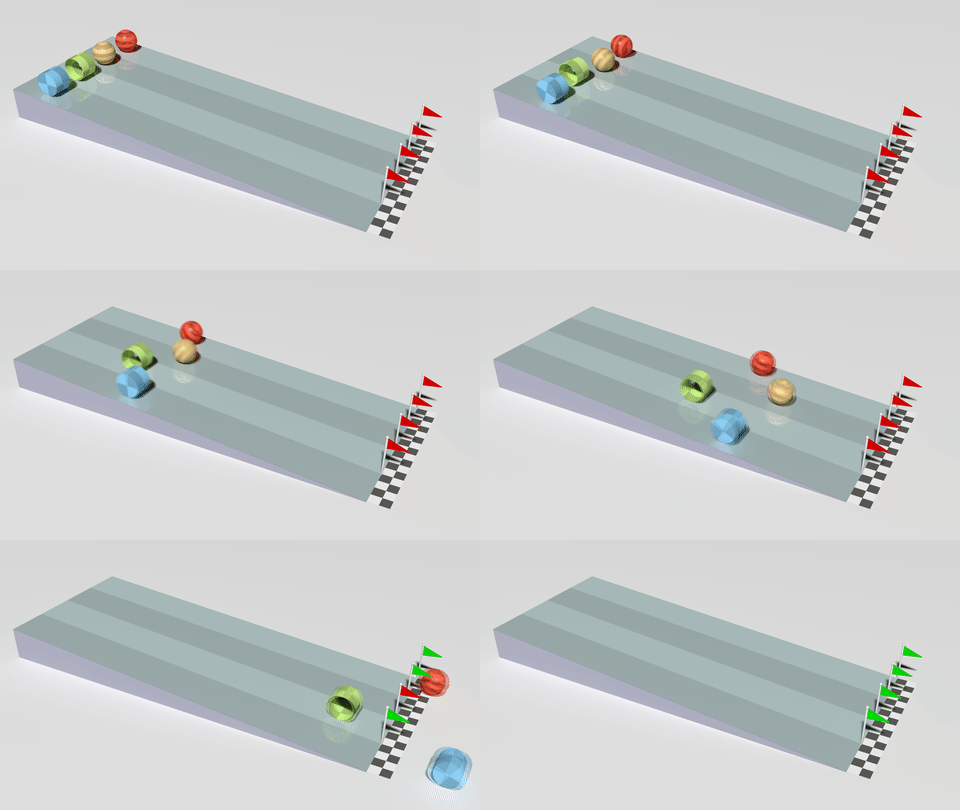
- Kinetics is the speed of chemical reactions, and it is the variation in the quantity of reactants or products as a function of time.
- fr: cinétique
- osmosis
- Osmosis is a processus that helps to equalize the concentrations of solute on both sides of a membrane. It is a movement of solvent molecules across a semipermeable membrane from a part with a low concentration of solute to a region with a higher concentration until equilibrium is reached.
- Example: Red blood cells are a case of osmosis.
- fr: osmose

- pressure
- Pressure is defined as the amount of force applied per unit area. There are multiple units of pressure like Pacals (Pa) and atmospheres (atm).
- Example: Pressure in earth is 101,3kPa.
- fr: pression
- solubility
- Solubility is the maximum quantity of solute that can dissolve in a solvent.
- Example: Salt (NaCl) is extremely soluble in water.
- fr: solubilité
- stoichiometry
- Stoichiometry is a way to calculate the amount of reactants and products when you have a balanced equation.
- fr: Stochiométrie
- titration
- A titration is a method to use in a laboratory to determine the concentration of a substance. There are different types of titration like acid-base titration it is when you neutralize an acid with a base or vise-versa to determine the concentration.
- Example: Using NaOH which is a base to neutralize an acid like HCl to determine the concentration of the acid is a titration.
- fr: titrage