the soul, especially the irrational part of the soul as distinguished from the rational mind
Example: persona and ANIMA switch roles and merge in slow, smooth ways
fr: anima
aphasia
noun
a language disorder caused by damage in a specific area of the brain that controls language expression and comprehension
Example: Non-verbal linguistic features, such as visual information from facial expression and gesture, have been suggested to be typically right hemisphere functions, as are features of prosody, seen to be so important in Broca's APHASIA; and aspects of comprehension relating to jokes and metaphors
fr: aphasie
bereavement
noun
the state or fact of being bereaved or deprived of something or someone
Example: Rosa did not have anyone within her family to rely on which means she was not able to prepare for BEREAVEMENT. Shultz (1997) suggest that when the individual is supported to care for someone who is chronically ill they do not experience such a strong sense of loss or BEREAVEMENT
fr: deuil
bias
noun
feeling prejudice for or against something
Example: there was evidence of bias against foreign applicants
fr: biais
brainstem
noun
the structure that connects the cerebrum of the brain to the spinal cord and cerebellum
Example: At least four cortical structures, more than ten separate midbrain sites and parts of the BRAINSTEM and cerebellum have all been referred to as involved in the reward process in study or other
fr: tronc cérébral
catharsis
noun
relief that occurs unconscious thoughts become conscious
Example: It has CATHARSIS, anagorisis and evokes fear amongst the audience.
fr: catharsis
contempt
noun
the feeling that a person or a thing is beneath consideration, worthless, or deserving scorn
Example: he showed his contempt for his job by doing it very badly
fr: outrage
coping mechanism
noun
tool to manage and/or relieve stress or trauma
Example: There is thus a theoretical paradox in trying to decide on the direction of causality in this relationship; substance use may itself be construed as a COPING MECHANISM
fr: mécanisme d'adaptation
debriefing
noun
a meeting that takes place in order to get information about a particular piece of work that has been finished, for example about what was done successfully and what was not
Example: The whole experiment could be divided into three stages: initial briefing session, experiment, and DEBRIEFING.
fr: compte rendu
dementia
noun
a condition characterized by progressive or persistent loss of intellectual functioning, especially with impairment of memory and abstract thinking, and often with personality change, resulting from organic disease of the brain.
Example: Alzheimer's disease is the most common form of DEMENTIA, accounting for up to 60% of all cases
fr: démence
groupthink
noun
the practice of thinking or making decisions as a group in a way that discourages creativity or individual responsibility
Example: The administration reveals how processes in the GROUPTHINK phenomenon influence individuals to conform to group norms and achieve a united group performance
fr: pensée de groupe
heuristic
adjective
enabling someone to discover or learn something for themselves
Example: a ‘hands-on’ or interactive HEURISTIC approach to learning
fr: heuristic
insanity
noun
the state of being seriously mentally ill; madness
Example: Thus, her INSANITY lies more in a failure to construct her own sense of self.
fr: folie
lobotomy
noun
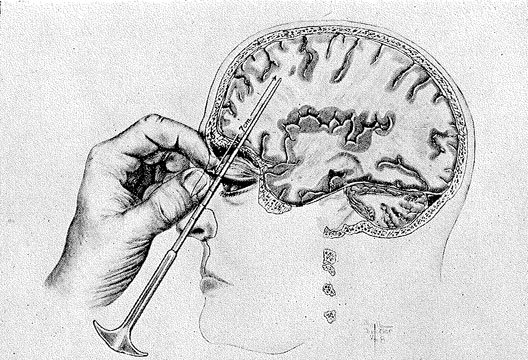
a surgical operation involving incision into the prefrontal lobe of the brain, formerly used to treat mental illness
Example: Although McMurphy is ostensibly defeated when Nurse Ratched orders him a LOBOTOMY, the release of his soul "through the chief's love" essentially symbolises the "triumph of the spirit over repression and death.
fr: lobotomie
mindfulness
noun
the quality or state of being conscious or aware of something
Example: their mindfulness of the wider cinematic tradition
fr: pleine conscience
persona
noun
the aspect of someone's character that is presented to or perceived by others
Example: her public PERSONA has been sold to millions of women as the ideal
fr: personnage
Personableness
noun
he state or quality of having a pleasant or agreeable manner in socializing with others never exactly known for his personableness, our boss unexpectedly showed his warm side at the company picnic
Example: he state or quality of having a pleasant or agreeable manner in socializing with others never exactly known for his PERSONABLENESS, our boss unexpectedly showed his warm side at the company picnic
fr: caractère raisonnable
reinforcer
noun
a consequence that increases the likelihood that a specific behavior or response will occur
Example: Facial expressions are a reliable way of judging the hedonic impact of a food REINFORCER on many animals, including newborn humans
fr: renforçateur
strain
noun
a psychological frustration or even suffering that one struggles to find a solution to reduce or eliminate
Example: Stress STRAIN - originally applied in static applications such as the stresses in supports
fr: souche
trance
noun
a half-conscious state characterized by an absence of response to external stimuli, typically as induced by hypnosis or entered by a medium
Example: The central point of almost all shamanistic religions is the spirit world, shamans try to enter and connect with this world by entering a TRANCE like state