Unusual animals
Unusual animals
21 List of truly unusual animals and their conservation status. terms
Today, due to global warming, many species are endangered. This is why this glossary can raise awareness while learning things about unusual, little-known species.
- Axolotls
- Noun
- Larval form of the amblystoma, with branchial respiration, capable of reproducing without having taken the adult form (phenomenon of neoteny).
Diet : Carnivorous. Conservation Statue: Critically Endangered
- Example: The axolotl sports a flat, rounded head, two small lidless eyes, and a large, wide mouth. On either side float three external gills that allow it to breathe
- fr: Axolotl

- Blobfish
- Noun
- The blobfish is found at depths where the pressure is nearly a hundred times that of the surface. To resist this, the flesh of the fish is mainly made up of a gelatinous mass3 whose density is lower than that of water, which allows it to float a little above the ocean floor without having to expend its precious energy. while swimming. Diet : Depositary. Conservation Status : Vulnerable
- Example: The most widespread photographs of the blobfish often represent the blobfish after having been brought to the surface: its body has been subjected to a strong decompression which has greatly modified its appearance . The blobfish indeed has a very different appearance in its natural environment.
- fr: Blobfish

- Box jellyfish
- Noun
- A jellyfish with a box-shaped swimming bell, living in warm seas. it is the most venomous animal species in the world. One individual contains enough poison to kill 60 adults
Diet : piscivorous
Conservation Status : Unknow
- Example: The greatest visual characteristic of box jellyfish is that their umbrella is shaped like a cube or an angular cobblestone, unlike "true" jellyfish or Scyphozoans, which are more of a rounded dome or crown shape.
- fr: Méduse boîte

- Coconut crab
- Noun
- From the hermit crab family, it is therefore not a crab in the strict sense. It is known for its ability to crack coconuts with its strong claws, to eat the contents. It is distributed in islands and islets of the Pacific Ocean and the Indian Ocean. Diet : Omnivorious. Conservation Status : vulnerable
- Example: Typically, the Coconut crab weighs up to four kilograms, with a length of up to 40 centimeters and a leg-to-leg span of up to one meter.
- fr: Le crabe des cocotiers

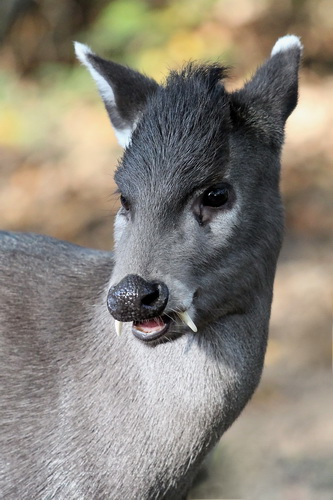
- Crested deer
- Noun
- The crested deer is a species of deer with large canines and a crest on its head. Diet : Omnivorous . Conservation status: near threatened
- Example: The crested deer measures around 60 cm at the withers and weighs between 17 kg and 30 kg
- fr: Le cerf huppé
- Giant bathynoma
- Noun
- The giant bathynome, brown to grey-purple in color, lighter on the ventral side, is oblong in shape. Its cuticle, which acts as an exoskeleton, is made up of 14 articulated segments, including the head and telson, each with a pair of legs. The large, rounded, and equipped with 12 to 14 terminal spikes, while the thoracic segments are equipped with paler lateral tears. The head is surmounted by two pairs of antennae and its jaws are equipped with four pairs of mandibles. It is the largest known isopod. Diet: scavenger. Conservation Status : Unknow
- Example: The giant bathynome is common throughout the Gulf of Mexico, from the West Indies to the mouth of the Amazon, and in lesser numbers in the Bay of Bengal, the Red Sea and the Indian Ocean. It is assumed that it has a preference for muddy or clay soils.
- fr: Bathynome Géant

- Giant siphonophore
- Noun
- The giant siphonophore is made up of thousands of organisms that come together to form a single body that can reach an average of 40 m. But the diameter of this animal does not exceed that of a broomstick. Each part of this animal has a specific role such as reproduction, food, hunting, defense, etc. They have long tentacles covered with stinging cells that allow them to immobilize and bring their prey back to their mouth and thus feed the colony. They can also produce light thanks to special cells that allow them to face the abyssal black. Diet : piscivarous. Conservation Status: Unknow
- Example: The giant siphonophore is an animal of the sea depths which is part of the branch of the cnidarians which also includes jellyfish.
- fr: Siphanophore géant

- Goblin shark
- Noun
- The goblin shark or goblin shark (Mitsukurina owstoni) is a species of shark in the monotypic family Mitsukurinidae which comprises a single genus, Mitsukurina. It lives on the continental slope, submarine canyons and seamounts around the world, between 30 and 1,300 m deep, with adults living deeper than juveniles. Diet : Piscivorous. Conservation Status : Least Concern
- Example: The Goblin shark is unlike any other shark, with a long, flattened snout, and very protractile jaws lined with nail-like teeth. It generally measures between 3 and 4 meters in length at maturity, but it can sometimes reach 6 meters . With its very slow speed, it is not a danger for humans, which it only encounters very exceptionally given the depths in which he lives.
- fr: Requin lutin

- lyre bird
- noun
- A large Australian songbird, the male of which has a long, lyre-shaped tail and is noted for his remarkable song and display.
Diet: insectivorous.
Conservation Statue: Least Concern
- Example: The lyre bird can reproduce a sound from a camera or public works.
- fr: Oiseau Lyre

- Mimetic octopus
- Noun
- The mimetic octopus lives in the tropical seas of Southeast Asia. This octopus is able to mimic the appearance and movements of more than fifteen different species, including sea snakes, lionfish, flatfish, frogfish, brittlestars, giant crabs, shellfish, rays, sea anemones, jellyfish and mantis shrimp. She accomplishes this feat by contorting herself, body and arms, and changing color. Diet : Piscivorous
Conservation Status : Unknow
- Example: The mimetic octopus is a relatively large octopus, which can reach 60 cm or even 1 m
- fr: Pieuvre mimétique

- Moloch
- Noun
- Saurian reptile from the Australian deserts, bristling with scaly spines. It can inflate and has a fake head in the back to ward off predators.
Diet : Myrmecophagus. Conservation status : Insufficient data
- Example: The moloch is found in arid areas. It likes sandy soils and is rarely found in rocky areas.
- fr: Morloch

- Narwhal
- Noun
- Large cetacean, commonly called sea unicorn, whose male has a long horizontal tusk. This one is actually a tooth. Diet : piscivorous Conservation Status : Least Concern
- Example: The Narwhal has a small rounded head with a small round mouth. It has small upturned fins. Like other arctic whales, it has no dorsal fins and has a thick vascular fatty layer that insulates it from the cold.
- fr: Narval

- Panda ant
- Noun
- The Panda-ant is an insect that belongs to the Mutillidae family. If it is nicknamed so it is on the one hand because it has white and black fur, similar to that of the panda, and on the other hand because its morphology resembles that of the ant. Diet : Nectarivorious.Conservation Status : Unknow
- Example: The panda ant lays about 2,000 eggs each year.
- fr: Fourmi panda

- Pistol shrimp
- Noun
- The compound word pistol-shrimp designates several species of crustaceans belonging to the Alpheidae family, but mainly the species Alpheus dentipes1. Snapped suddenly, their huge claw produces a violent detonation of nearly 220 decibels and a strong heat which can go up to 5,000 kelvin accompanied by a powerful jet of water, which will strike, or even kill, the prey (small fish or shrimp). Diet : scavenger. Classification Statue: from "endangered" to "least concern"
- Example: Pistol shrimp measureS 3 to 5 cm. The eyes are protected by the shell, which gives them very poor eyesight. They have a short, non-serrated rostrum between the two eyes. The two claws are asymmetrical, the larger often being half the size of the shrimp
- fr: Crevette Pistolet

- Platypus
- Noun
- The platypus is a semi-aquatic animal endemic to eastern Australia and Tasmania. It is one of five species in the order Monotremes, the only order of mammals that lays eggs instead of giving birth to fully formed young. It secretes venom with its paws. Diet : Carnivorious
Conservation Status : near threatened
- Example: The platypus has a horny jaw resembling a duck's beak, a tail reminiscent of a beaver, which serves as both a rudder in the water and a reserve of fat.
- fr: Ornithorynque

- Raccoon dog
- Noun
- The raccoon dog is a species of carnivorous mammal that looks like a raccoon, but actually belongs to the Canidae family, of which it is the only representative that hibernates. Diet : opportunistic Conservation Status : Least Concern
- Example: The raccoon dog was intensively bred for its fur in Europe and Russia, particularly during the 20th century.
- fr: Chien viverrin

- Red-lipped batfish
- Noun
- A kind of fish found in the Galápagos Islands, hence its common name "Galápagos batfish. This fish is particularly known for its prominent red lips. This fish does not swim but moves by walking in the seabed. Diet: insectivorous. Conservation Statue: Least Concern
- Example: Red-lipped batfish live in the deep waters of the Atlantic, Indian Ocean and Western Pacific.
- fr: Poisson chauve-souris à lèvres rouges

- Scotoplane
- Noun
- Scotoplanes are characterized by their 7 pairs of large legs, their swollen, pale pinkish and almost translucent body, and their four long dorsal papillae.
The Scotoplane species, is found in all major ocean basins of the globe in multiple locations.
Diet : depositary. Conservation Status : Unknow
- Example: Scotoplanes are abundant at depths of over 6,000 meters, and have been observed down to depths of over 9,500 m2. They usually live in very dense groups of several hundred individuals, slowly pacing the bottom in the same direction, against the current.
- fr: Scotoplane

- Slender loris
- Noun
- The slender loris is a species of primate mammals in the family Loridae. This strepsirrhine hides in the tropical rainforest, Sri Lanka. It is one of the rare mammals to secrete a toxin. The species is threatened due to deforestation of its natural habitat, Its venom is secreted by the elbows Diet : Insectivorious.
Conservation Status : In Danger
- Example: This slender loris is a small animal with gray-red fur, becoming lighter on the belly and around the face.
- fr: Loris grêle

- The Gobi jerboa
- Noun
- The Gobi jerboa is a small jerboa, living in central Asia, in the Palearctic regions of China and Mongolia, in the Gobi desert. She walks on her hind legs and uses her long ears as cover. Diet : Omnivorous . Conservation status: Least Concern
- Example: The Gobi jerboa is a species of the Dipodidae family.
- fr: La Gerboise de Gobi

- Wood frog
- Noun
- This species has the particularity of surviving completely frozen.
During the winter, she buries herself in the ground and goes into cardiac arrest, the blood hardly circulating in her veins3. This blood contains elements that limit the damage caused by freezing. In fact, glucose would be quickly accumulated when the blood freezes. Diet: insectivorous. Conservation Status: Vulnerable
- Example: The Wood Frog, Lithobates sylvaticus, is a North American species of amphibian in the family Ranidae.
- fr: La grenouille des bois
