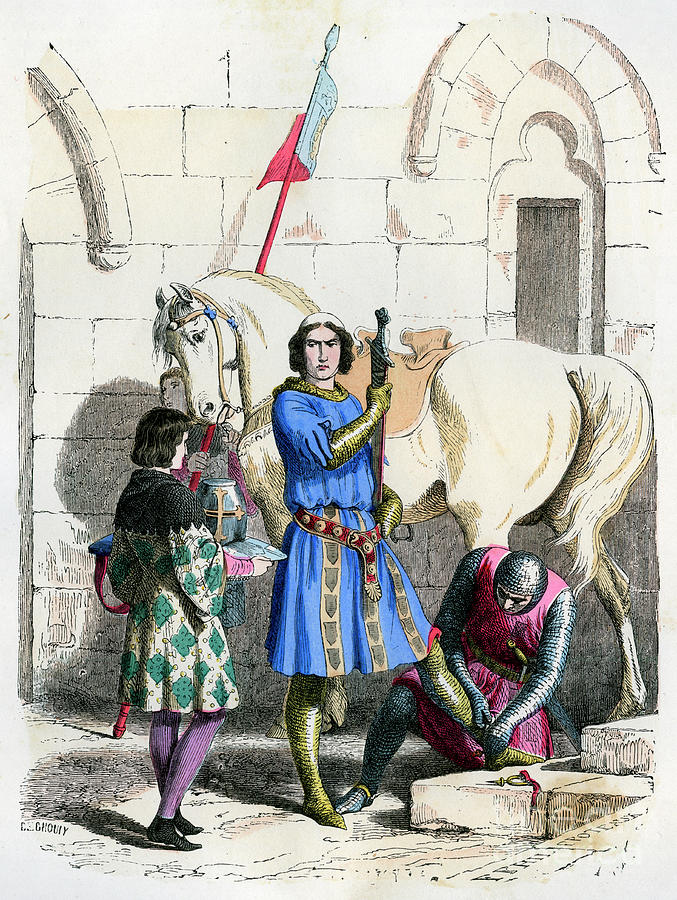
An initial offensive action made by extending the sword arm and continuously threatening the opponent’s target.
Example: He attacked his opponent by extending the sword arm and hitting him on the mask.
sk: Útok
Blade
Noun
The main component of a sword on which the hilt is mounted.
Example: The blade of this sword isn’t very sharp.
sk: Čepeľ
Buckler
Noun
A small round shield held by a handle or worn on the forearm.
Example: He received all the blows on his buckler and was not harmed.
sk: Pästný štít
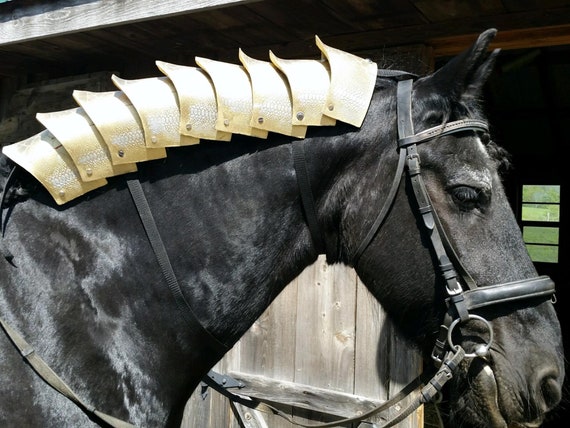
Chamfron
Noun
A piece of armor for a horse's head.
Example: Thunder tossed restlessly beneath the weight of crinet, chamfron, and blanket of heavy mail.
sk: Šamfrón
Compound attack
Noun
a fencing attack combining two or more successive movements in order to deceive parries
Example: The compound attack was very thought out very well.
sk: Zložený útok
Crinet
Noun
Articulated armor protecting the upper surface of the neck of a medieval war horse.
Example: Chainmail was often affixed to the crinet and wrapped about the horse's neck for additional protection.
sk: Konské brnenie na krk
Defence
Noun
Not being hit by the opponent’s offensive actions, either by parrying, avoiding, or moving out of distance.
Example: His defence was successful thanks to the quick reactions and movements of his arms.
sk: Obrana
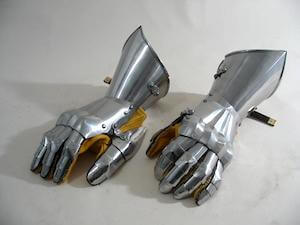
Gauntlet
Noun
A long thick glove (= covering for the hand), worn for protection.
Example: He balked slightly at that, then he tucked the tenners down his gauntlet and handed it over.
sk: Kovová rukavica
Hilt
Noun
The handle of a weapon or tool, especially a sword, dagger, or knife.
Example: He clutched the hilt of a broken sword.
sk: Rukoväť
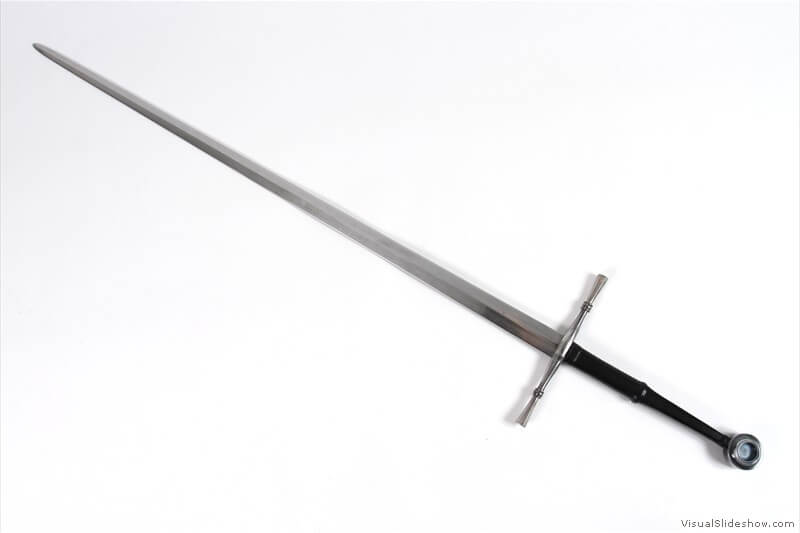
Longsword
Noun
Also hand-and-a-half sword. A larger cutting sword, not used in contemporary fencing, could be used with one or two hands.
Example: Bastard-sword was just a mixture of a two-handed greatsword and a longsword.
sk: Dlhý meč
Lunge
Noun
The most basic movement used to attack. The fencer takes a step forward with the weapon-wielding arm extended to carry the blade to target.
Example: There are advance lunges but with different tempos.
sk: Výpad
Mounted combat
Noun
A fight when opponents rode horses instead of marching.
Example: Their entertainments included sporting events such as archery competitions and presentations of mounted combat skills at least once a week.
Page
Noun
In the past, a boy who worked as a servant for a knight and who was learning to become a knight.
Example: He who would become a knight must first learn the rudiments as a page.
sk: Páža
Parry
Noun
The act of blocking an attack by pushing a weapon away or putting something between your body and a weapon.
Example: The parry is intended to deflect an attack.
sk: parry, odraz
Pommel
Noun
A rounded knob on the end of the handle of a sword, or dagger.
Example: The hilt is often padded red with a non-ornate blue pommel.
sk: Hlavica
Rapier
Noun
A thin, virtually edgeless sharp-pointed sword of the Renaissance used for thrusting.
Example: “En garde,” the musketeer said as he pointed his rapier at his enemy.
sk: Rapír
Riposte
Noun
To make a quick return thrust in fencing.
Example: And the most important defensive skill is the parry, which is often followed by counter - riposte.
sk: riposte, odveta
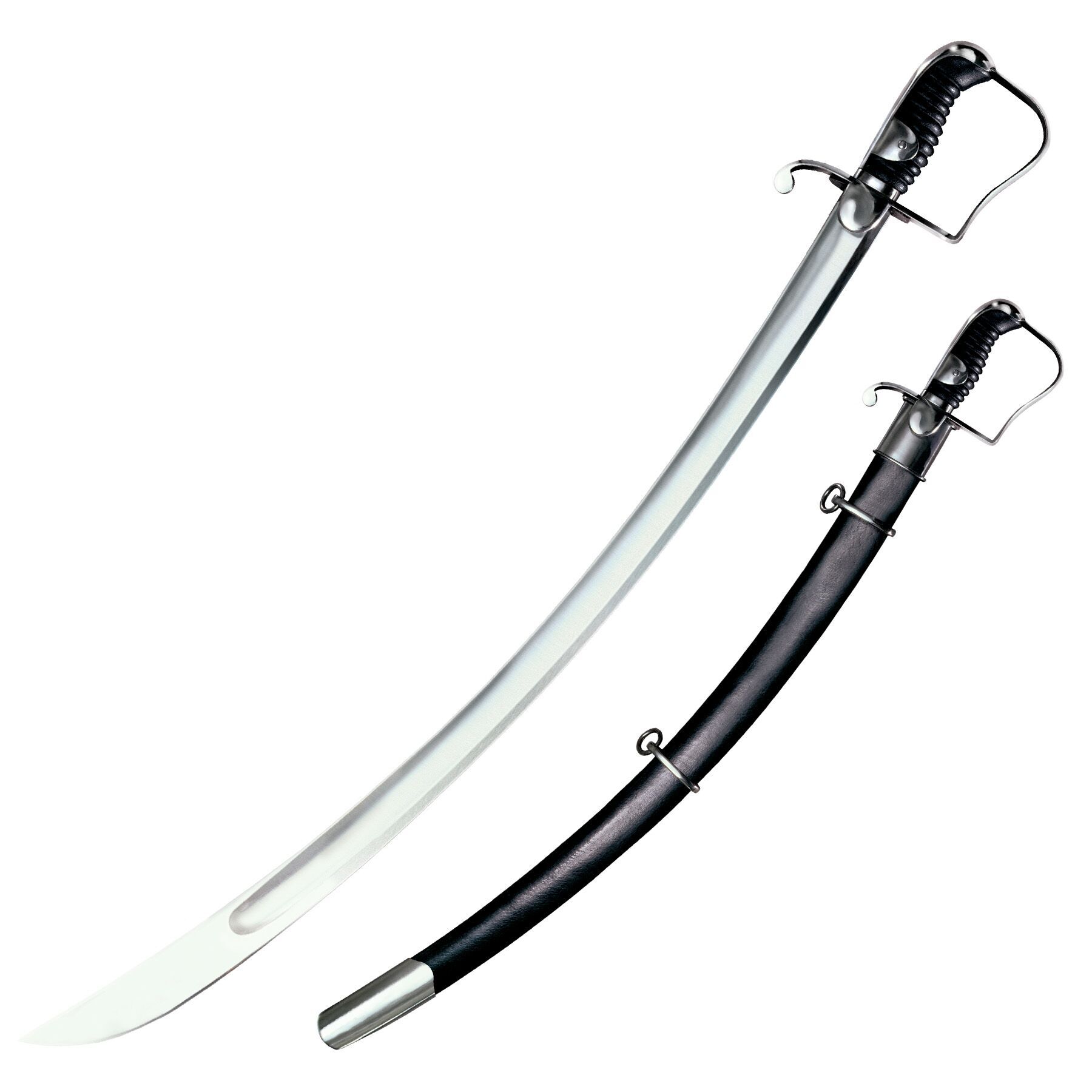
Sabre
Noun
1. a heavy cavalry sword with a curved blade and a single cutting edge.
2. a light fencing sword with a tapering, typically curved blade.
Example: Sabres were commonly used by the British in the Napoleonic era for light cavalry and infantry officers, as well as others.
sk: Šabľa
Spur
Noun
A device with a small spike or a spiked wheel that is worn on a rider's heel and used for urging a horse forward.
Example: The knight nudged his horse with spurs.
sk: Ostroha
Squire
Noun
A shield-bearer or armor-bearer of a knight.
Example: The first was a series based on his relatively lighthearted Dunk and Egg novellas, which follow a knight who wanders Westeros with a young squire.
sk: Panoš
Thrust
Noun
An attack made by moving the sword parallel to its length and landing with the point.
Example: Due to lack of good exposures, direct measurement of the thrusts is difficult.