Business glossary
Business glossary
10 Terms used in business terms
- Assets
- noun
- A business asset is an item of value owned by a company. Business assets span many categories. They can be physical, tangible goods, such as vehicles, real estate, computers, office furniture, and other fixtures, or intangible items, such as intellectual property.
- Example: As a fundamental measure of business performance, this ratio shows how effective a company uses its ASSETS, where inputs and outputs are compared.
- fr: Actif

- B2B
- noun
- Business-to-business (B2B or, in some countries, BtoB) is a situation where one business makes a commercial transaction with another.
- Example: Finally, it is important for B2B companies to note that whilst they are selling into businesses, demand is eventually derived from the end consumer so it is always worthwhile keeping an eye on the end consumer markets of the businesses they sell into and shifts in these markets.
- fr: D'entreprise à entreprise

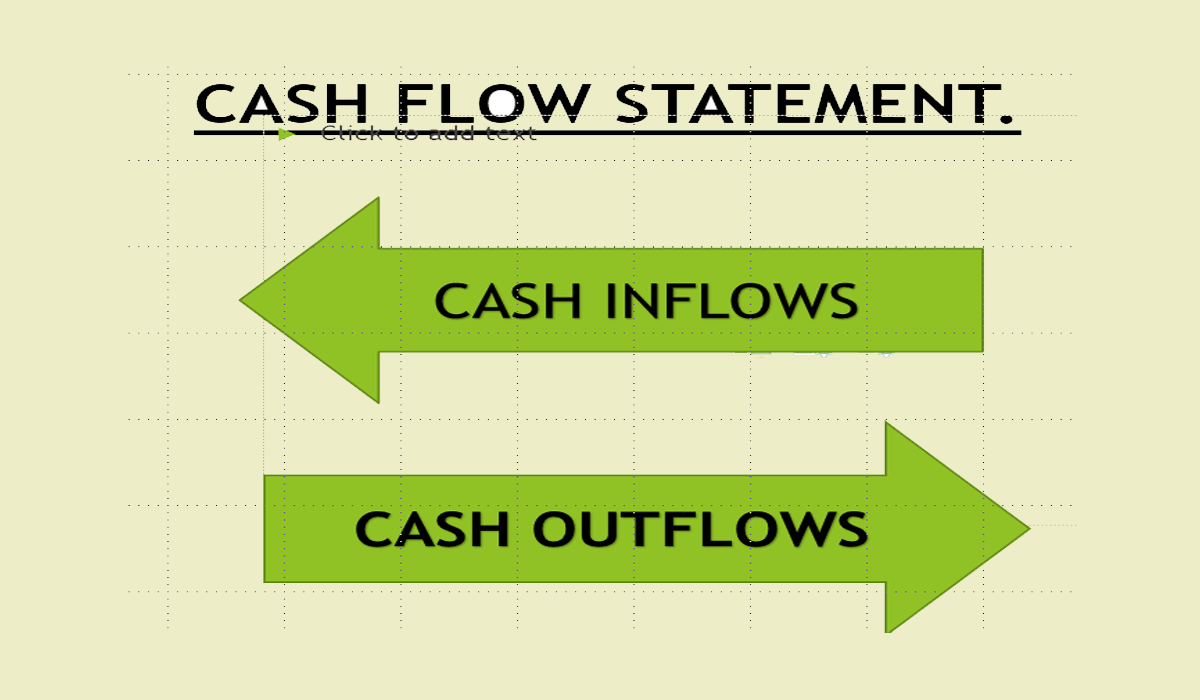
- CASH FLOW STATEMENT
- noun
- A cash flow statement measures the cash generated (inflow) or used (outflow) by a company in a given period.
- Example: In addition to financial and budgetary analysis' there are various other methods available to me to use for measuring and controlling the organisational performance of the farm, the main ones of which are by analysis of the CASH FLOW STATEMENT, the Profit and Loss Statement and by looking at Share values.
- fr: TABLEAU DES FLUX DE TRÉSORERIE
- Conversion Rate
- noun
- The conversion rate is the percentage of users who take a desired action.
- Example: The archetypical example of conversion rate is the percentage of website visitors who buy something on the site.
- fr: Taux de conversion

- Customer Acquisition Cost (CAC)
- phrase
- The cost related to acquiring a new customer.
- Example: Customer acquisition cost is a key business metric that is commonly used alongside the customer lifetime value (LTV) metric to measure value generated by a new customer.
- fr: Coût d'acquisition client (CAC)

- Liabilities
- noun
- Liabilities are the legal debts a company owes to third-party creditors. They can include accounts payable, notes payable and bank debt. All businesses must take on liabilities in order to operate and grow.
- Example: Debt Adequacy is the ability of reserves to cover external debt obligations, mainly short-term debt LIABILITIES and is measured by ratio of reserves to external debt and short-term debt.
- fr: Passif

- Margin
- noun
- Profit margin is the measure of your business's profitability. It is expressed as a percentage and measures how much of every dollar in sales or services that your company keeps from its earnings. Profit margin represents the company's net income when it's divided by the net sales or revenue.
- Example: Businesses need to pay attention to profit margins to remain fiscally healthy.
- fr: Marge

- Marketing
- noun
- Marketing is the activity, set of institutions, and processes for creating, communicating, delivering, and exchanging offerings that have value for customers, clients, partners, and society at large.
- Example: Advertising also plays a role in supporting other areas of MARKETING activity.
- fr: Commercialisation

- Prospecting
- noun
- The process of searching for and finding potential buyers. Sales reps (or "prospectors") seek out qualified prospects and move them through the sales cycle.
- Example: The goal of prospecting is to develop a database of likely customers and then systematically communicate with them in the hopes of converting them from potential customer to current customer.
- fr: Prospection

- Stock
- noun
- The goods or merchandise kept on the premises of a business or warehouse and available for sale or distribution.
- Example: The store has a very low turnover of stock.
- fr: Reserve / Provision
