This glossary contains the terms that people can use in the field of health and specially the human body. I'm studying Science and Biology in college, and I hope that this glossary could be helpful for people who want to understand scientific terms. I think it's important to understand scientific terms because we will have a bigger understanding of our health and environment.
bacteria
noun
Bacteria are microbes with a cell structure simpler than that of many other organisms.
Example: A disease is attributable to a particular virus or BACTERIA which can be clearly demonstrated and which hence constitutes the essential cause of a disease.
fr: Bactérie
cell
noun
The smallest unit that can live on its own and that makes up all living organisms and the tissues of the body.
Example: In most neurons impulses are received by numerous short fibres called dendrites and carried away from the CELL by a single long fibre called an axon.
fr: cellule
chromosome
noun
A chromosome is a long DNA molecule with part or all of the genetic material of an organism.
Example: For the tumour to occur, a nonsense or frameshift mutation in the gene gives rise to a truncated protein, non disjunction may occur in a second mutation leading to the loss of CHROMOSOME 13.
fr: chromosome
deoxyribonucleic acid (DNA)
noun
The molecules inside cells that carry genetic information and pass it from one generation to the next.
Example: The molecule of deoxyribonucleic acid, DNA, that provides the programme for living creatures, is formed by a pair of right handed helices in parallel.
fr: Acide désoxyribonucléique (ADN)
evolution
noun
the scientific theory explaining the appearance of new species and varieties through the action of various biological mechanisms (such as natural selection, genetic mutation or drift, and hybridization)
Example: He points to an inevitable parallel here between biological EVOLUTION and cognitive development in the life of an individual.
fr: évolution
heredity
noun
Heredity is the passing on of traits from parents to their offspring through reproduction.
Example: Few scientists dispute that heredity can create a susceptibility to alcoholism.
fr: hérédité
metabolism
noun
Metabolism is a term that is used to describe all chemical reactions involved in maintaining the living state of the cells and the organism.
Example: Energy formation is one of the vital components of metabolism.
fr: Métabolisme
molecule
noun
A group of atoms bonded together, representing the smallest fundamental unit of a chemical compound that can take part in a chemical reaction.
Example: O2 is the oxygen molecule most commonly found in the earth's atmosphere; it has two atoms of oxygen.
fr: molécule
natural selection
noun
The process whereby organisms better adapted to their environment tend to survive and produce more offspring. The theory of its action was first fully expounded by Charles Darwin and is now believed to be the main process that brings about evolution.
Example: The extensive nature of convergence in the biological world is possibly the strongest evidence of all for NATURAL SELECTION.
fr: sélection naturelle
virus
noun
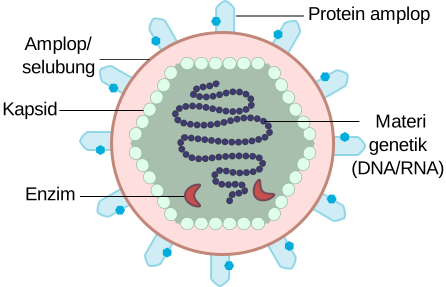
an infective agent that typically consists of a nucleic acid molecule in a protein coat, is too small to be seen by light microscopy, and is able to multiply only within the living cells of a host
Example: Injectors who become infected through sharing needles can spread the VIRUS to people in the wider community through sexual contacts, particularly those who turn to prostitution as a means of financing the habit.