LINKING WORDS
LINKING WORDS
48 null terms
- Additionally
- Adverb
- as an extra factor or circumstance.
- Example: "brokers finance themselves additionally by short-term borrowing".
- es: Adicionalmente
-

- Admittedly
- Adverb
- used to introduce a concession or recognition that something is true or is the case.
- Example: "admittedly, the salary was not wonderful, but the duties were light".
- es: Cierto es que
-
- Also
- Adverb
- in addition; too.
- Example: "a brilliant linguist, he was also interested in botany".
- es: Además
-
- Although
- Conjunction
- in spite of the fact that; even though.
- Example: "although the sun was shining it wasn't that warm".
- es: A pesar de que
-
- Altogether
- Adverb
- completely; totally.
- Example: "I stopped seeing her altogether".
- es: En total
-

- As a rule
- Adverb
- Talk about mandatory conditions of certain things.
- Example: "As a rule i get up at six o'clock, but yesterday morning i got up at eight".
- es: Como una regla
-
- Because of
- preposition
- for the reason that; since.
- Example: "We fought because of our political differences".
- es: porque
-
- Before
- Adverb
- during the period of time preceding a particular event or time.
- Example: "my playing days had ended six years before".
- es: Antes de
-
- Besides
- Adverb
- in addition; as well.
- Example: "I'm capable of doing the work, and a lot more besides".
- es: Además
-
- Briefly
- Adverb
- for a short time; fleetingly.
- Example: "he worked briefly as a lawyer".
- es: Brevemente
-
- Due to
- Adverb
- caused by or ascribable to.
- Example: "unemployment due to automation will grow steadily".
- es: Debido a
-
- Due to
- Preposition
- Refers to an explanation.
- Example: "due to multiple community guideline violations".
-
- Equally
- Adverb
- in the same manner or to the same extent.
- Example: "all children should be treated equally".
- es: Igualmente
-

- Especially
- Adverb
- used to single out one person, thing, or situation over all others.
- Example: "he despised them all, especially Sylvester".
- es: Especialmente
-
- Even so
- Adverb
- in spite of that; nevertheless.
- Example: "not the most exciting of places, but even so I was having a good time".
- es: Aún así
-
- Even so
- Adverb
- means that something works despite some conditions.
- Example: "It was raining, but even so we had to go out".
- es: Aún así
-
- Finally
- Adverb
- In the last place.
- Example: "We finally made it home".
- es: Finalmente
-

- First
- Adverb
- coming before all others in time or order; earliest; 1st.
- Example: "his first wife".
- es: Primero
-

- Generally
- Adverb
- in most cases; usually.
- Example: "the term of a lease is generally 99 years".
- es: generalmente
-
- Hence
- Adverb
- as a consequence; for this reason.
- Example: "a stiff breeze and hence a high windchill".
- es: Por eso
-
- If
- Conjunction
- (introducing a conditional clause) on the condition or supposition that; in the event that.
- Example: "if you have a complaint, write to the director".
- es: Si / cuando
-

- In case
- Adverb
- Give explanation about a specific case.
- Example: "A fairly large disco for shows in case of rain".
- es: En caso
-
- In conclusion
- Adverb
- End or end of something.
- Example: "in conclusion the company closes in two weeks".
- es: En conclusión
-

- In fact
- Adverb
- Used to explain a situation.
- Example: "The belief is that these gods were in fact extraterrestrials".
- es: De hecho
-

- In most cases
- Conjunction
- Indicates that it is very common to see certain things.
- Example: "I use a mask in most cases".
- es: en la mayoría de los casos
-
- in order to
- Conjunction
- Justify the purpose of something.
- Example: "We will contact you in order to complete the payment".
- es: Con el fin de
-

- in spite of
- Preposition
- means that something works despite some conditions.
- Example: "In spite of that, we arrived on time".
- es: A pesar de
-
- in this case
- Adverb
- Indicates conditions on a specific case.
- Example: "in this case handsome does very well indeed".
- es: En este caso
-
- Including
- Preposition
- containing as part of the whole being considered.
- Example: "languages including Welsh, Cornish, and Breton".
- es: Incluso
-

- Indeed
- Adverb
- used to emphasize a statement or response confirming something already suggested.
- Example: "it was not expected to last long, and indeed it took less than three weeks".
- es: Por supuesto
-

- just as
- Adverb
- Indicates similar things or situations.
- Example: "This one is just as good as that one".
- es: Tal como
-

- Likewise
- Adverb
- in the same way; also.
- Example: "the dream of young people is to grow old, and it is likewise the dream of their parents to relive youth".
- es: Igualmente
-
- Namely
- Adverb
- that is to say; to be specific (used to introduce detailed information or a specific example).
- Example: "to me there is only one kind of rock, namely, loud rock".
- es: A saber
-
- Never
- Adverb
- at no time in the past or future; on no occasion; not ever.
- Example: "they had never been camping in their lives".
- es: Nunca
-

- Nonetheless
- Adverb
- in spite of that; nevertheless.
- Example: "it was the barest of welcomes, but it was a welcome nonetheless".
- es: Sin embargo
-
- Obviously
- Adverb
- in a way that is easily perceived or understood; clearly.
- Example: "she was obviously sick".
- es: Obviamente
-

- Overall
- in all parts; taken as a whole.
- Example: "the overall effect is impressive".
- es: En general
-
- Second
- Adverb
- constituting number two in a sequence; coming after the first in time or order; 2nd.
- Example: "he married for a second time".
- es: Segundo/segunda
-

- Similarly
- Adverb
- in a similar way.
- Example: "a similarly priced property".
- es: Similar
-

- Such as
- Adjetive
- means it resembles a situation.
- Example: "your eyes are such as sunset".
- es: Tal como
-

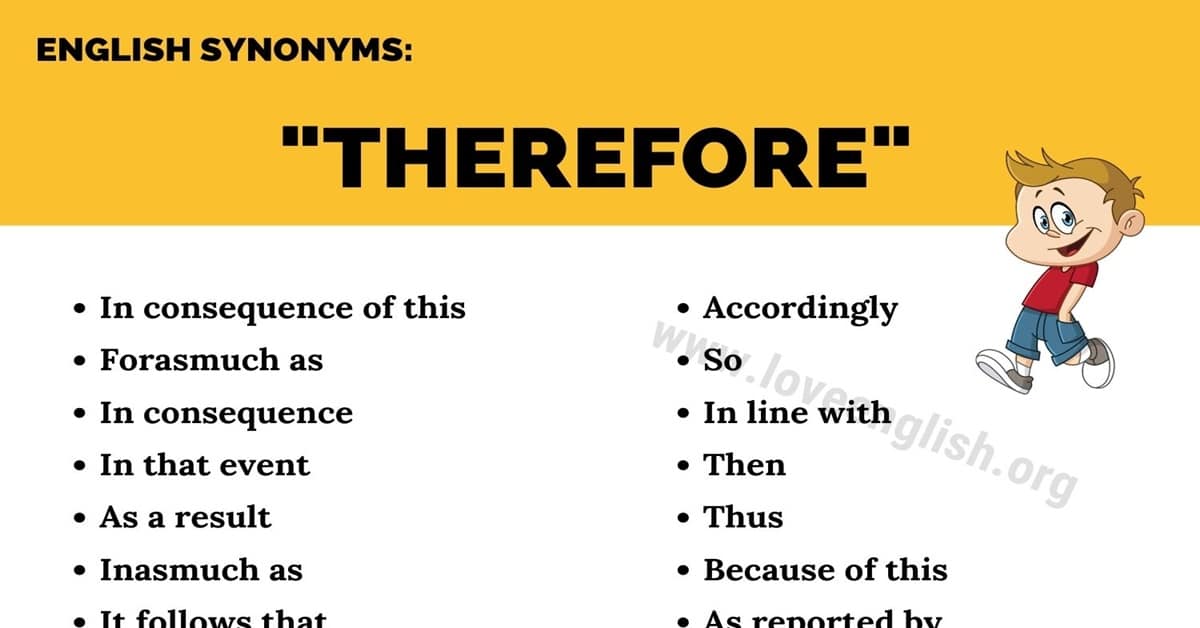
- Therefore
- Adverb
- for that reason; consequently.
- Example: "he was injured and therefore unable to play".
- es: Por lo tanto
-
- Thus
- Adverb
- as a result or consequence of this; therefore.
- Example: "Burke knocked out Byrne, thus becoming champion".
- es: Por lo tanto
-

- To clarify
- Adverb
- make (a statement or situation) less confused and more clearly comprehensible.
- Example: "send questions for gmail to clarify the exam".
- es: Para aclarar
-

- To conclude
- Adverb
- End or end of something.
- Example: "I wish to conclude my speech with a prayer for the continued happiness of thenewly married couple".
- es: Para concluir
-

- Too
- Adverb
- to a higher degree than is desirable, permissible, or possible; excessively.
- Example: he was driving too fast
- es: También
-
- Unless
- Conjunction
- except if (used to introduce the case in which a statement being made is not true or valid).
- Example: "unless you have a photographic memory, repetition is vital".
- es: A no ser que
-
- Unlike
- Adjetive
- dissimilar or different from each other.
- Example: "hey seemed utterly unlike, despite being twins".
- es: Diferente a
-

- Whereas
- in contrast or comparison with the fact that.
- Example: "you treat the matter lightly, whereas I myself was never more serious".
- es: Mientras que
-