The variety of life in the world or in a particular habitat or ecosystem.
Example: Costa Rica concentrates 6% of the world's biodiversity.
en: biodiversité
biology
noun
The study of living organisms, divided into many specialized fields that cover their morphology, physiology, anatomy, behavior, origin, and distribution.
Example: All science students have to take biology for at least one term.
en: biologie
calculator
noun
Something used for making mathematical calculations, in particular a small electronic device with a keyboard and a visual display.
Example: The calculator allows exact calculations to be made instantly.
en: calculatrice
cell
noun
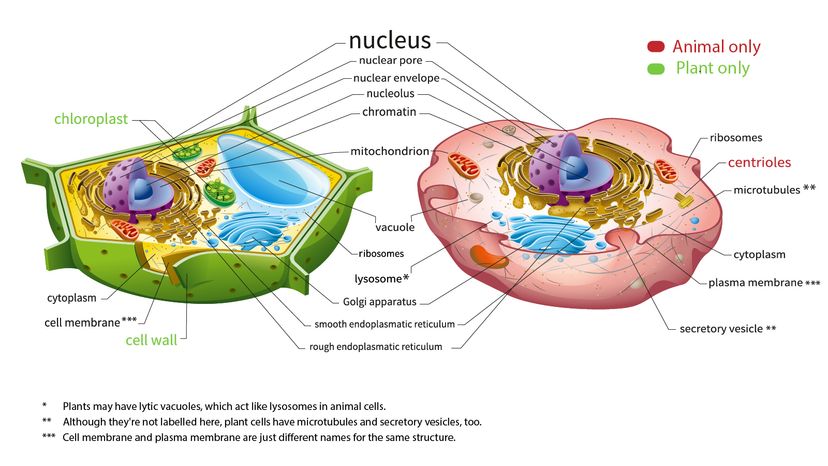
The smallest structural and functional unit of an organism, typically microscopic and consisting of cytoplasm and a nucleus enclosed in a membrane. Microscopic organisms typically consist of a single cell, which is either eukaryotic or prokaryotic.
Example: Human beings are made up of many different types of cells that each have their own function.
en: cellule
chemical fume hood
noun
A laboratory fume hood is a device that allows the extraction of toxic vapours from products used during handling.
Example: It always has a chemical hood in the laboratories.
en: hotte chimique
chemistry
noun
He branch of science that deals with the identification of the substances of which matter is composed; the investigation of their properties and the ways in which they interact, combine, and change; and the use of these processes to form new substances.
Example: Chemistry is a physical science that requires a strong knowledge of math.
en: chimie
equation
noun
Equality relation which is only verified for certain values of the variable, called unknown.
Example: In mathematics, solving an equation involves determining the value of the unknowns.
en: équation
evolution
noun
Gradual transformation from one living species to another.
Example: Darwin developed the theory of evolution.
en: évolution
immune system
noun
A complex network of cells, tissues, organs, and the substances they make that helps the body fight infections and other diseases
Example: The immune system allows the human organism to defend itself against attacks from the outside.
en: système immunitaire
laboratory
noun
A room or building equipped for scientific experiments, research, or teaching, or for the manufacture of drugs or chemicals.
Example: Professor Durand is not in his laboratory on Sundays.
en: laboratoire
mathematics
noun
The abstract science of number, quantity, and space. Mathematics may be studied in its own right ( pure mathematics ), or as it is applied to other disciplines such as physics and engineering ( applied mathematics ).
Example: Algebra is one of the many branches of mathematics.
en: mathématiques
mechanics
noun
The branch of applied mathematics dealing with motion and forces producing motion.
Example: Jean did well in mechanics at school.
en: mécanique
molecule
noun
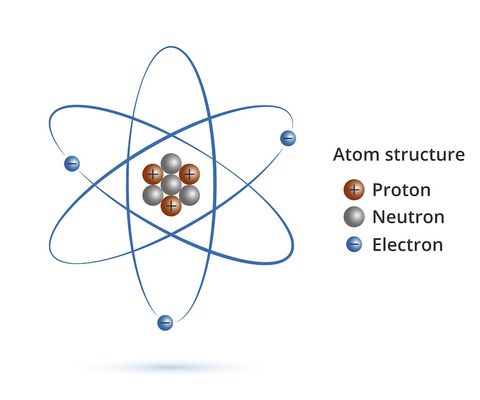
The smallest part of a body capable of existing in an isolated state while retaining the characteristics of this body.
A molecule is made up of atoms.
Example: With two hydrogen atoms and one oxygen atom, you get a water molecule.
en: molécule
physics
noun
The branch of science concerned with the nature and properties of matter and energy. The subject matter of physics, distinguished from that of chemistry and biology, includes mechanics, heat, light and other radiation, sound, electricity, magnetism, and the structure of atoms.
Example: Physics provides the tools to understand matter.
en: la physique
protective glasses
noun
Toughened glasses or goggles for protecting the eyes when using power tools or industrial or laboratory equipment.
Example: Marie must absolutely put her protective glasses in the laboratory.
en: lunettes de protection
pycnometer
noun
A standard vessel for measuring and comparing the densities of liquids or solids.
Example: Jean used the pycnometer in his chemistry lab
en: pycnomètre
science
noun
All the work and results of science; exact, universal and verifiable knowledge expressed by laws.
Example: We see advances in science every day.
en: science
smock
noun
A loose dress or blouse, with the upper part closely gathered in smocking.
Example: Pascal always wears a smock when he does DIY.
en: sarrau
solution
noun
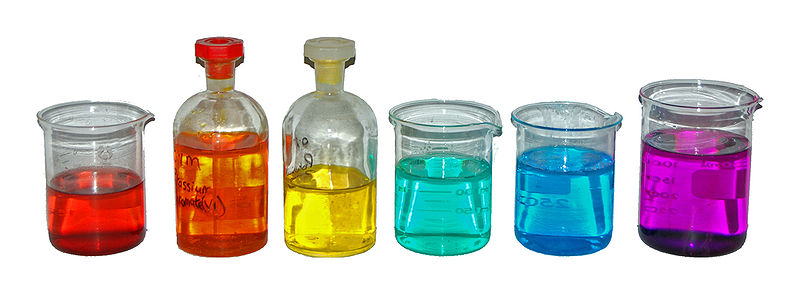
A solution is a homogeneous mixture resulting from the dissolution of one or more solutes in a solvent.