Joel Solórzano
Joel Solórzano
10 Glossary-Week4 terms
This glossary will help you to get to know the subject, especially in the basic concepts of heat transfer.
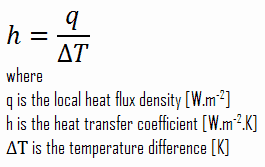
- Convection heat transfer coefficient
- where h is the convection heat transfer coefficient, Ts is the surface temperature, and T is the free-stream temperature. The convection coefficient is also expressed as
- It can be defined as the rate of heat transfer between a solid surface and a fluid per unit area per unit temperature difference.
- Example: The convective heat transfer coefficient is not a property of the fluid.
- es: Coeficiente de transferencia de calor por convección
- Critical Reynold’s number
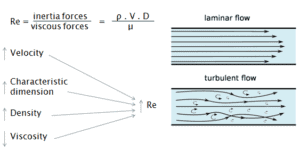
- The Reynolds number at which the flow becomes turbulent is called the critical Reynolds number.
- Is the the reynolds number at which the flow becomes turbulent
- Example: The Reynolds number is the ratio of inertial forces to viscous forces and is a convenient parameter to predict whether a flow condition will be laminar or turbulent.
- es: Número crítico de Reynold
- Friction Coefficient
- where is the dynamic viscosity, is the upstream velocity, and Cf is the dimensionless friction coefficient.
- The coefficient of friction is the ratio of the sliding force to the holding force exerted by two surfaces in contact.
- Example: ice on a polished steel sheet has a low coefficient; while the rubber on the pavement has a high coefficient. The coefficient of friction can take values from almost zero to not exceeding unity.
- es: Coeficiente de fricción

- Kinematic viscosity
- The property v=m/p is the kinematic viscosity.
- Kinematic viscosity is a measure of the internal resistance of a fluid to flow under gravitational forces.
- Example: the viscosity of the grease is never reported, but the apparent viscosity of the grease is reported in centipoise.
- es: Viscosidad cinemática

- Laminar flow
- The highly ordered fluid motion characterized by smooth streamlines is called laminar.
- Laminar flow is one where the air moves in the same volume and in the same direction through the clean room or a zone of controlled environment in a parallel flow and of uniform speed.
- Example: laminar flows constitute the fundamental element for the effective evacuation of airborne pollutants.
- es: Flujo laminar

- Nusselt number
- The Nusselt number, which is the dimensionless heat transfer coefficient, is defined as
- is the dimensionless heat transfer coefficient
- Example: The Nusselt number represents the improvement in heat transfer through a fluid layer as a result of convection.
- es: Número de Nusselt

- Prandtl number
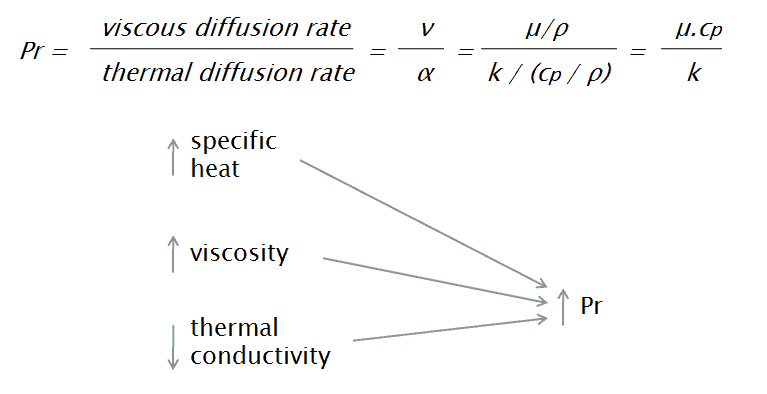
- The relative thickness of the velocity and the thermal boundary layers is best described by the dimensionless Prandtl number, defined as
- The Prandtl number is defined as the ratio of impulse diffusivity to thermal diffusivity.
- Example: in liquid mercury it has a Prandtl number (Pr) = 0.03 which represents that heat conduction is more dominant compared to convection.
- es: Número de prandtl
- Reynold number
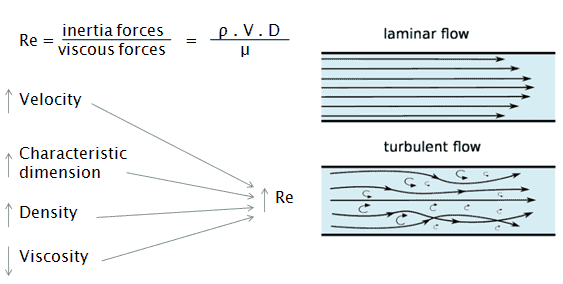
- The Reynolds number at which the flow becomes turbulent is called the critical Reynolds number.
- The Reynolds number is the ratio of inertial forces to viscous forces and is a convenient parameter to predict whether a flow condition will be laminar or turbulent.
- Example: The Reynolds number applies to any type of fluid flow such as flow in circular or non-circular conduits, in open channels, and flow around submerged bodies.
- es: Número de Reynold
- Shear stress
- The friction force per unit area is called shear stress, and the shear stress at the wall surface is expressed as
- It is known as shear stress that results from applying two forces parallel to a surface and in the opposite direction. In this way you can divide an object into two parts, making the sections slide over each other.
- Example: Direct shear forces are applied daily on fabrics, papers or metals, exerted by scissors, guillotines or shears. They also appear in structures such as bolts or screws, dowels, beams, wedges, and welds.
- es: Esfuerzo cortante

- Turbulent flow
- The highly disordered fluid motion that typically occurs at high velocities is characterized by velocity fluctuations is called turbulent.
- turbulent flow is characterized by the irregular movement of fluid particles. Unlike laminar flow, the fluid does not flow in parallel layers, the lateral mixing is very high, and there is a break between the layers
- Example: The flow of water in rivers or the movement of air near the surface of the earth are typical examples of turbulent flows.
- es: Flujo turbulento