The rate of heat transfer between a solid surface and a fluid per unit area per unit temperature difference. Thermal engineering
Example: the convection heat transfer coefficient is proportional to the temperature difference and is conveniently expressed by Newton's law of cooling
es: Coeficiente de transferencia de calor por convección
Critical Reynold’s number
noun
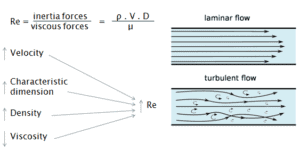
The critical Reynolds number is associated with the laminar-turbulent transition, in which a laminar flow becomes turbulent.
Example: The critical Reynolds number depends on the fluid velocity, the pipe diameter, or equivalent diameter if the conduction is not circular, and the kinematic viscosity or, failing that, density and dynamic viscosity.
es: Número crítico de Reynolds
Friction Coefficient
noun
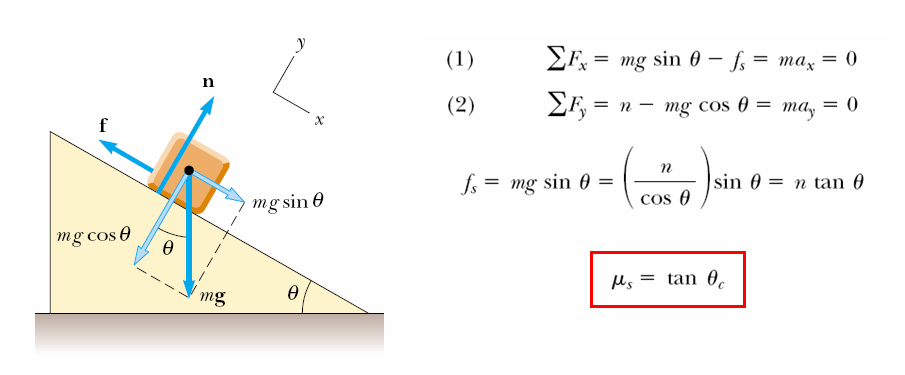
The friction coefficient is the ratio of the sliding force to the holding force exerted by two surfaces in contact.
Example: The friction coefficient is in fact an evaluation of the difficulty with which the surface of one material will slide over another material.
es: Coeficiente de Fricción
Kinematic viscosity
noun
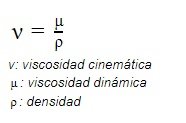
Kinematic viscosity is a measure of the internal resistance of a fluid to flow under gravitational forces
Example: Kinematic viscosity is determined by measuring the time in seconds required for a fixed volume of fluid to flow by gravity a known distance through a capillary within a calibrated viscometer at a closely controlled temperature.
es: Viscosidad cinemática
Laminar flow
noun
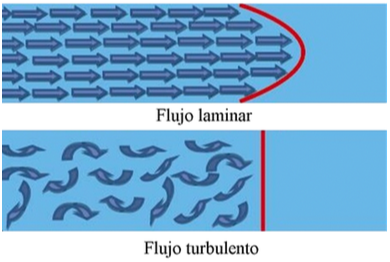
It is called laminar flows, the movement of a fluid when it is ordered, stratified and smooth
Example: In a laminar flow the fluid moves in parallel sheets without intermingling and each fluid particle follows a path called the streamline.
es: Flujo Laminar
Nusselt number
noun
The Nusselt number (Nu) is a dimensionless number that measures the increase in heat transfer from a surface through which a fluid passes (heat transfer by convection) compared to the transfer of heat if it occurred only by conduction.
Example: The Nusselt number equals the dimensionless temperature gradient at the surface, and provides a measure of the convective heat transfer that occurs at the surface.
es: Número de Nusselt
Prandtl number
noun
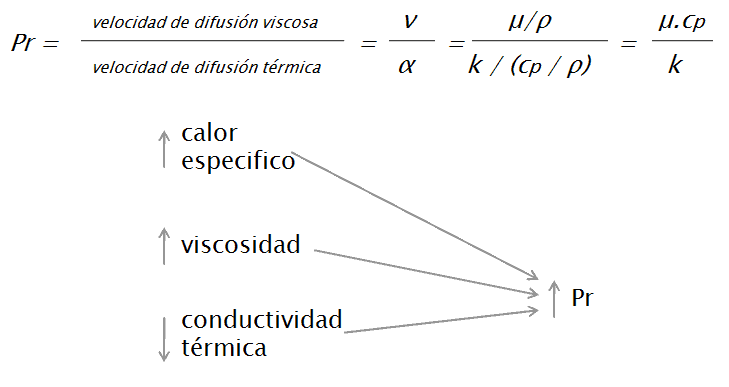
The Prandtl number (Pr) is a dimensionless number proportional to the quotient between the diffusion rate of the amount of moment (viscosity) and the thermal diffusivity.
Example: liquid metals have very low Prandtl numbers
es: numero de prandtl
Reynold number
noun
The Reynolds number (Re) is a dimensionless number used in fluid mechanics, reactor design, and transport phenomena to characterize the motion of a fluid. Its value indicates whether the flow follows a laminar or turbulent pattern.
Example: The Reynolds number is defined as the relationship between the inertial forces and the viscous forces present in a fluid
es: Número de Reynolds
Shear stress
noun
Shear stress is the internal stress or stress resulting from stresses parallel to the cross section of a mechanical prism such as a beam or a column.
Example: The components of the shear stress can be obtained as those resulting from the shear stresses.
es: Esfuerzo Cortante
Turbulent flow
noun
movement of a fluid that occurs in a chaotic way, in which the particles move disorderly and the trajectories of the particles are forming eddies
Example: Turbulent flow is one of the most critical phenomena in modern physics, and there is still no single theory that provides predictability to a number of situations involving turbulent flow.