The process of heat conduction depends on four basic factors: the temperature gradient, the cross section of the materials involved, their path length.
es: Factor de forma de conducción
Convection resistance
The convection thermal resistance is calculated from the convection heat transfer coefficient and the conduction thermal resistance is calculated from the thermal conductivity.
Example: Newton’s Law of Cooling is used for both natural convection
es: Resistencia a la convección
Critical radius of insulation
The critical radius of insulation is a counterintuitive concept within the study of heat transfer.
Example: The theory states that adding insulation to a cylindrical or spherical object will increase the rate of heat loss rather than decrease it, if the radius (thickness) of the insulation is at its “critical” value.
es: Radio crítico de aislamiento
Cylinder conduction resistance
The conduction and convection heat transfer in engines are processes that occur in series and parallel with each other. A series path is convection through the cylinder gas boundary layer, conduction across the cylinder wall.
Example: Steady Conduction Through a Straight Cylindrical Pipe Wall
es: Resistencia de conducción del cilindro
Efficiency
The heat exchanger efficiency is defined as the ratio of the heat transferred in the actual heat exchanger to the heat that would be transferred in the ideal heat exchanger.
es: Eficiencia
Fin effectiveness
Fin efficiency is defined as the ratio of actual heat flow of the fin to that which would be obtained with a fin of constant temperature uniformly equal
Example: The fin efficiency is defined as the ratio of the heat transfer to the fin to the heat transfer
es: Eficacia final
Fin efficiency
The fin efficiency is defined as the ratio of the heat transfer to the fin to the heat transfer to an ideal fin. ηth = qfin. hAfin(Tb − T∞). , Tf = T∞,
Example: fin efficiency and a model for pure-heat transfer coefficient are suggested, which are applicable to the heat exchanger.
es: eficiencia ideal
Interface resistance
nterfacial thermal resistance, also known as thermal boundary resistance, or Kapitza resistance, is a measure of an interface's resistance to thermal flow. This thermal resistance differs from contact resistance
Example: But interfacial resistance impacts the effective thermal conductivity.
es: Resistencia de interfaz
Plane wall conduction resistance
Consider steady heat conduction through the walls of a house.
es: Resistencia a la conducción de la pared plana
Radiation resistance
Radiation resistance is that part of an antenna's feedpoint electrical resistance that is caused by the radiation of electromagnetic waves from the antenna.
Example: The radiation resistance can be defined as the value of resistance that would dissipate the same amount of power as radiated as radio waves by the antenna with the antenna input current passing through it.
es: Resistencia a la radiación
Sphere conduction resistance
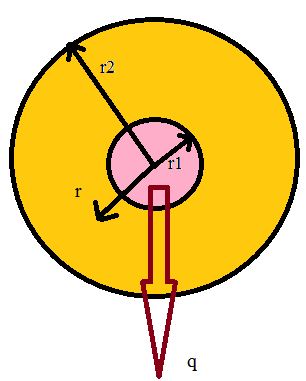
Consider heat conduction through a hollow sphere of inner radius r1, outer radius r2 and made of a material of constant thermal conductivity.
Example: The expression for steady state temperature distribution in a spherical wall can be set up by integrating the Fourier rate equation between the limits
es: la resistencia de conducción de la esfera
Surfaces
Extended surfaces have fins attached to the primary surface on one side of a two-fluid or a multifluid heat exchanger
es: Superficies
Thermal contact conductance
In physics, thermal contact conductance is the study of heat conduction between solid bodies in thermal contact.
Example: The thermal contact conductance coefficient, {\displaystyle h_{c}}h_{c}, is a property indicating the thermal conductivity,
es: Conductancia de contacto térmico
Thermal contact resistance
Thermal contact resistance is defined as the ratio between this temperature drop and the average heat flow across the interface
Example: According to Fourier's law, the heat flow between the bodies is found by the relation: (1) where is the heat flow, is the thermal conductivity, is the cross sectional area and.
es: Resistencia al contacto térmico
Total thermal resistance
collective
Thermal resistance is a heat property and a measurement of a temperature difference by which an object or material resists a heat flow. Thermal resistance is the reciprocal of thermal conductance.
Example: Thermal resistance is a heat property and a measurement of a temperature difference