15 Módulo de transferencia de calor & inglés terms
This glossary allows us to understand in simple words that the glossary is the place or part where the words that are not understood are stored. The glossary is always at the end of each work, thesis, project, etc., allowing the reader to go to them to clarify their doubts regarding the words they do not understand.
Conduction shape factor
noun
the f orm actor allows calculating the heat between the surface that is at 1T and the surface that is located at 2T
Example: The form factor Many problems encountered in practice are two-dimensional or three-dimensional and are related to somewhat complicated geometric configurations for which no simple solutions are available.
es: Factor de forma de conducción
Convection resistance
noun
Convection resistance can be defined as the inverse of the convection heat transfer coefficient per unit area.
Example: heat by conduction has its respective thermal resistances, according to the system under study, convection also has a particular thermal resistance: Rh = 1 ℎ
es: Resistencia a la convección
Critical radius of insulation
noun
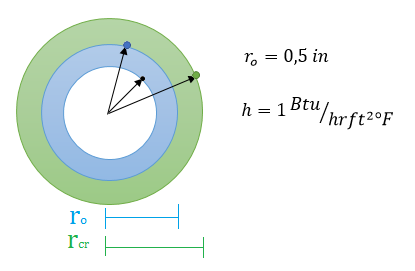
The critical insulation radius is the measure of the radius of an insulator in which the heat transfer is maximum or the resistance of the heat flow is very low, so when placing an insulating material it must be verified that the external radius of this is greater than the critical radius or that the critical radius is less than the radius of the outer cylinder, so that it duly complies with its insulating property.
Example: A 1 in. OD tube of unknown material is coated with an asbestos of k = 0.12 Btu / hrft ° F and a heat transfer coefficient h = 1Btu / hrft2 ° F; Calculate the rcr of the pipe and its relationship to the external radius.
es: Radio crítico de aislamiento
Cylinder conduction resistance
noun
the one-dimensional steady-state flow of heat through a cylindrical or spherical layer that is exposed to convection on both sides into fluids that are at temperatures T∞1 and T∞2, with heat transfer coefficients h1 and h2, respectively.
Example: In this case, the network of thermal resistances consists of one resistance to conduction and two to convection, in series, precisely like that for the flat wall.
es: Resistencia de conducción del cilindro.
Efficiency
adjective
It is defined as the relationship between the resources used in a project and the achievements achieved with it.
Example: It occurs when fewer resources are used to achieve the same objective or when more objectives are achieved with the same or fewer resources.
es: Eficiencia
Fin effectiveness
adjective
is the ratio between the thermal power (Q-point) that is dissipated in it and the thermal power that is dissipated without fin from the area of the base that it occupies on the primary surface.
Example: In practice, the fins lose heat at the end, to account for that loss of heat Jakob, recommends using the deduced expressions for a fin with insulated end but making a correction to the length of the fin.
es: Eficacia de la aleta
Fin efficiency
noun
It is the relationship that exists between the heat (Qf) that is transferred from a fin under certain conditions, and the maximum heat transfer (Qmax) that would exist if that fin were at the maximum temperature (the base temperature).
Example: The fins are used when the coefficient of heat transfer by convection h is little.
es: Eficiencia de las aletas
Interface resistance
noun
the shear strength parameters at the soil-concrete interface, in this case, in order to have a more specific field of action, the research was oriented to the study of the soil-pass sieve No. 4-concrete interface, in which the concrete presents different roughnesses in order to best simulate the interaction between the two materials.
Example: shear resistance parameters such as the angle of internal friction or resistance, cohesion and the relationship between the roughness of the concrete and the resistance parameters obtained.
es: Resistencia de interfaz
Plane wall conduction resistance
noun
Heat flows in a direction perpendicular to the surface. If the thermal conductivity is uniform.
Example: the integration of the equation is as:
q_k=-kA/L (T_2-T_1 )=kA/L (T_1-T_2 )
es: Resistencia a la conducción de la pared plana
Radiation resistance
noun
is the act of manufacturing electronic components and systems resistant to damage or malfunction caused by ionizing radiation (high energy electromagnetic and particle radiation), such as those found in outer space, high altitude flights, around nuclear reactors and particle accelerators or in nuclear accidents.
Example: Radiation resistant components are based on their non-resistant equivalents, to which variations in design and manufacturing are made to reduce this susceptibility to damage.
es: Resistencia a la radiación
Sphere conduction resistance
noun
The sphere is heated to a uniform temperature T0 (initial temperature distribution T (r, 0) = T0. At time t = 0, it is immersed in a large container of water at temperature Ts that is continuously stirred. The boundary condition is therefore, T (R, t) = Ts.
Example: Consider a sphere of radius R in which the initial temperature distribution and boundary conditions have spherical symmetry. Isothermal surfaces are concentric spherical surfaces and temperature is a function only of radial distance r and time t.
es: Resistencia a la conducción de la esfera
Surfaces
noun
It can be defined as a set of points in a Euclidean space that forms a three-dimensional topological space, which locally, that is, seen up close, resembles two-dimensional Euclidean space. Thus, around each point of a surface it is sufficiently approximated by the tangent plane to the surface at that point.
Example: Thick cuticles; reduced transpiration SURFACES; and dead hairs covering the stomata, also aid in keeping water loss to a minimum.
es: Superficies
Thermal contact conductance
noun
the thermal contact conductance [W / m 2 .K] or the thermal contact resistance [m 2 .K / W] represents the heat conduction between two solid bodies.
Example: When components are bolted or pressed together, a knowledge of the thermal performance of such joints is also needed.
es: Conductancia de contacto térmico
Thermal contact resistance
noun
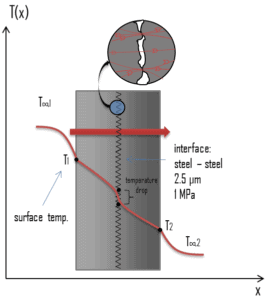
The usefulness of the analogy between the flow of electric current and the flow of heat becomes apparent when a satisfactory description of heat transfer at the interface of two conducting media is needed. Due to equipment limitations, neither solid surface forms perfect contact when placed together. There are always tiny air gaps between the contact surfaces due to roughness.
Example: Through the interconnection between the two faces in contact, there are two modes of thermal transfer. The first is conduction through 'solid to solid' contact points (Qconduction), which is very effective. The second is conduction through gaseous gaps (Qseparation) which, due to its low thermal conductivity, can be poor.
es: Resistencia al contacto térmico
Total thermal resistance
noun
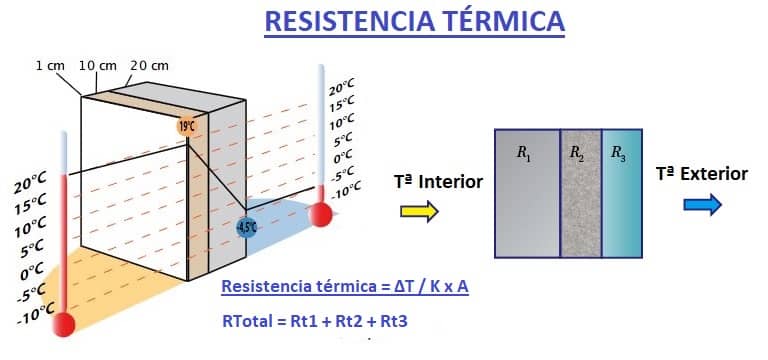
It is a measure of the resistance with which a material is opposed (easily or not) to being penetrated by heat, for example in a wall of a house.
Thermal resistance determines the thermal insulation property of a material.
Example: If an electrical resistance is related to conduction of electricity, thermal resistance is related to conduction of heat.