Heat Transfer
Heat Transfer
15 Week 3 terms
The science of thermodynamics deals with the amount of heat transfer as a system undergoes a process from one equilibrium state to another, whereas the science of heat transfer deals with the rate of heat transfer, which is the main quantity of interest in the design and evaluation of heat transfer equipment.
- Conduction shape factor
- The process of heat conduction depends on four basic factors: the temperature gradient, the cross section of the materials involved, their path length, and the properties of those materials.
A temperature gradient is a physical quantity that describes in which direction and at what rate the temperature changes in a specific location.
- en: Factor de forma de conducción
- Convection resistance
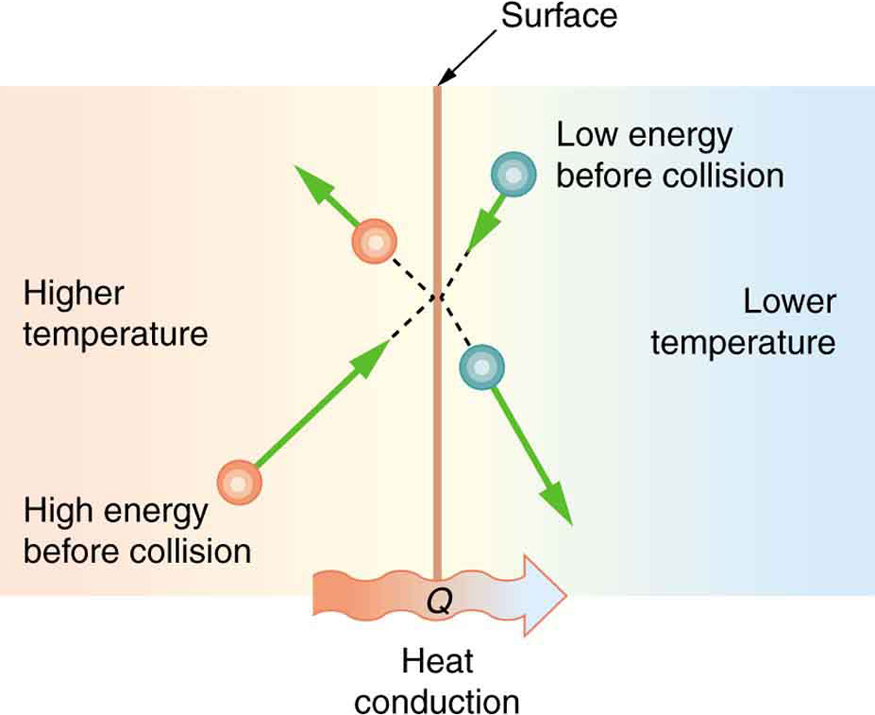
- The conduction and convection heat transfer in engines are processes that occur in series and parallel with each other. A series path is convection through the cylinder gas boundary layer, conduction across the cylinder wall, and convection through the coolant liquid boundary layer; and a parallel path is conduction through the cylinder wall and through the piston crown.
- en: Resistencia a la convección
- Critical radius of insulation
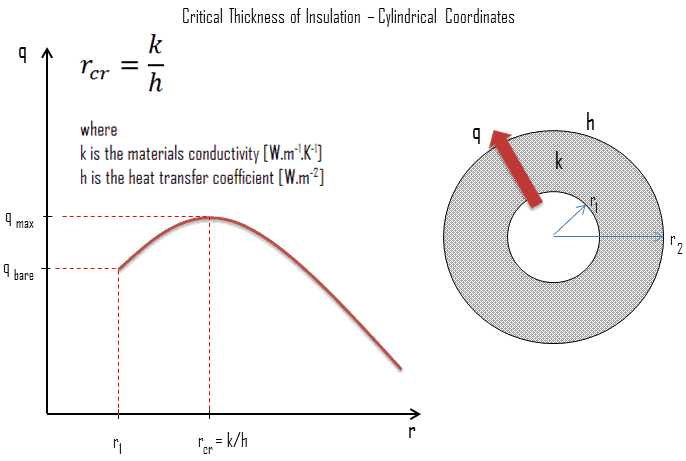
- The critical radius of insulation is a counterintuitive concept within the study of heat transfer. The theory states that adding insulation to a cylindrical or spherical object will increase the rate of heat loss rather than decrease it, if the radius of the insulation is at its “critical” value.
- en: Radio crítico de aislamiento
- Cylinder conduction resistance
- Steady state heat transfer through pipes is in the normal direction to the wall surface. Steady Conduction Heat Transfer modeled as steady‐state and one‐dimensional, and the temperature of the pipe will depend only on the radial direction.
- en: Resistencia de conducción del cilindro

- Efficiency
- Efficient use of energy, sometimes simply called energy efficiency or energy saving, is the goal of reducing the amount of energy required to provide products and services. Energy efficiency improvements are generally achieved by adopting a more efficient technology or production process or by applying commonly accepted methods to reduce energy losses.
- en: Eficiencia

- Fin effectiveness
- The efficiency of a fin is defined as the ratio of the actual heat transfer from the fin to that the heat that would be dissipated if whole surface of the fin is maintained at base temperature.
- en: Eficacia de la aleta

- Fin efficiency
- Fin Efficiency is the ratio of the heat transferred by a fin to the heat that would have been transferred if the total fin surface were at the base (or wall) temperature. Then, if the efficiency of a fin is known, the heat transferred by the fin can readily be determined.
- en: Eficiencia final

- Interface resistance
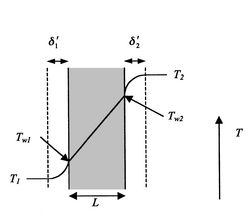
- Interfacial thermal resistance, also known as thermal boundary resistance, or Kapitza resistance, is a measure of an interface's resistance to thermal flow. This thermal resistance differs from contact resistance because it exists even at atomically perfect interfaces.
- en: Resistencia térmica interfacial

- Plane wall conduction resistance
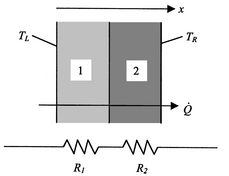
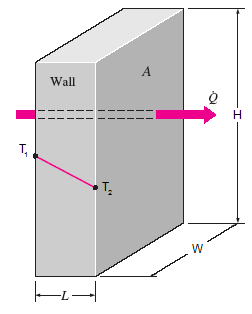
- Rwall is the thermal resistance of the wall against heat conduction or simply the conduction resistance of the wall. Rconv is the thermal resistance of the surface against heat convection or simply the convection resistance of the surface.
- en: Resistencia a la conducción de la pared plana
- Radiation resistance
- The transmitter generates a radio frequency alternating current which is applied to the antenna, and the antenna radiates the energy in the alternating current as radio waves. Because the antenna is absorbing the energy it is radiating from the transmitter, the antenna's input terminals present a resistance to the current from the transmitter.
- en: Resistencia a la Radiación

- Sphere conduction resistance
- Consider heat conduction through a hollow sphere of inner radius r1, outer radius r2 and made of a material of constant thermal conductivity. Geometrical symmetry indicates that the heat flow is limited to radial direction only. Further if temperature t1 at the inner surface is greater than temperature t2 at the outer surface, the heat flows radially outwards.
- en: Resistencia a la conducción de la esfera

- Surfaces
- Heat flux or thermal flux, sometimes also referred to as heat flux density, heat-flow density or heat flow rate intensity is a flow of energy per unit of area per unit of time. In SI its units are watts per square metre. It has both a direction and a magnitude, and so it is a vector quantity.
- en: superficie

- Thermal contact conductance
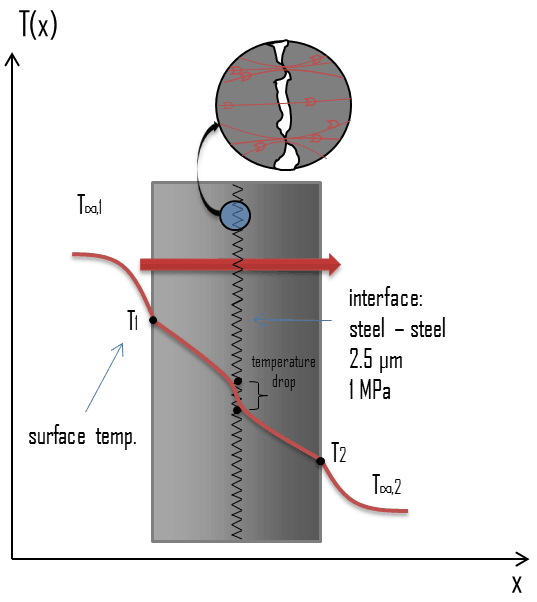
- In heat transfer and thermodynamics, a thermodynamic system is said to be in thermal contact with another system if it can exchange energy through the process of heat. When two solid bodies are in contact, a resistance to heat transfer exists between the bodies.
- en: Conductancia de contacto térmico
- Thermal contact resistance
- Thermal contact resistance is defined as the ratio between this temperature drop and the average heat flow across the interface. According to Fourier's law, the heat flow between the bodies is found by the relation: where is the heat flow, is the thermal conductivity, is the cross sectional area.
- en: Resistencia al contacto térmico
- Total thermal resistance
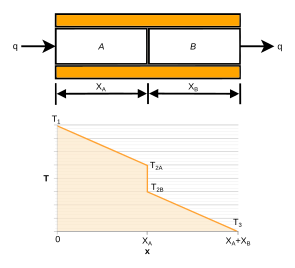
- The thermal resistance of a material represents the ability of the material to oppose the flow of temperature. In the case of homogeneous materials, it is the ratio between the thickness and the thermal conductivity of the material; in inhomogeneous materials resistance is the inverse of thermal conductance.
- en: Resistencia térmica total