15 Módulo de transferencia de calor & Inglés terms
This glossary tries to be a meeting point so that all readers can know at any time what we want to say or explain with the use of a specific term.
Boundary conditions
noun
Flow (flow rate) or pressure states assigned to theoretical boundaries used in developing and solving differential equations that are applied to well testing and in specifying a model that matches pressure transient data .
Example: Expertise is necessary to apply the appropriate BOUNDARY CONDITIONS and forces to the model to extract the relevant data.
es: Condiciones de borde
Convection
noun
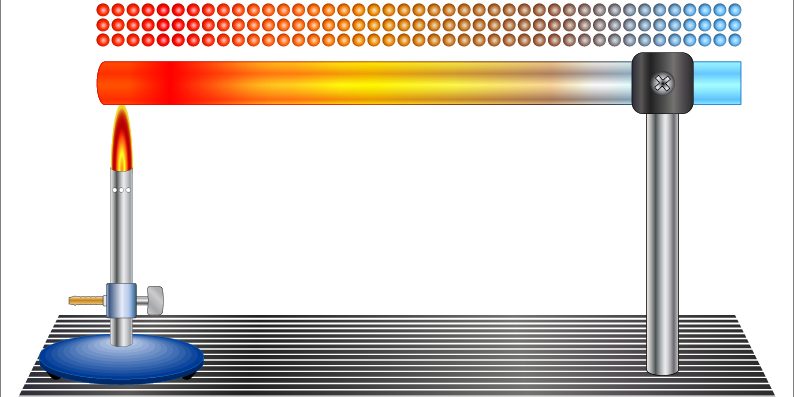
It is one of the three forms of heat transfer and is characterized in that it occurs through a fluid (air, water) that transports heat between areas with different temperatures.
Example: Convection occurs only through fluid materials. These, when heated, increase in volume and, therefore, decrease their density and rise, displacing the fluid that is in the upper part and that is at a lower temperature.
es: Convección
Emissivity
noun
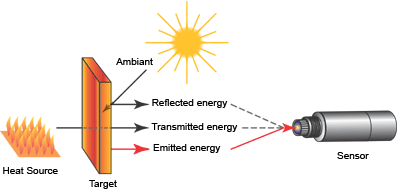
Emissivity is a property of the surface that determines the amount of radiation an object emits at a given temperature compared to a black body at the same temperature. Emissivity (along with background thermal radiation) is a major source of infrared temperature measurement errors. Emissivity can be more easily understood by observing that infrared has similar properties to visible light.
Example: Emissivity can range from 0 (glossy mirror) to 1.0 (black body) but most organic surfaces have emissivity values close to 0.95.
es: Emisividad
Energy balance
noun
The energy balance is a relationship of the energy that enters and leaves a system, that is, it is the study of the energy changes of a system. The application of the energy balance is fundamental in industrial processes and physical transformations in different areas of the industry, such as oil, manufacturing, food, among others.
Example: A nozzle is a rigid-walled static device whose function is to increase the kinetic energy of a fluid, increasing the pressure; operates in steady state and is thermally insulated. According to these approaches, there is no variation of potential energy, the system is adiabatic and does not work is produced, so the energy balance boils down to:
∆ E_c+∆ H=0
:
es: Balance de energía
Heat conduction equation
noun
Let J be the energy current density (energy per unit area and per unit time), which is established in the bar due to the difference in temperatures between two points of the bar. Fourier's law states that there is a proportionality between the energy flow J and the temperature gradient.
J=-K ∂T/∂x
Example: In a metal rod, heat flows from regions where the temperature is higher to regions where it is lower. Fourier's law states that the heat flow J (energy per unit area and unit time is proportional to the temperature gradient.
es: Ecuación de conducción de calor
Heat flux
noun
Heat flow is the measure of energy transfer, which is caused by a temperature difference and leads to temperature equilibrium between substances. In this context, the energy is called heat.
Example: Heat flow occurs when liquid or gaseous media move through pipes, for example, taking their heat with them.
es: Flujo de calor
Heat generation.
Heat generation is called the transformation of some form of energy into thermal energy, be it electrical by resistance of wire, exothermic chemical reactions in a solid and nuclear reactions in nuclear fuel rods.
Example: Heat generation is usually expressed per unit volume of the medium whose unit is W / m3, where: I is the intensity of the current and Re is the electrical resistance of the wire.
es: Generación de calor.
Homogeneous
adjective
A homogeneous mixture is a union of two or more substances in which the original substances cannot be distinguished. The elements that make up the homogeneous mixture cannot be differentiated with the naked eye, but they are physically separable since a chemical reaction does not take place between them.
Example: Coffee with sugar. By dissolving a tablespoon of sugar in coffee, we stop appreciating the white color of this ingredient, even though we can feel its flavor when taking a sip.
es: Homogénea
Insulation
noun
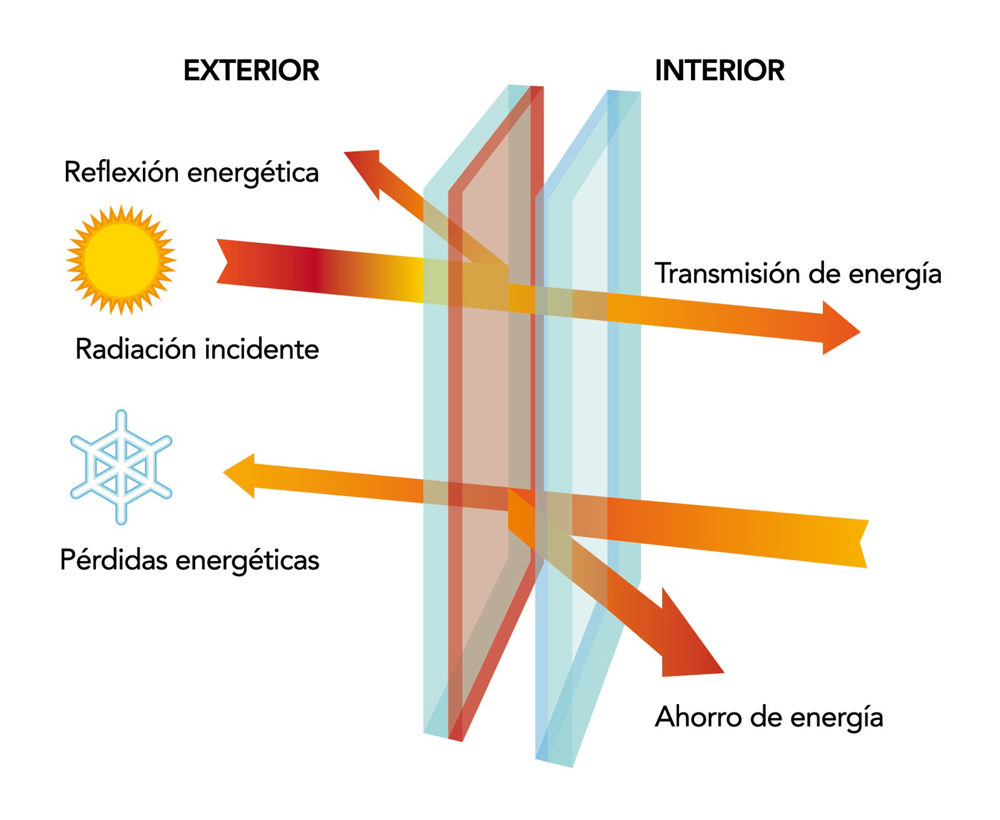
define insulation as the ability to control heat transmission when it is desired not to exceed certain limits. In a building, for example, the amount of heat or cooling required to maintain a comfortable temperature depends, to a large extent, on the level of thermal insulation.
Example: The high temperatures of 650°C - 700°C may still be enough to damage INSULATION and anneal the conductor though.
es: Aislamiento
Internal energy
noun
The internal energy is the result of the contribution of the kinetic energy of the molecules or atoms that constitute it, of their energies of rotation, translation and vibration, in addition to the intermolecular potential energy due to the forces of gravitational, electromagnetic and nuclear type.
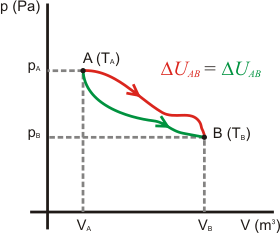
Example: Internal energy is a function of state: its variation between two states is independent of the transformation that connects them, it only depends on the initial state and the final state.
es: Energía interna
Temperature
noun
It is a physical quantity that indicates the internal energy of a body, an object or the environment in general, measured by a thermometer.
Example: Rice is produced in the majority of the geographical areas in this country owing to high rainfall throughout the year and constant high TEMPERATURE.
es: Temperatura
Thermal conductivity
noun
Thermal conductivity is a property of certain materials capable of transmitting heat, that is, allowing the passage of kinetic energy from their molecules to other adjacent substances. It is an intensive quantity, inverse to thermal resistivity.
Example: The steel. With a conductivity of 47 to 58 W / (K.m).
Water. With a conductivity of 0.58 W / (K.m).
The alcohol. With a conductivity of 0.16 W / (K.m).
The bronze. With a conductivity of 116 to 140 W / (K.m).
Timber. With a conductivity of 0.13 W / (K.m).
Titanium. With a conductivity of 21.9 W / (K.m).
es: Conductividad térmica
Thermal diffusivity
noun
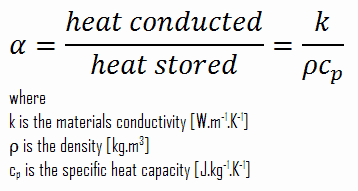
Thermal diffusivity appears in the transient heat conduction analysis and in the heat equation.
It represents how fast heat diffuses through a material and has units of m 2 / s. In other words, it is the measure of the thermal inertia of a given material.
Example: Initial spore load: The severity of the process depends on the initial spore load; good factory hygiene keeps this low. 8.Thermophysical properties: The THERMAL DIFFUSIVITY is the controlling factor.
es: Difusividad térmica
Thermal symmetry
noun
It occurs as a result of symmetry in imposed thermal conditions. Where it does not present heat flux in the central plane if not to the closest point of the surface.
Example: In the case of cylindrical or spherical bodies, it indicates that it has thermal symmetry with respect to the center line, so the derivative of the temperature with respect to r will be zero at the center line.
es: Simetría térmica
Variable coefficients
noun
Solving differential equations with variable coefficients is not as easy as solving equations with constant coefficients.
Example: To test if the students from different years performed differently, the following hypothesis is used: H0 : = = = = 0 HA : At least one of the dummy VARIABLE COEFFICIENTS is different from 0.