This glossary will help you to get to know the subject, especially in the basic concepts of heat transfer.
Boundary conditions
The solution of a heat conduction problem depends on the conditions at the surfaces, and the mathematical expressions for the thermal conditions at the boundaries are called the boundary conditions.
The solution of a heat conduction problem depends on the conditions at the surfaces, and the mathematical expressions for the thermal conditions at the boundaries
Example: The most common boundary conditions are the specified temperature, specified heat flux, convection, and radiation boundary conditions.
es: Condiciones de borde
Emissivity
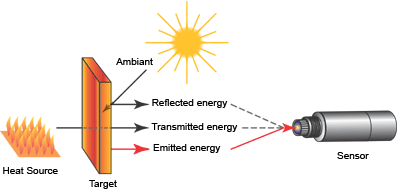
Emissivity is the measurement of an object's ability to emit infrared energy. The emissivity value is calculated by the proportion of thermal radiation emitted by a surface or object due to a temperature difference with its surroundings.
Example: The emissivity of a surface depends on factors such as its temperature, the finish, the angle of emission, and the wavelength of the radiation.
es: Emisividad
Energy balance
The heat conduction equation can be derived by performing an energy balance on a differential volume element.
An energy balance is an accounting of the contributions and energy consumption by a system to be studied. It is about knowing the changes in the energy level of a system.
Example: Energy balances are one of the most important tools in process engineering and are used to record energy flows between a certain industrial process and its surroundings or between the different operations that comprise it.
es: Balance de energía
Given by
The maximum temperature rise between the surface and the midsection of a medium is given by
dada por
Example: That information was given by the teacher.
es: dada por
Heat conduction equation
The heat conduction equation can be derived by performing an energy balance on a differential volume element.
The heat conduction equation is a partial differential equation that describes the distribution of heat (or the temperature field) in a given body over time.
Example: The heat conduction equation can be derived by performing an energy balance on a differential volume element.
es: Ecuación de conducción de calor
Heat flux
The most common boundary conditions are the specified temperature, specified heat flux, convection, and radiation boundary conditions.
Is a flow of energy per unit area per unit time.
Example: The most common boundary conditions are the specified temperature, specified heat flux, convection, and radiation boundary conditions.
es: Flujo de calor
Heat generation
In heat transfer analysis, the conversion of electrical, chemical, or nuclear energy into heat (or thermal) energy is characterized as heat
generation.
Heat generation is called the transformation of some form of energy into thermal energy
Example: The absorption of radiation from a semi-transparent medium such as water is also considered as the generation of heat within the medium.
es: Generación de calor
Insulation
Insulation or thermal symmetry:
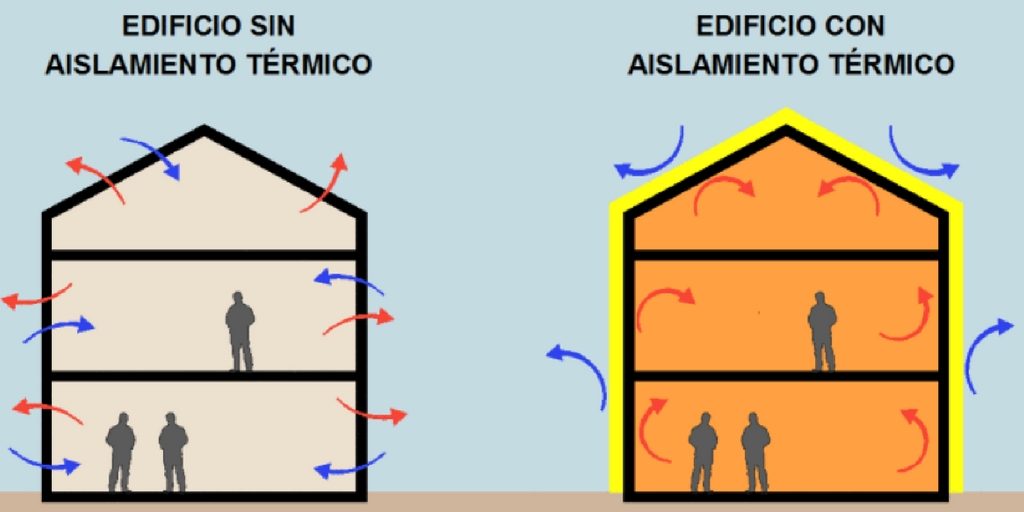
Ability to control heat transmission when it is desired not to exceed certain limits.
Example: Thermal insulation is the first, cheapest and most effective measure for energy saving.
es: Aislamiento
Internal energy
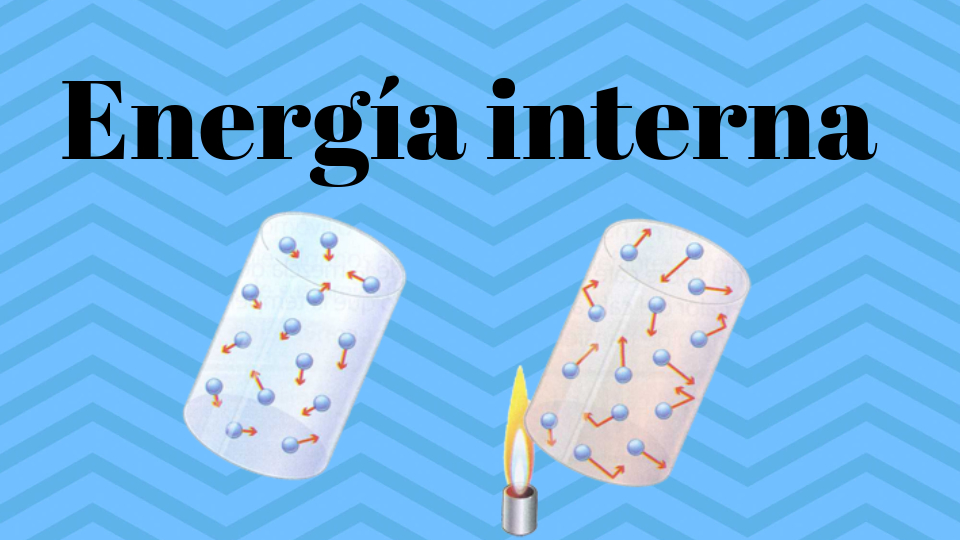
The internal energy represents the molecular energy of a system, and it consists of sensible, latent, chemical, and nuclear forms. The sensible and latent forms of internal energy can be transferred from one medium to another as a result of a temperature
Represents the molecular energy of a system, and it consists of sensible, latent, chemical, and nuclear forms.
Example: In the batteries The body of charged batteries contains usable internal energy, thanks to the chemical reactions between acids and heavy metals inside them. This internal energy will be greater when its electrical charge is complete and less when it has been consumed.
es: Energía interna
Steady
Heat conduction in a medium is said to be steady when the temperature does not vary with time and unsteady or transient when it does.
Stable, strong, that does not move or waver.
Example: The construction is steady.
es: firme
Surrounding
per unit volume in a surrounding medium at T can be expressed as
The circumstances, conditions, or objects by which one is surrounded.
Example: I know the city and the surrounding region very well.
es: circundante
Thermal conductivity
The variation of thermal conductivity of a material with temperature can often be approximated as a linear function and expressed as
It is a property of certain materials capable of transmitting heat, that is, allowing the passage of kinetic energy from their molecules to other adjacent substances.
es: Conductividad térmica
Thermal diffusivity
where the property a=k/pC is the thermal diffusivity of the material.
Thermal diffusivity appears in the transient heat conduction analysis and in the heat equation. Thermal diffusivity represents how quickly heat diffuses through a material.
Example: Thermal diffusivity is directly proportional to the thermal conductivity of a material, and inversely proportional to its density and specific heat.
es: Difusividad térmica
Thermal symmetry
Insulation or thermal symmetry:
Used in heat transfer problems
es: Simetría térmica
Transient
Heat conduction in a medium is said to be steady when the temperature does not vary with time and unsteady or transient when it does.
Said of a phenomenon or of a magnitude: That varies between two consecutive stationary regimes during a short time interval.