11 Módulo de procesamiento de señales e inglés terms
This is my online glossary, which will help me to know and remember several key concepts.
Analog frequency
Noun
Is a type of signal generated by some type of electromagnetic phenomenon; it is representable by a continuous mathematical function in which its amplitude and period (representing a piece of information) are variable as a function of time.
Example: Before acting as the input signal of the panel monitor, the analog frequency must be processed by AD conversion.
en: Frecuencia analógica
Continuous-Time Signals
Noun
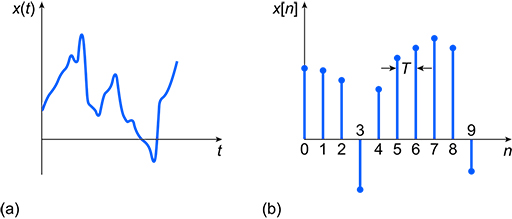
A continuous-time (CT) signal is a function, s(t), that is defined for all time t contained in some interval on the real line. For historical reasons, CT signals are often called analog signals.
Example: A signal x (t) is a continuous-time signal if it is not a continuous variable.
en: Señales de tiempo continuo
Discrete-Time Signals
Noun
A discrete signal or discrete-time signal is a time series consisting of a sequence of quantities.
Unlike a continuous-time signal, a discrete-time signal is not a function of a continuous argument; however, it may have been obtained by sampling from a continuous-time signal.
Example: The discrete-time signals x (n) can represent a phenomenon for which the independent variable is intrinsically discrete.
en: Señales de tiempo discreto
Exponential function
Noun
An exponential function is a Mathematical function in form f (x) = ax, where “x” is a variable and “a” is a constant which is called the base of the function and it should be greater than 0. The most commonly used exponential function base is the transcendental number e, which is approximately equal to 2.71828.
Example: The rise in the last 5 years appears to be almost exponential.
en: Funcion exponencial
Real sinusoidal function
Noun
A compound sinusoidal sequence can be identified by repeating spectral peak selection from the interpolated spectral sequence iteratively independent of the observation length, provided the sinusoidal components are time independent.
Example: The model excited the forms of the Van der Pol equations with sinusoidal excitation at their natural frequency.
en: Función sinusoidal real
Sampling
Noun
Is a process used in statistical analysis in which a predetermined number of observations are taken from a larger population.
Example: In sampling, we choose a small number of items which we think are typical of the whole and examine the sample.
en: Muestreo
Signal energy
Noun
An energy signal has finite energy. In general, every signal in the practical sense has finite duration, so the energy is finite. The signal has to be of finite type for the measurement to have meaning. A necessary condition for the signal to be finite is that its amplitude → 0 when |t|→ ∞. In any other case, the integral does not converge.
Example: All non-periodic signals are energy signals, but vice versa is not true. Could you give me an example for this?
en: Señal de energia
Signals
Noun
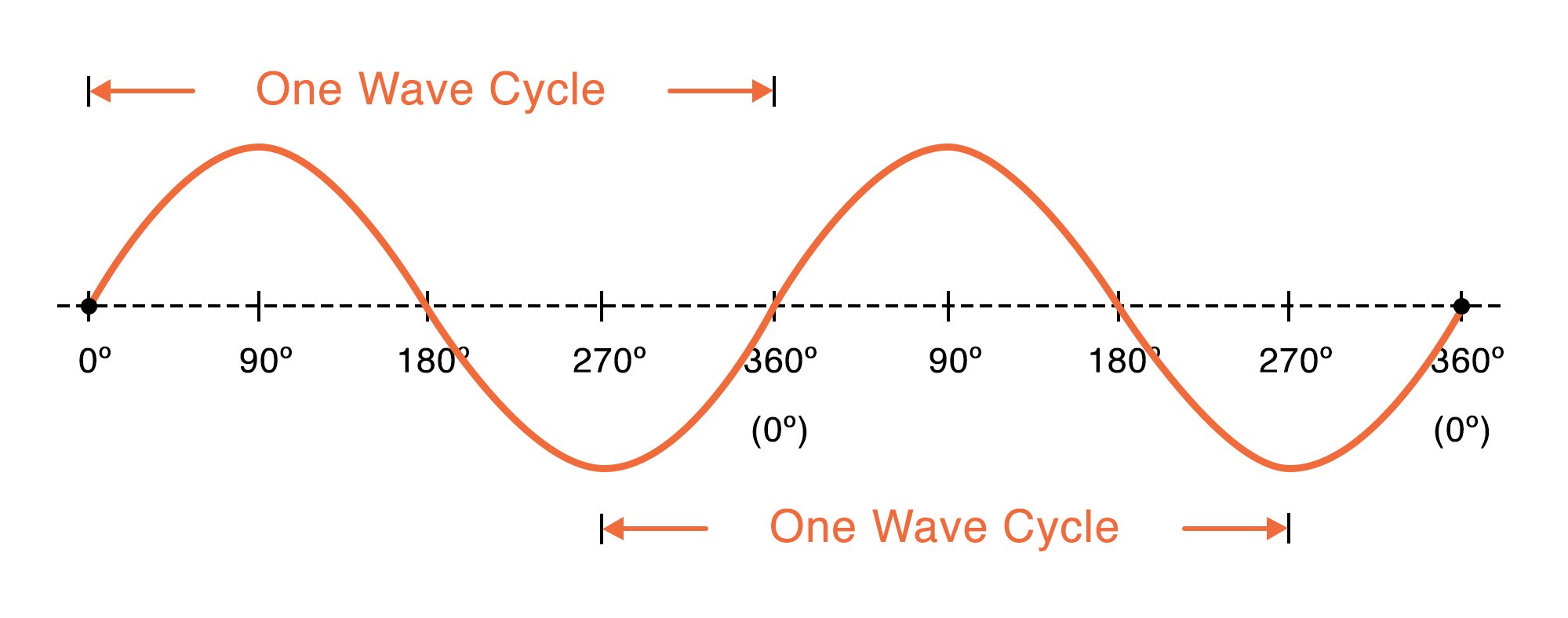
Is a function that conveys information about a phenomenon. In electronics and telecommunications, it refers to any time-varying voltage, current, or electromagnetic wave that carries information. A signal may also be defined as an observable change in a quality such as quantity.
Example: A radio signal was sent to the spacecraft.
en: Señales
Speech signal
Noun
Sound waves are longitudinal mechanical waves, originated by the movement of some portion of an elastic medium (solid, liquid, or gas) with respect to its equilibrium position, and due to the elastic properties of the medium, this disturbance can move from one place to another. There is a wide range of frequencies between which longitudinal mechanical waves can be generated. Sound waves are reduced to the frequency limits that can stimulate the human ear to be perceived in the brain as an acoustic sensation.
Example: Speech signals play a major role in the human communication system.
en: Señal de voz
Systems
Noun
Is a group of interacting or interrelated elements that act according to a set of rules to form a unified whole. A system, surrounded and influenced by its environment, is described by its boundaries, structure, and purpose and expressed in its functioning.
Example: The security system didn't recognize her thumbprint.
en: Sistemas
Unit step function
Noun
It is a step function, named after Oliver Heaviside, the value of which is zero for negative arguments and one for positive arguments. It is an example of the general class of step functions, all of which can be represented as linear combinations of translations of this one.
Example: The relationship between retention and particles size is not a step function.