In thermodynamics, a closed system can exchange energy (as heat or work) but not matter, with its surroundings. An isolated system cannot exchange any heat, work, or matter with the surroundings, while an open system can exchange energy and matter.
Example: For example, the contents of a pressure cooker on a stove with its lid tightly closed and the whistle in position, is a closed system as no mass can enter or leave the pressure cooker, but heat can be transferred to it.
es: Sistema Cerrado
Consist Of
Phrase
To be formed or made up of (specified things or people)
Example: Breakfast consisted of cereal, fruit, and orange juice.
es: consiste en
Fixed Mass
Conjunction
Terms system and control volume are very familiar to the one who has studied thermodynamics. The word system refers to a fixed mass with a boundary. However, with time the boundary of the system may change, but the mass remains the same.
Example: Pumping a tire tube with gas.
The air in our lungs
es: Masa fija
Heat Conduction
Conjunction
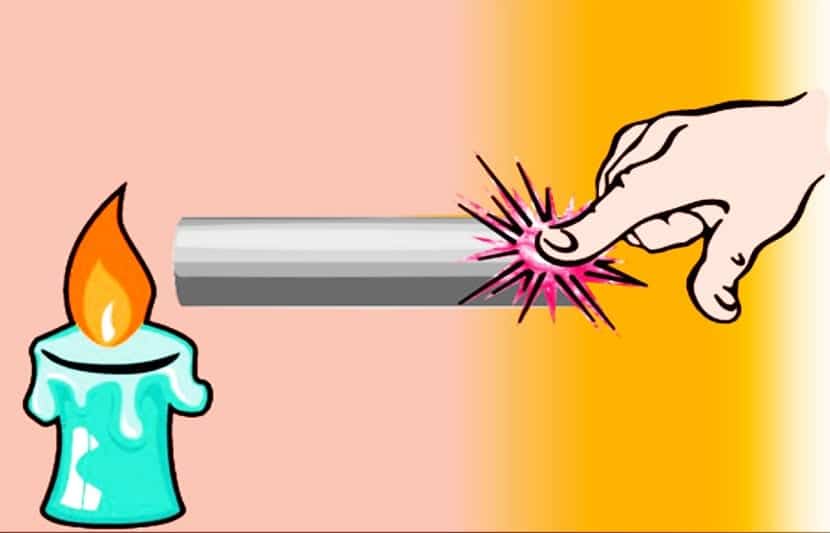
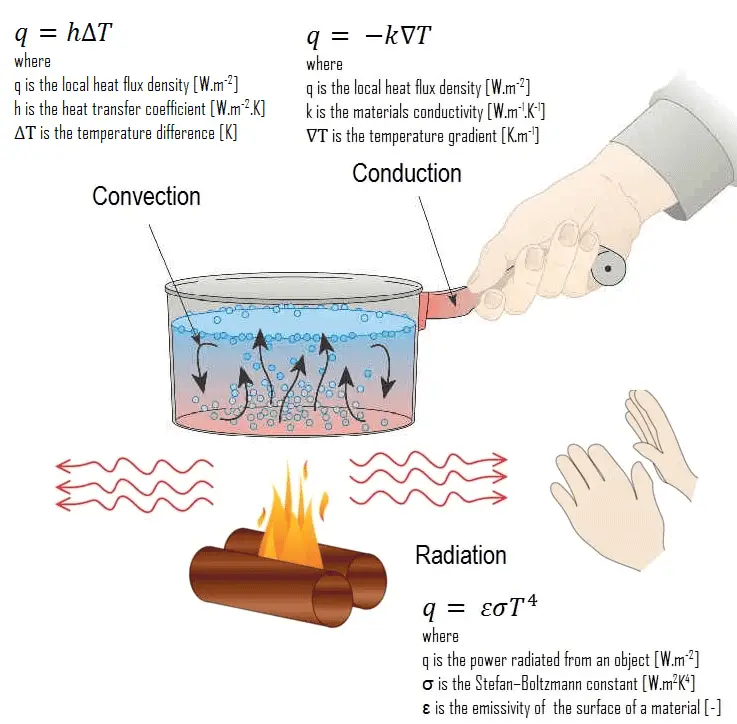
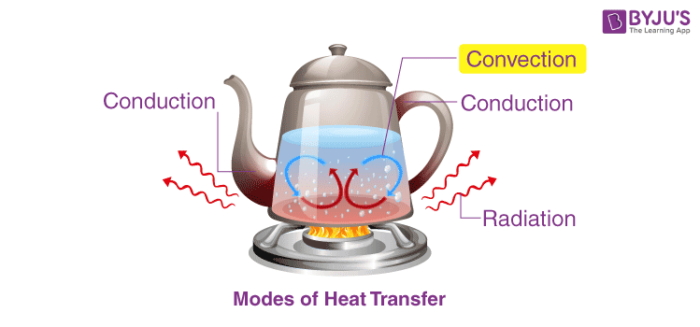
eat conduction, also called diffusion, occurs within a body or between two bodies in contact. It is the direct microscopic exchange of kinetic energy of particles through the boundary between two systems.
Example: When an object is at a different temperature from another body or its surroundings.
es: Conduccion de Calor
Heat Convection
Conjunction
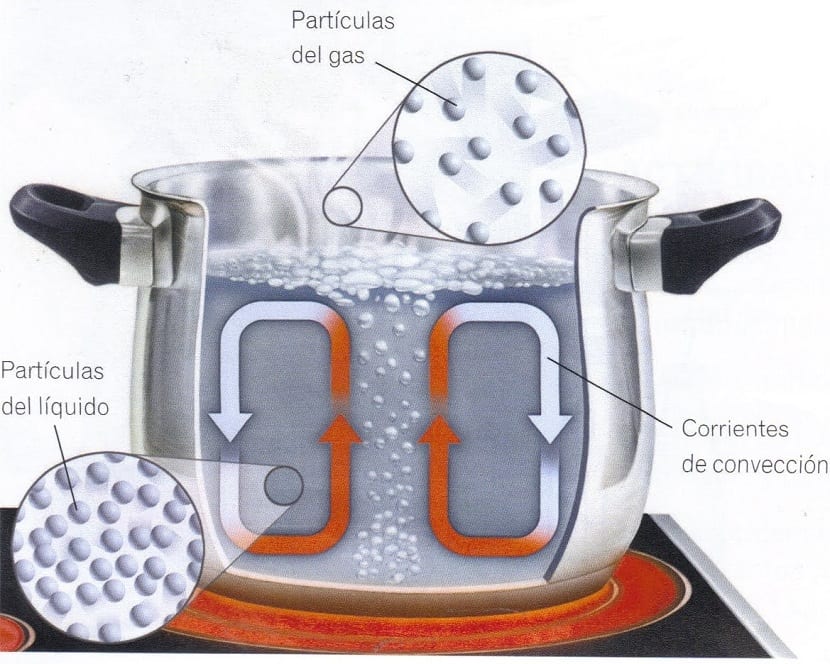
Heat convection depends on motion of mass from one region of space to another. Heat convection occurs when bulk flow of a fluid (gas or liquid) carries heat along with the flow of matter in the fluid.
Example: The formation of sea and land breeze form the classic examples of convection. Going by the definition of convection, the molecules at a higher temperature displace the ones at a lower temperature. Similarly, in the afternoon, the surface of the land near the sea is warmer as compared to in the evening. Convection causes the air, which is closer to the land surface, to heat and, hence, rise. This warm air near the land is readily replaced by the cool air resulting in “Sea Breeze.” When its night, the tendency of land to cool down is more
es: Convección de Calor
Heat Transfer
Conjunction
Heat transfer is an engineering discipline that concerns the generation, use, conversion, and exchange of heat (thermal energy) between physical systems. In power engineering it determines key parameters and materials of heat exchangers. Heat transfer is usually classified into various mechanisms, such as: Heat Conduction, Heat Convection, and Thermal Radiation.
Example: The heat source in the nuclear power plant is a nuclear reactor. As is typical in all conventional thermal power stations the heat is used to generate steam which drives a steam turbine connected to a generator which produces electricity.
es: Transferencia de calor
Inner Surface
Conjunction
the human mind regarded as being as unknown or as unfathomable as space
Example: In all cases, the inspection is carried out from the inner surface of the tube with access being gained from beneath the vessel.
es: Superficie Interior
Internal Energy
Conjunction
The internal energy of a thermodynamic system is the energy contained within it. It is the energy necessary to create or prepare the system in any given internal state. It does not include the kinetic energy of motion of the system as a whole, nor the potential energy of the system as a whole due to external force fields, including the energy of displacement of the surroundings of the system.
Example: Batteries. In the body of the charged batteries, there is using internal energy, thanks to the chemical reactions between acids and heavy metals inside.
es: Energia Interna
Isolated System
Conjunction
An isolated system is one that cannot exchange either matter or energy with its surroundings. A perfect isolated system is hard to come by, but an insulated drink cooler with a lid is conceptually similar to a true isolated system.
Example: A thermos flask is the best example of an isolated system. A thermos flask is used to keep things either cold or hot. Thus a thermos does not allow energy for transfer. An isolated system does not exchange energy or matter with its surroundings.
es: Sistema Aislado
Mass Transfer
Conjunction
Mass transfer is the net movement of mass from one location, usually meaning stream, phase, fraction or component, to another. Mass transfer occurs in many processes, such as absorption, evaporation, drying, precipitation, membrane filtration, and distillation
Example: Some common examples of mass transfer processes are the evaporation of water from a pond to the atmosphere, the purification of blood in the kidneys and liver, and the distillation of alcoho
es: Transferencia de masa
Open system
Conjunction
An open system can exchange both energy and matter with its surroundings. The stovetop example would be an open system, because heat and water vapor can be lost to the air.
Example: For example, boiling water without a lid. Heat escaping into the air.
es: Sistema Abierto
Outer Surface
Conjunction
the outer face, outside, or exterior boundary of a thing; outermost or uppermost layer or area.
Example: the six surfaces of a cube.
es: Superficie Exterior
Thermal Radiation
Conjunction
Radiation is heat transfer by electromagnetic radiation, such as sunshine, with no need for matter to be present in the space between bodies.
Example: The transmission of electromagnetic waves through the microwave oven.
The heat emitted by a radiator.
Solar ultraviolet radiation, precisely the process that determines the Earth’s temperature.
es: Radación Termal
Total Energy
Conjunction
The science of thermodynamics deals with the
amount of heat transfer as a system undergoes a process from
one equilibrium state to another, whereas the science of heat
transfer deals with the rate of heat transfer, which is the main
quantity of interest in the design and evaluation of heat transfer
equipment. The sum of all forms of energy of a system is called
total energy
Example: after heating an object, its increase in energy could be measured as a small increase in mass, with a sensitive enough scale.
es: Energia Total
Undergo
Verb
to submit to : ENDURE
to go through : EXPERIENCE undergo a transformation






/physical-and-chemical-changes-examples-608338_FINAL-f4e256e7fbf54f46a8c7bcefb300f5db.png)