Oriented-object programming is a way to structure code and to process solutions of problems. It is very helpful to create a code more readable and more organized. It can also be more performant for certain application than other methods. This glossary consists of all the most used therms in OOP.
Abstraction
noun
The ability to represent a complex reality in terms of a simplified model. Abstraction is not limited to OOP.
Example: We can use ABSTACT variables in interface.
fr: Abstraction
Aggregation
noun
A relationship in which an object contains one or more other subordinate objects as part of its state.
Example: An AGGREGATION of the dog class and the cat class is the time for the domestic animal attribute of the master class.
fr: Agrégation
Application
noun
designed to meet a specific set of needs. Often used simply as a synonym for program.
Example: My APPLICATION will put a notification on your screen when your dog will get old.
fr: Application
Array
noun
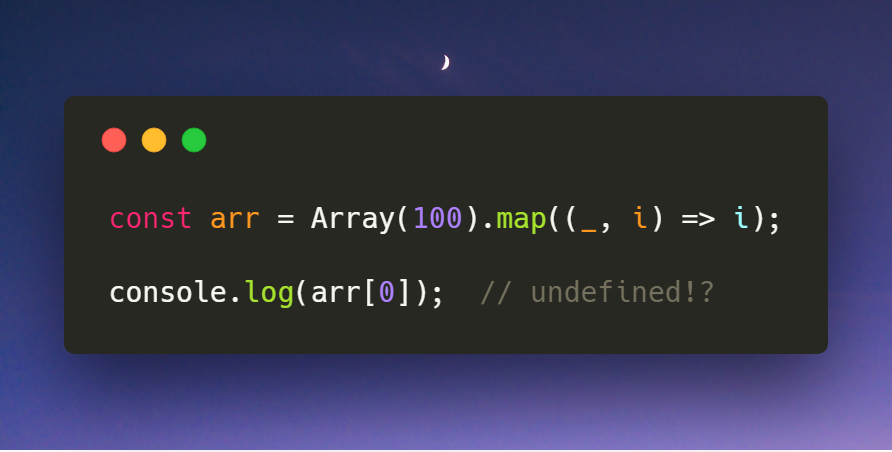
A fixed-size object that can hold zero or more items of the array's declared type.
Example: In my ARRAY of dog, I have dog1, dog2 and dog3. To access them, I need there location in the array. Dog1 is first, so it's dog_array[0].
fr: Tableau
Attribute
noun
A piece of information which determines the properties of a field or tag in a database or a string of characters in a display.
Example: My dog class as many ATTRIBUTES like name and age.
fr: Attribut
Class
noun
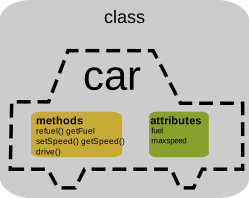
In object-oriented programming, a class is a blueprint for creating objects (a particular data structure), providing initial values for state (member variables or attributes), and implementations of behavior (member functions or methods).
Example: A dog CLASS is created and have variables : name, age, weight, height, etc. This CLASS also have a method called is_old() when the age of the dog exceeds 12.
fr: Classe
Constructor
noun
A subroutine designed to create an object in a particular class.
Example: The CONSTRUCTOR of the class dog can be dog(name, age). With that form, it takes a name and an age to create a dog.
fr: Constructeur
Encapsulation
noun
The ability to "hide" the implementation and the data stored in an object.
Example: Using private variable, you ENCAPSULATE them from other blocs of code.
fr: Encapsulation
Inheritance
noun
It is used to define relationship between two class,
which a child class occurs all the properties and behaviors of a parent class.
Example: The class dog INHERITE of the interface animal.
fr: Héritage
Instance
noun
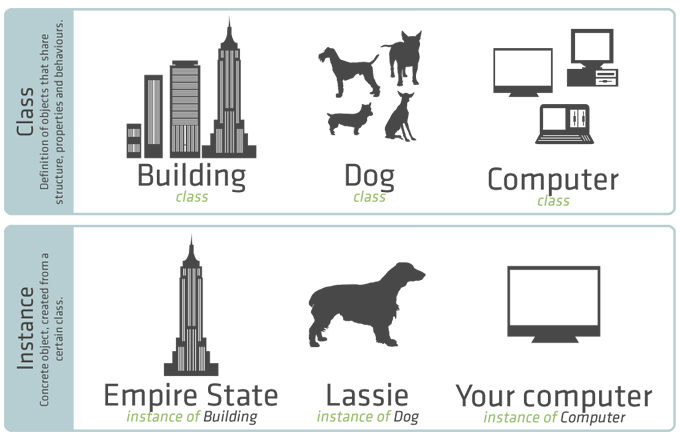
An instance, in object-oriented programming (OOP),
is a specific realization of any object.
An object may be varied in a number of ways.
Each realized variation of that object is an instance.
Example: We can create an INSTANCE of the dog class called dog1. Now we can define the attributes of the instance that come from the class ; we can name him Bob, he weighs 15 pounds, he is 14 years old and become of that, he is old (the methods is_old() return true).
fr: Instance
Interface
noun
Interfaces specify what a class must do.
It is the blueprint of the class.
It is used to achieve total abstraction.
Example: We construct an INTERFACE animal with abstract attributes name and age, and with an abstract method is_old(). Everything in this INTERFACE is empty, but a class relative to this INTERFACE, like the class dog, now is forced to have the attributes name and age, and a method called is_old().
fr: Interface
Method
noun
This is when code is defining many actions or behaviors of the class.
Example: is_old() is a METHOD of the dog class.
fr: Méthode
Object
noun
In object-oriented programming, a class is a blueprint for creating objects (a particular data structure), providing initial values for state (member variables or attributes), and implementations of behavior (member functions or methods).
Example: From the dog class, we can create dog OBJECTS. They will be able to access the dog class variables and methods. So, the dogs created will be able to have a name, an age, a weight, a height, and we will be able to tell if they are old with the function is_old().
fr: Objet
Polymorphism
noun
It is an ability of object to behave in multiple forms.
Example: The most common use of POLYMORPHISM is Java, when a
parent class reference type of variable is used to refer to a child
class object.
fr: Polymorphisme
Type
noun
The type is a quality of data that defines the possible values the data may have.
Example: In my dog class, the attribute name is of TYPE string, and the age attribute is of TYPE integer.