The world of business overtime has become a part of everyone's life. For example, buying the latest iPhone or doing groceries are even part of the various steps closely related to business. Therefore, they need managers to ensure the satisfaction of customers' needs and wants and to be successful. However, it is sometimes difficult to understand some specific terms related to the entrepreneurship world but thanks to this glossary it would be easier to understand the business terms.
Accounting
noun
This concept should be in every entrepreneur’s arsenal of basic business terms. Accounting involves the systematic recording and reporting of business financial transactions. Accounting is often complicated. You may want to hire a professional to handle this.
Example: The actual change concerns the accounting system and information system, particularly important to the distribution of power within organisations.
fr: Comptabilité
Assets
noun
“Assets” refers to your business’ cumulative financial holdings. These are usually classified as current or fixed. Current, or short-term, assets include cash or inventory. Fixed, or long-term assets, include equipment or land.
Example: Furthermore, this will permit a better management of the firm's assets, possibly even enabling it to benefit from future investment opportunities, as they will have some constancy in their revenue figures, and to make long-run plans.
fr: Les atouts
B2B/B2C
adjective
Is the purpose of your business to supply goods or services to other business? If so, you operate a B2B, or business-to-business, venture. On the flip side of B2B businesses are B2C businesses. These businesses supply goods or services directly to an end user or consumer.
Example: Organisations that sell Business to Business (b2b) rather than Business to Consumer (B2C), such as Fujitsu, arguably have a tougher task in understanding client behaviour and buying patterns, as these markets are often more complex with a number of intricacies evident only in b2b markets.
fr: B2B / B2C
Balance sheet
noun
A balance sheet is a financial statement that reports a company's assets, liabilities and shareholders' equity at a specific point in time, and provides a basis for computing rates of return and evaluating its capital structure.
Example: However, it is used as more "reliable guide to the liquidity of a business than the current assets held at the balance sheet date".
fr: Bilan
Break-even point
noun
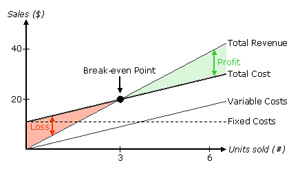
Break-even point is output of the standard break-even analysis. The unit sales volumes or actual sales amounts that a company needs to equal its running expense rate and not lose or make money in a given month.
Example: A person making £40,000 would be at the break-even point and would neither pay taxes nor receive any benefits.
fr: Seuil de rentabilité
Cash flow
noun
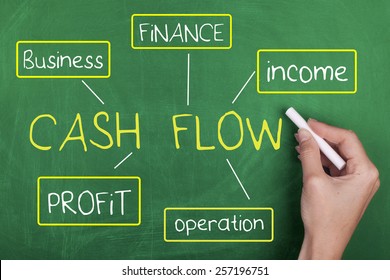
Cash flow is the movement of money in and out of your business. You want there to be a higher flow of income into the business than there is an outflow of expenses from the business. This is called positive cash flow.
Example: "A consistent and sustainable cash flow stream from product sales is key to any long-term investment, and the best way to attain a stable revenue stream is a 'cash cow' product, leading products that command a large market share in mature markets."
fr: Flux de trésorerie
Dividends
noun
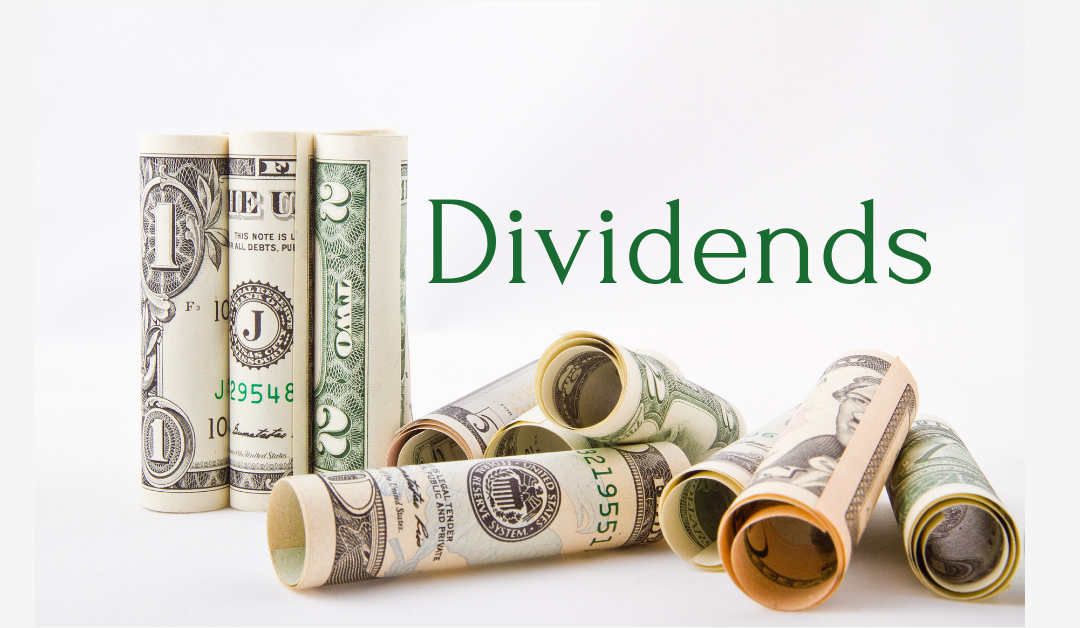
A dividend refers to money distributed to the owners of a business as profits.
Example: Getting the perfect product by listening to customers pays dividends as can be seen by SUKA's vast increase in sales in first few periods.
fr: Dividendes
Economies of scale
noun
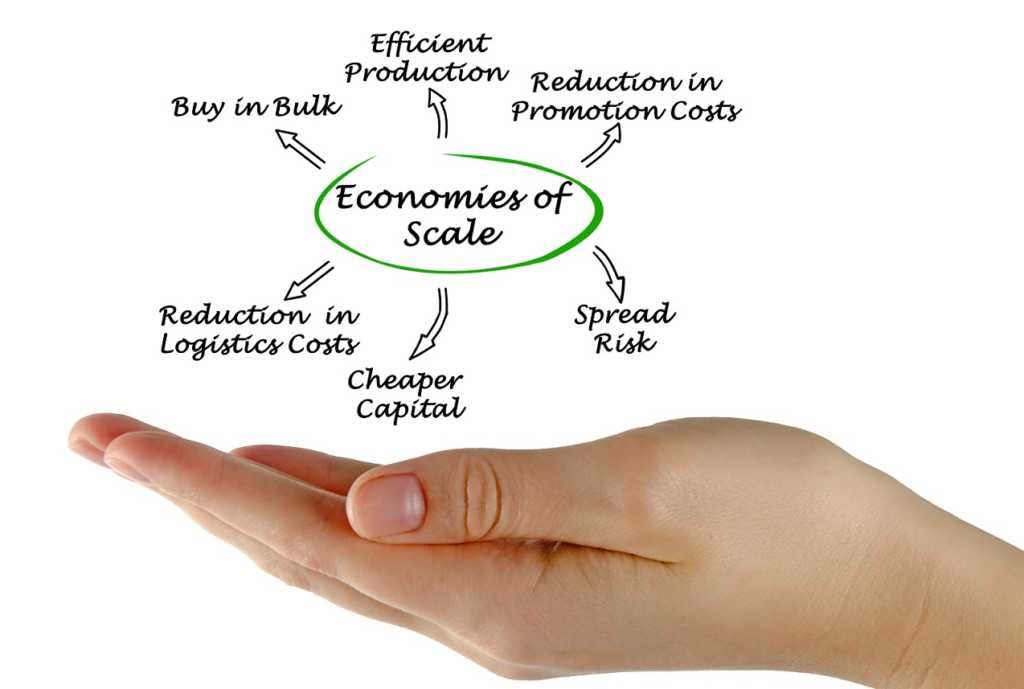
Economies of scale refers to the benefit that larger production volumes allow fixed costs to be spread over more units lowering the average unit costs and offering a competitive price and margin advantage.
Example: In the real world, firms often experience economies of scale in production, markets do not follow perfect competition and product differentiation is used to gain competitive advantage.
fr: Économies d'échelle
Economy
noun
An entire network of producers, distributors, and consumers of goods and services in a local, regional, or national community.
Example: There is also a need to conduct frequent Market research studies, which help to understand the economy, show the estimated market conditions, customers' behavior and most importantly they show the performances of competitors and their product ranges, thus the firm can decide on how to respond to their actions.
fr: économie
Entrepreneurship
noun
The capacity and willingness to develop, organize and manage a business venture along with any of its risks in order to make a profit. The most obvious example of entrepreneurship is the starting of new businesses. In economics, entrepreneurship combined with land, labor, natural resources and capital can produce profit. Entrepreneurial spirit is characterized by innovation and risk-taking, and is an essential part of a nation’s ability to succeed in an ever-changing and increasingly competitive global marketplace.
Example: Also, entrepreneurship would be encouraged since creative ideas would be protected by IPRs.
fr: Entrepreneuriat
Goodwill
noun
An intangible, salable asset arising from the reputation of a business and its relations with its customers, distinct from the value of its stock and other tangible assets.
Example: It should be noted that these projects should not redirect resources from any superior projects, discourage development of future products, alter the firm's risk profile or affect the enterprise's reputation or goodwill.
fr: survaleur
Income statement
noun
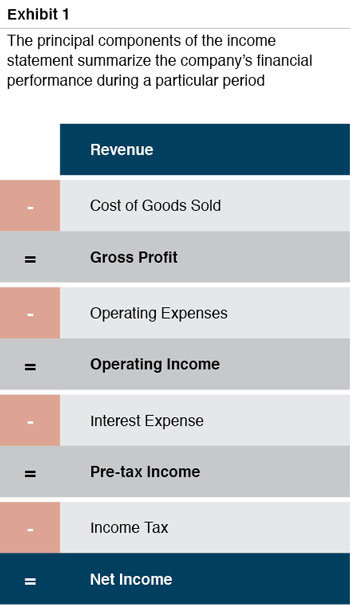
Also, called profit and loss statement, an income statement is a financial statement that shows sales, cost of sales, gross margin, operating expenses, and profits or losses. Gross margin is sales less cost of sales, and profit (or loss) is gross margin less operating expenses and taxes. The result is profit if it’s positive, loss if it’s negative.
Example: The three main financial statements are the Balance Sheet, the Cash Flow statement, and the income statement.
fr: Rélévé de revenue
Liabilities
noun
Liabilities are debts your business owes another person or entity. Like assets, you’ll have to define liabilities as current or long-term. Current, or short-term, liabilities might include an expense payable to a supplier. Many business loans are long-term debts.
Example: Jolly SU has no loan history and therefore has no liabilities in the form of loan repayments.
fr: Passifs
Macroeconomics
adjective
Macroeconomics is a branch of economics dealing with the performance, structure, behavior, and decision-making of an economy as a whole. For example, using interest rates, taxes and government spending to regulate an economy's growth and stability.
Example: His teaching interests include macroeconomics and labor economics, and his research interests cover all aspects of labor markets.
fr: Macroéconomie
Market share
noun
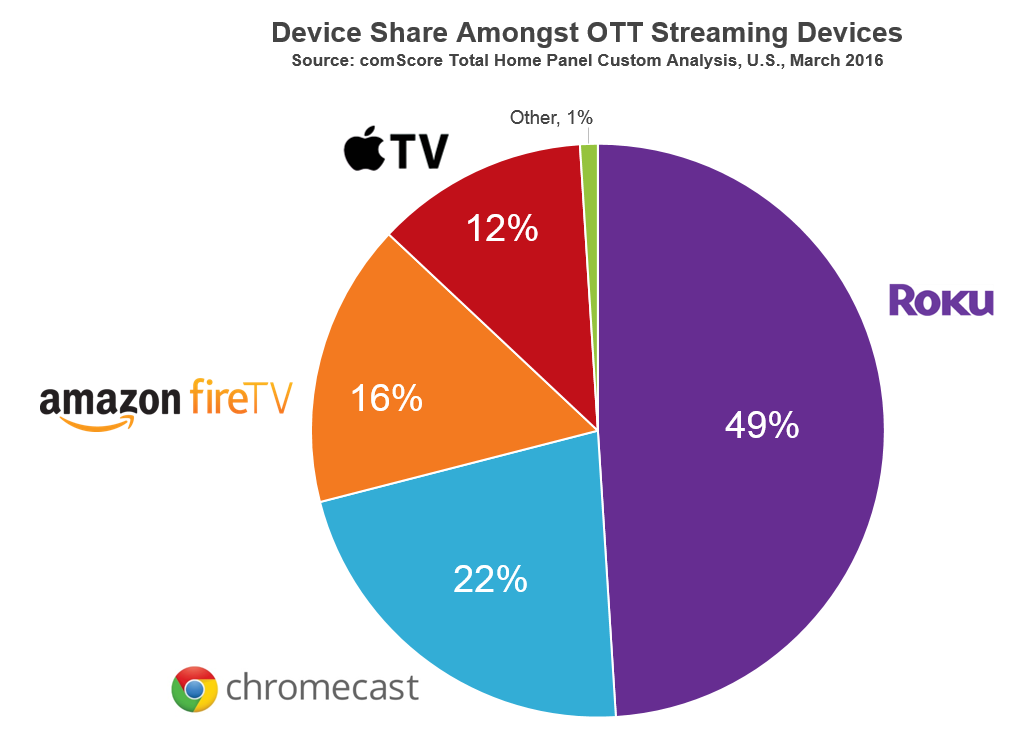
Market share is the total sales of an organization divided by the sales of the market they serve.
Example: The establishment of distribution channels is required to achieve market share and product sales.
fr: Part de marché
Microeconomics
adjective
The branch of economics that analyzes the market behavior of individual consumers and firms in an attempt to understand the decision-making process of firms and households.
Example: microeconomics and managerial economics, the short run is the decision-making period during which at least one input is considered fixed.
fr: Microéconomie
Owner’s equity
noun
Owner's equity represents the owner's investment in the business minus the owner's draws or withdrawals from the business plus the net income (or minus the net loss) since the business began.
Example: Single proprietorship and partnership prepare the statement of owner’s equity.
fr: Capitaux propres du propriétaire
Profit margin
noun
the amount by which revenue from sales exceeds costs in a business.
Example: Target market where a bigger profit margin is obtainable.
fr: marge bénéficiaire
Return on investment
noun
Your Return on Investment, or ROI, shows how much you gained or lost on a business investment relative to how much you spent on it. Calculate ROI by dividing net profit by the cost of the investment.
Example: SPI over time return on investment (ROI) has grown 54.7% from period 0 (4.27) but is half of the leading company (E - 8.24).
fr: Retour sur investissement
SWOT analysis
noun
A SWOT analysis is a formal framework of identifying and framing organizational growth opportunities. SWOT is an acronym for an organization’s internal strengths and weaknesses and external opportunities and threats.
Example: A swot analysis of Company U is useful starting block.



/balancesheet.asp-V1-5c897eae46e0fb0001336607.jpg)